Port Wine Negus, Hot Port with Lemon and Nutmeg
Reader ratingsA bottle of hot ruby port poured into a covered jug of lemon sugar, sliced lemons, a little spice and a quart of boiling water, then grated over with nutmeg: negus as Oxford made it in 1847.
- Recipe makes
- About 1.9 liters, 10 small cups or glasses
- Prep
- Cook
- Total
Includes 15 minutes for the lemons and spices to steep in the covered jug.
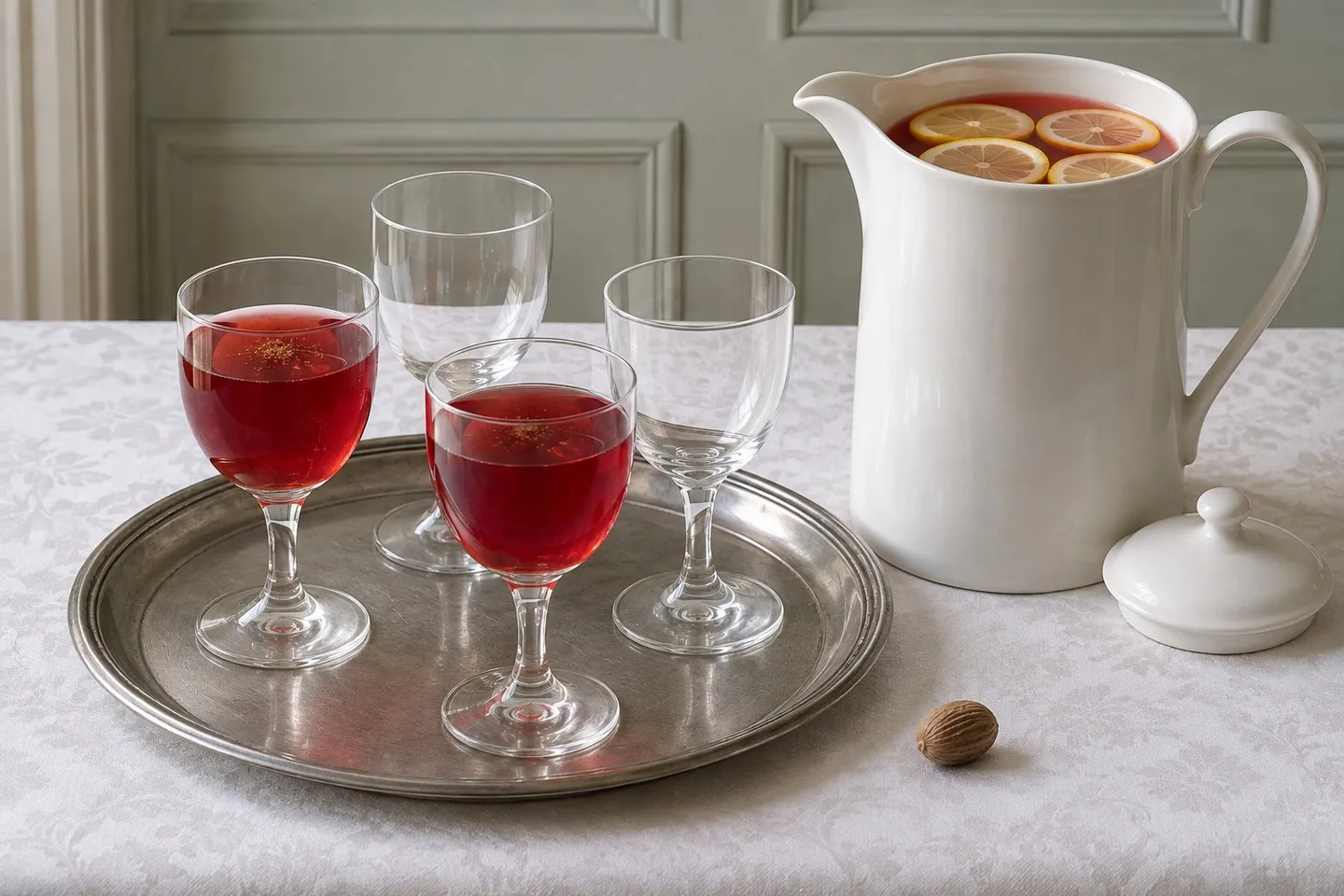
Port wine negus in a white china jug with lemon slices, and small stemmed glasses on a white cloth.
The story behind the recipe
Port wine negus, as Oxford made it in 1847, is a bottle of hot port poured into a covered jug of boiling water that has already steeped with lemon sugar, sliced lemons and a little spice, then grated over with half a nutmeg. It is a jug drink, poured into small glasses, and lighter than it looks.
Leave out the jelly
Oxford Night Caps gives its full method for white wine negus, which takes “four glasses of calves-feet jelly in a liquid state” as well as the lemons and spice. Port gets one line of its own. “In making port wine Negus, merely omit the jelly; for when port wine comes in contact with calves-feet jelly, it immediately assumes a disagreeable muddy appearance.” So port negus is the plainer of the two, and this recipe is that method with that one omission.
The book also settles a question of fruit. The physician A. F. M. Willich had recommended Seville oranges in place of lemons, and Oxford quotes him, but adds that “Seville oranges are not generally used at Oxford in making Negus; when they are, one orange is allowed to each bottle of wine.” Lemon is the Oxford fruit. Rubbing the sugar over the peel, as the book tells you, draws the oil out of the rind without the bitter white pith.
Read more about this recipe
A bottle to a quart
The proportion is a bottle of wine to a quart of boiling water, about one part port to one and a half of water. That makes it a little stronger than the one-to-two of Mrs. Beeton’s children’s party negus. With a ruby port at about 20% ABV the jug comes out near 7.7%, between 7.3 and 8.5% depending on the bottle. Serve it in small glasses.
The 1847 cook added the wine “boiling hot,” which would have driven off an unmeasured share of the alcohol. Here the port is warmed only until it steams, which keeps the flavor and avoids a pan of hot alcohol vapor near a flame. An everyday ruby port is the right bottle here.
The colonel the name is said to come from gets his due in Negus, the Warm Wine of Georgian Balls. Hot wine and water is a very old idea: the Romans drank theirs as calda, more water than wine, and the same jug without the port is our alcohol-free negus.
WHITE WINE NEGUS. Extract the juice from the peeling of one lemon, by rubbing loaf sugar on it; or cut the peeling of a lemon extremely thin, and pound it in a mortar. Cut two lemons into thin slices; four glasses of calves-feet jelly in a liquid state; small quantities of cinnamon, mace, cloves, and all-spice. Put the whole into a jug, pour one quart of boiling water upon it, cover the jug close, let it stand a quarter of an hour, and then add one bottle of boiling hot white wine. Grate half a nutmeg into it, stir it well together, sweeten it to your taste, and it is fit for use.
PORT WINE NEGUS. In making port wine Negus, merely omit the jelly; for when port wine comes in contact with calves-feet jelly, it immediately assumes a disagreeable muddy appearance.

Recipe makes: About 1.9 liters, 10 small cups or glasses
Ingredients
For About 1.9 liters, 10 small cups or glasses. Quantities are shown as written.
Quantities as written here, for About 1.9 liters, 10 small cups or glasses.
- Unwaxed lemon, for the sugar1
- Sugar cubes, or granulated sugar, plus more to taste50 g
- Lemons, thinly sliced2
- Cinnamon stick, about 3 cm1
- Blade mace1
- Cloves2
- Allspice berries2
- Boiling water1140 ml
- Ruby port750 ml
- Freshly grated nutmeg1/2–1 metric tsp (5 ml per tsp)
Measurement notes
Ingredients as written here
- 1 unwaxed lemon, for the sugar
- 50 g sugar cubes, or granulated sugar, plus more to taste
- 2 lemons, thinly sliced
- 1 cinnamon stick, about 3 cm
- 1 blade mace
- 2 whole cloves
- 2 allspice berries
- 1140 ml boiling water
- 750 ml ruby port
- 1/2 to 1 tsp freshly grated nutmeg
Equipment
 Fine grater
 Large heatproof jug with a lid or a plate to cover it
 Saucepan
 Kettle
 Small heatproof cups or glasses
Instructions
Rub the sugar cubes hard over the rind of the unwaxed lemon until they turn pale yellow and smell of lemon, and drop them into a large heatproof jug. If using granulated sugar, finely grate the zest into the jug and rub it into the sugar with your fingertips.
Add the sliced lemons, picking out the pips, with the cinnamon stick, mace, whole cloves and allspice berries.
Pour the boiling water into the jug, stir once, cover it closely with a lid or a plate and leave it to stand for 15 minutes.
Meanwhile, warm the ruby port in a saucepan over low heat until it steams, about 70°C. Do not let it boil.
Pour the hot port into the jug, grate in the nutmeg and stir well until the sugar has dissolved. Taste, and add more sugar if you like.
Serve hot from the jug in small heatproof cups or glasses, leaving the lemon slices behind.
Nutrition
145calories per serving
- Recipe makes
- About 1.9 liters, 10 small cups or glasses
- Servings
- 10
Roughly estimated from USDA FoodData Central values for sweet dessert wine, granulated sugar and lemon juice, ignoring any alcohol lost to heat.
Recipe notes
When adjusting quantities
One bottle of port to an Imperial quart of water is the 1847 batch. For two bottles, double every ingredient.
Notes
Quantities mentioned in these notes don’t change when you adjust the batch.
Keep the pan of port away from open flames and never pour from the bottle near a gas burner: hot wine gives off alcohol vapor that can catch light. Warm the jug with hot water before you start and use heatproof cups or glasses. Nutmeg is used here in a kitchen amount; the nutmeg poisonings reviewed by the Illinois Poison Center (Ehrenpreis and colleagues, Journal of Medical Toxicology, 2014) involved amounts many times larger than any recipe calls for.
The book’s quart is the British Imperial quart of about 1,136 ml, rounded to 1,140 ml, and its bottle is taken as a standard 750 ml. It gives no weight for the spices, only “small quantities,” and no amount of sugar beyond “sweeten it to your taste,” so those amounts are our choice. A blade of mace is a dried piece of the lacy red coat around the nutmeg seed; a pinch of ground mace will do instead.
The same page makes cold white wine negus by letting the mixture go quite cold before the wine goes in, and sometimes standing it in a tub of ice in summer, “as extreme cold detracts from the sweetness of liquors,” with extra sugar to make up for it. The book adds that without the jelly, negus “can be made with any, or several sorts mixed together,” so a sherry or a white port works by the same method.
Scaling changes the ingredients only; glassware, ice and timings need their own judgment. To adapt this recipe further, try the recipe tool at TuneMyRecipe (opens in a new tab), our sister site.
Sources and attribution
[Richard Cook, attrib.], Oxford Night Caps, being a Collection of Receipts for Making Various Beverages Used in the University, 4th ed., enlarged (Oxford: Henry Slatter, 1847), “White Wine Negus” and “Port Wine Negus”, pp. 6–7
See the original pages (scan at Internet Archive) (opens in a new tab)
Recipe details
- Drink family
- Hot Drinks
- Region
- British
- Era
- 19th century
- Difficulty
- Easy
- Occasion
- Christmas
- Season
- Winter