A History of Kiddie Cocktails
From weak negus at Victorian parties to cambric tea, red grenadine punch and the Shirley Temple: what children were given to drink beside the grown-ups.
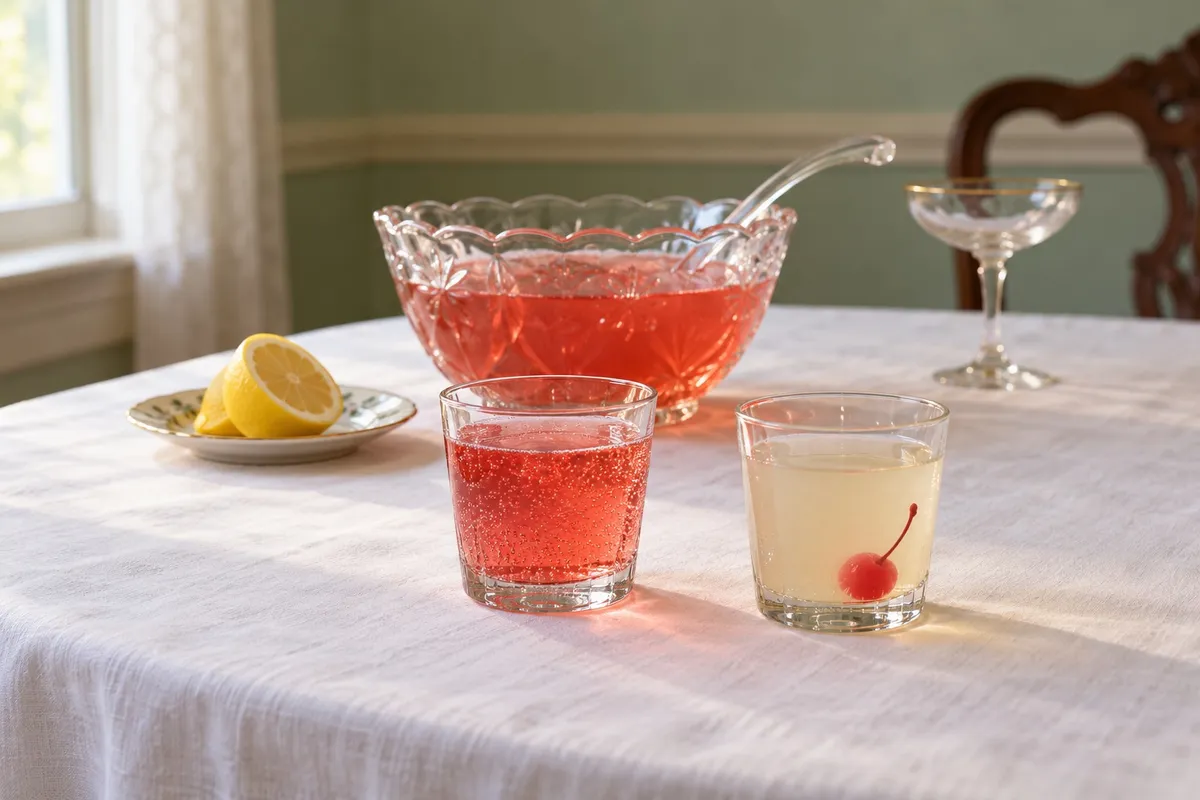
Since at least the 1840s, children at a party have been given a drink that looked like the grown-ups’ one. In Victorian Britain it was a jug of weak, warm negus, port and boiling water with sugar and lemon, which Mrs. Beeton called the drink “more usually drunk at children’s parties than at any other.” By the 1890s American advice books kept children away from alcohol altogether and gave them “cambric tea” instead: milk and hot water at the tea table, under a grown-up name. In 1930 a Prohibition party book was coloring ginger ale red with grenadine for a children’s punch, and by the 1950s the red glass with a cherry had a name, the kiddie cocktail, and a famous example, the Shirley Temple.
A weak negus for the children
Negus was a grown-up drink first: port with lemon, sugar and nutmeg, softened with hot water, a cup for a cold evening. Its history is in What Was Negus?. At a Victorian children’s party the same jug simply went to the children. In January 1849 Punch printed a father’s complaint about the season of juvenile parties, in which he goes downstairs for “some of the weak negus with which Children’s Parties are refreshed.” Twelve years later Beeton’s Book of Household Management set the quantity: “Allow 1 pint of wine, with the other ingredients in proportion, for a party of 9 or 10 children.”
The custom faded quietly. An etiquette book of 1893 lists “lemonade, wine and water” among the refreshments at a juvenile party, and the 1899 edition of Beeton’s book kept the negus recipe but changed its last line to “a party of 9 or 10 persons.” Nobody explained the edit. The whole Christmas evening, from the tea table to the crackers, is in What Did Victorian Children Drink at Christmas?
The lemonade on that 1893 list was probably close to Beeton’s own, sugar rubbed on the lemon rind and boiling water poured over, which we make as Mrs. Beeton’s lemonade. For a warm, spiced jug in the spirit of the children’s negus, the alcohol-free bishop puts grape juice where the port was.
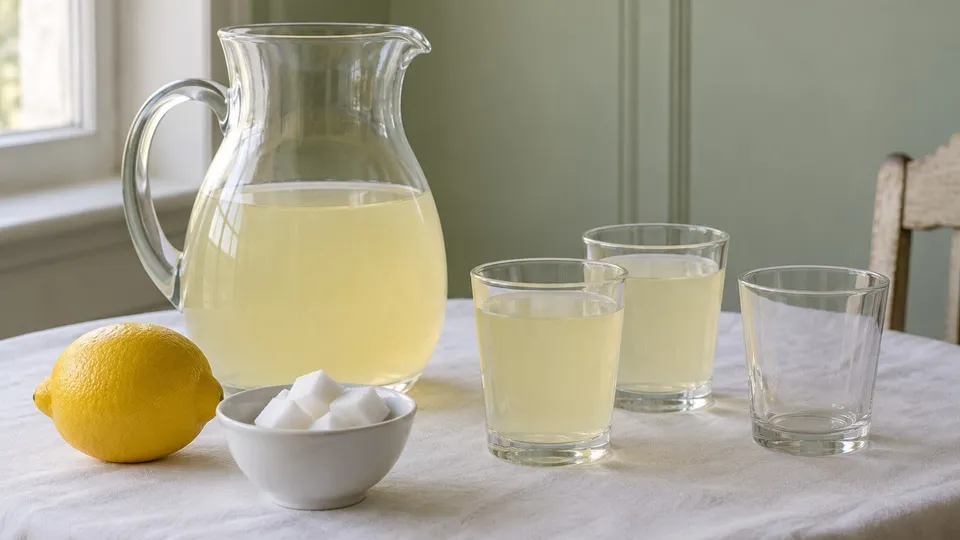 Always alcohol-freeMrs. Beeton’s Lemonade, Made with Boiling Water
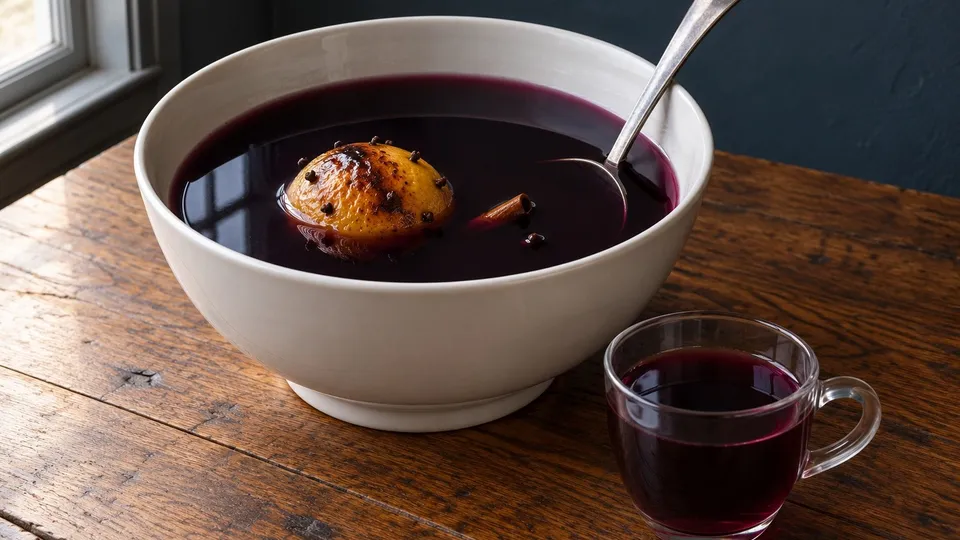 Alcohol-free versionAlcohol-Free Bishop, Spiced Grape Juice with a Roasted Lemon
Cambric tea and ice cream milk
In America the rule was firmer by the 1890s. Elisabeth Robinson Scovil, who wrote books on nursing and the care of children, set it out in 1894: “A child, until it is twelve years old, should drink little beside milk or water.” Tea and coffee were stimulants, in her view better left alone “by a nervous race like ourselves.” On alcohol she wrote that “it is needless to say they should never touch alcohol in any form unless it is prescribed by a physician, or is used in an emergency.”
What a child could have was a grown-up name. Milk thinned with hot water and sweetened, Scovil explains, “is called ‘cambric tea,’” and so a child had tea at the tea table like everyone else. A child who disliked milk could sometimes be coaxed with a few drops of vanilla and a little sugar, “calling it ‘ice cream milk.’” The name was the treat. So, now and then, was color: Scovil, who thought ice water bad for a child’s stomach, kept the water cool in a stoneware pitcher in the ice chest and allowed “a small quantity of home-made fruit syrup” in it “as a treat.” Her syrup is strawberries or raspberries and sugar, heated in a jar standing in boiling water and strained.
Red punch for Betsy Ann and Junior
The dry years made the children’s party drink a subject for whole chapters. In 1930 Roxana B. Doran, writing as Mrs. James M. Doran, published Prohibition Punches, a book of drinks for entertaining without alcohol. Her husband was the federal Commissioner of Prohibition from 1927 to 1930. Her Temperance Punch is behind our Ginger Ale Punch for a Dry Party, and the book turns up again among the Five Alcohol-Free Drinks for a 1920s Party.
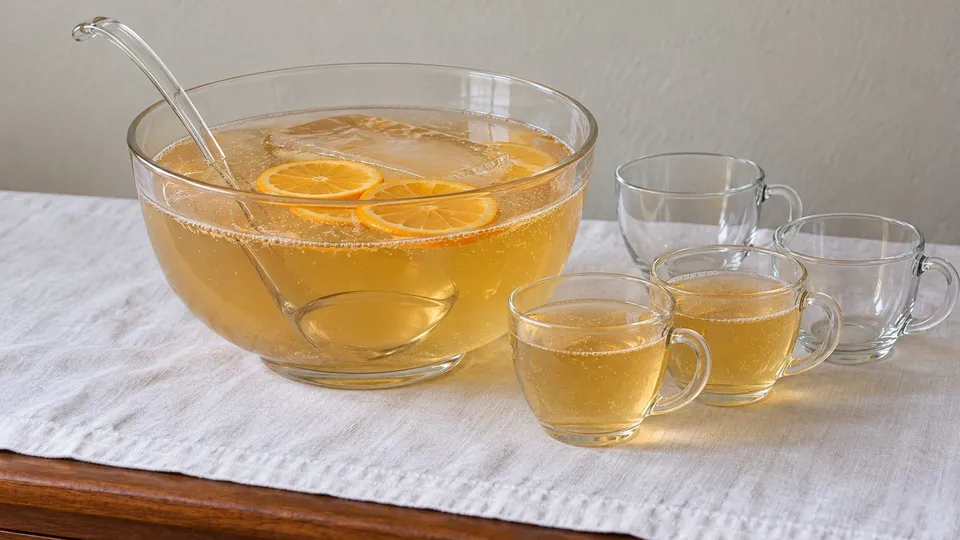 Always alcohol-freeGinger Ale Punch for a Dry Party
Chapter VII, “The Children’s Hour,” opens: “What is more fun than planning the little party for Betsy Ann and Junior?” Its drinks are for a children’s party “even if there are to be some grown-ups present, too.” The make-believe of cambric tea was still at work. Describing the playroom of the Labor Secretary’s children, Doran writes that many a tea party had been staged when “the ‘tea’ was concocted from the mixed juices of fresh fruits.”
Her Mother Goose Punch, for twenty, mixes grapefruit and orange juice with honey and three bottles of white ginger ale, folds in beaten egg whites, and adds half a cup of grenadine, which she calls “harmless vegetable coloring matter.” The grenadine was there to turn the punch red. On the next page, Lemonade for Children, contributed by the wife of the Secretary of Labor, is served in glasses holding a thin slice of orange “and a Maraschino cherry.” So by 1930, ginger ale reddened with grenadine and a glass with a cherry in it were both in print as drinks for children at a party with adults. Nobody connects Doran with the Shirley Temple, and the book never uses the name.
The kiddie cocktail
Ginger ale was a grown-up’s soft drink by the 1890s, when the Horse’s Neck was nothing more than ginger ale and a spiral of lemon peel. Once the cocktail hour came back after repeal in 1933, a red glass of soda with a cherry let a child stand with the adults holding something that looked like theirs. The name for it, the kiddie cocktail, is often dated to the 1930s, but we have not found it in print before the late 1950s. By 1961 a doctor quoted by the Associated Press could define it in one line: kiddie cocktails were “fruit juices or soft drinks served children at cocktail time.”
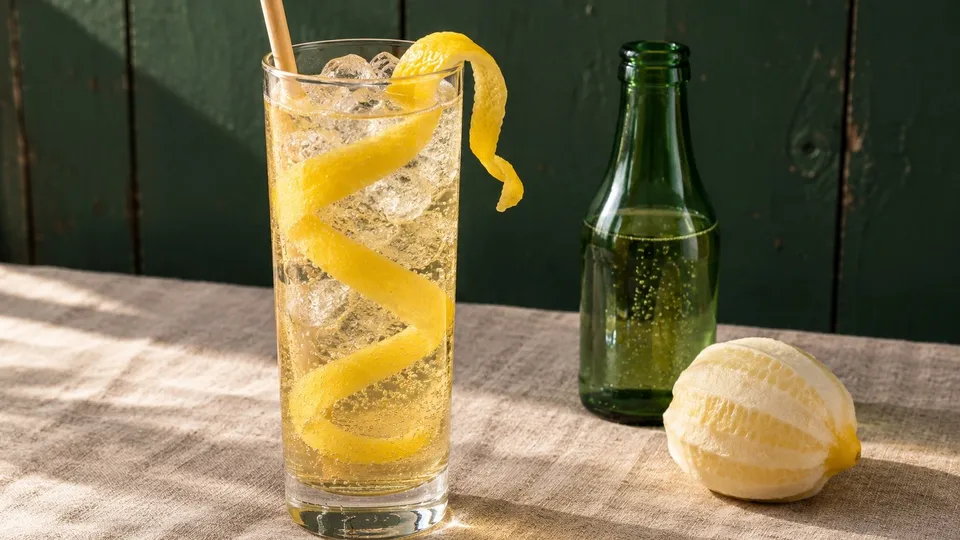 Always alcohol-freeHorse’s Neck, Ginger Ale and a Spiral of Lemon Peel
The best known of them carries the name of the child film star of the 1930s. Shirley Temple Black never claimed it. In an interview with Scott Simon, quoted by NPR in 2014, she said: “Yes, well, those were created in the 1930s by the Brown Derby Restaurant in Hollywood, and I had nothing to do with it.” That is the only first-hand account. Other claimants, among them Chasen’s in Los Angeles and the Royal Hawaiian Hotel in Honolulu, tell their own stories, and none has produced a 1930s menu or recipe. NPR also reported that she went to court twice against companies that wanted to sell a bottled version under her name. The earliest mention we have found is from 1957, when a Key West society column reported that the girls at a ninth-birthday party in an officers’ club “were first treated to Shirley Temple cocktails before entering the dining room.”
A doctor objects
That doctor was a critic. In October 1961 Dr. Marvin A. Block, of the University of Buffalo medical school, told the New York State Nurses Association that he was opposed to kiddie cocktails, the Associated Press reported, and that children should not be treated like small adults. His objection was to the very thing that had made the drink a treat since cambric tea: the grown-up name, the grown-up glass and the grown-up hour.
The drinks themselves had changed a great deal in a century, from a Victorian jug of watered port to a glass with no alcohol in it at all. The idea behind them had not changed much. A child at the party wanted the same thing the adults had, and every generation found a version it was willing to pour.
The Shirley Temple is the easiest to make tonight: pour the ginger ale over ice, then spoon in the grenadine slowly so it sinks to the bottom in a red layer, the way Doran’s grenadine was meant to color her punch, and finish with the cherry.
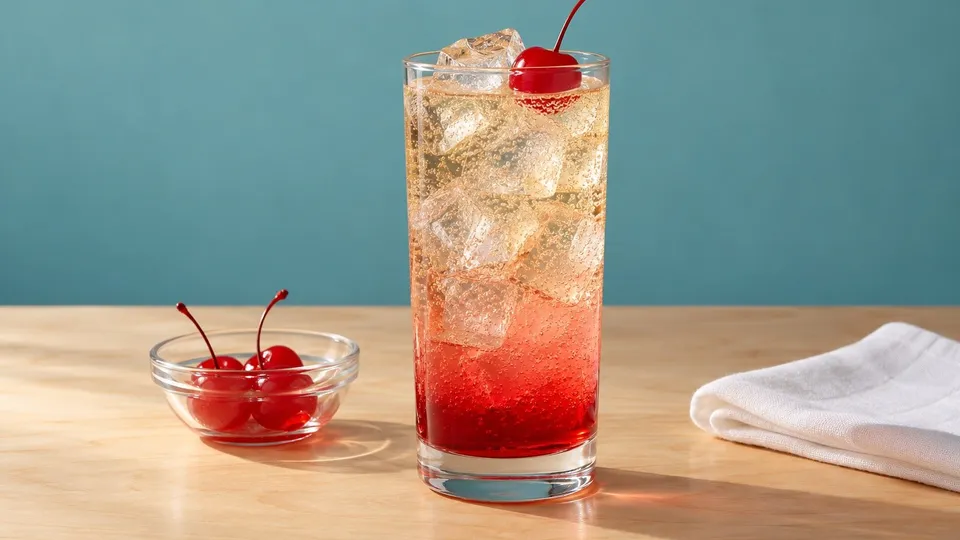 Always alcohol-freeShirley Temple, the Ginger Ale and Grenadine Drink
Sources
- [W. M. Thackeray, signed “Spec”], “Child’s Parties: and a Remonstrance concerning them,” Punch, or the London Charivari, vol. XVI (January 1849), pp. 13 and 35.
- Isabella Beeton, The Book of Household Management (London: S. O. Beeton, 1861), pp. 889–890, recipe 1835.
- [Isabella Beeton], The Book of Household Management, new edition (London: Ward, Lock, 1899), p. 1219, recipe 2736.
- A Member of the Aristocracy, Manners and Rules of Good Society, or Solecisms to be Avoided (London and New York: F. Warne, 1893), ch. XXIV, “Juvenile Parties,” pp. 170–172.
- Elisabeth Robinson Scovil, The Care of Children (Philadelphia: Henry Altemus, 1894), pp. 58–60.
- Mrs. James M. Doran [Roxana B. Doran], Prohibition Punches: A Book of Beverages (Philadelphia: Dorrance, 1930), ch. VII, “The Children’s Hour,” pp. 81–86.
- “Now Hear This,” The Key West Citizen (Key West, Fla.), November 13, 1957, p. 3.
- “Kiddie Cocktails Seen Harmful by Medical Leader” (Associated Press, Buffalo), Kingston Daily Freeman (Kingston, N.Y.), October 12, 1961, p. 19.
- Eliza Barclay, “Thank You, Shirley Temple, For The Original ‘Mocktail’,” NPR, The Salt, February 11, 2014.