Fountain Root Beer, Syrup and Soda Water
Reader ratingsRoot beer extract stirred into a heavy sugar syrup and drawn with very cold soda water, as an 1897 soda manual made it: never fermented, and alcohol-free with an alcohol-free extract.
- Recipe makes
- About 380 ml syrup, enough for 8 drinks
- Prep
- Cook
- Total
Includes about 30 minutes for the syrup to cool. Each drink then takes a minute.
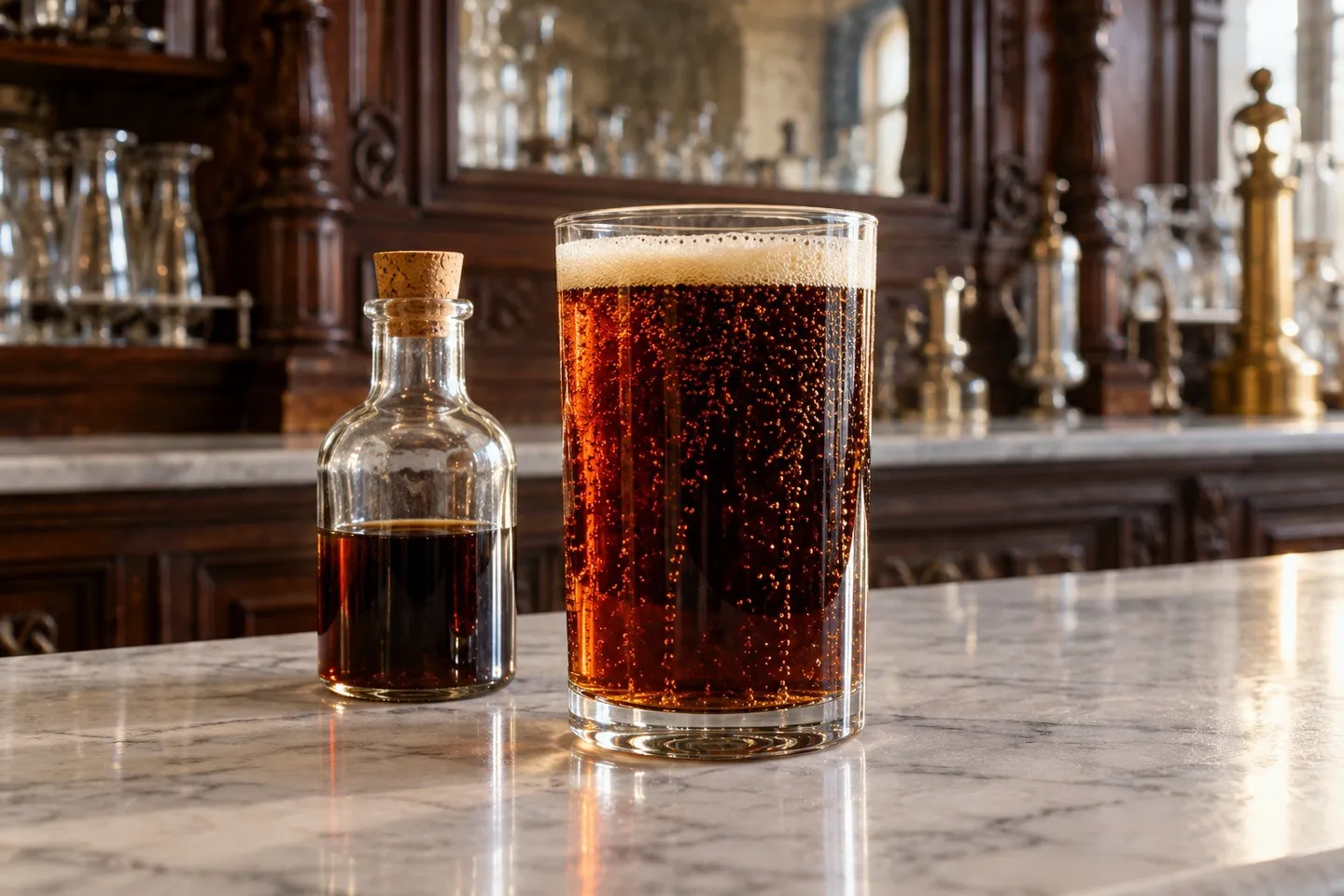
Fountain root beer in a straight soda glass, with the syrup bottle beside it.
The story behind the recipe
At the soda fountain, root beer was a syrup, and the fizz came from the tap. The clerk kept a bottle of root beer syrup behind the counter, poured a measure into a glass and filled it from the soda tap for each customer. The “Root Beer Syrup” in A. Emil Hiss’s 1897 soda manual, which this recipe follows, is a bought extract in heavy sugar syrup, colored with caramel and sometimes sharpened with citric acid.
LaWall’s two root beers
Made with an alcohol-free extract, this root beer has no alcohol in it: the syrup is only sugar, water and flavor, and the soda water brings the gas. The household kind was brewed with yeast in tightly closed bottles, and in 1916 the pharmacist Charles H. LaWall found it growing stronger for eleven days. The fountain kind, he wrote, held no more alcohol than the extract brought with it. His test, day by day, is set out in Did Root Beer Have Alcohol in It?
Hiss serves it two ways: “with foam in a 12-ounce glass or ‘solid’ in an 8-ounce glass.” We read solid as a full glass without a foamy head. His medicinal drinks were all served that way, “filling the latter with the coarse stream of carbonated water,” the tap’s stronger jet. This version uses the 8-ounce glass.
Read more about this recipe
The extract
The old extracts got most of their flavor from sassafras, usually as its oil, which is now barred from food in the United States. Use a modern root beer extract or concentrate labeled safrole-free or sassafras-free. Many are made with alcohol; for a drink with no alcohol at all, choose one made with glycerin or another alcohol-free base. Brands differ in strength, so start with the smaller amount and taste.
The syrup follows the heavy proportion of sugar to water that Hiss calls “the most common formula in vogue,” so by our arithmetic each glass is sweeter than a cola, and its flavor is only as strong as the extract you buy. Most extracts are already colored, so the caramel is left out. Our alcohol-free ginger beer is built on the same plan, a syrup in the glass and cold soda water on top.
This may be prepared from one of the root beer extracts by adding sufficient of the latter (from 1 to 4 fluidounces) to ½ gallon of syrup ...

Recipe makes: About 380 ml syrup, enough for 8 drinks
Ingredients
For About 380 ml syrup, enough for 8 drinks. Quantities are shown as written.
Quantities as written here, for About 380 ml syrup, enough for 8 drinks.
Root beer syrup
- Sugar290 g
- Water200 ml
- Safrole-free, alcohol-free root beer extract2–3 metric tsp (5 ml per tsp)
- Citric acid (optional)1 pinch
Per drink
- Root beer syrup45 ml
- Soda water, very cold170 ml
Measurement notes
Ingredients as written here
- 290 g sugar
- 200 ml water
- 2 to 3 tsp safrole-free, alcohol-free root beer extract
- 1 pinch citric acid (optional)
- 45 ml root beer syrup
- 170 ml soda water, very cold
Equipment
 Small saucepan
 Clean glass bottle or jar for the syrup
 Straight soda glass, about 8 fl oz
Instructions
For the syrup, put the sugar and water in a small saucepan and stir over medium heat until the sugar has completely dissolved and the syrup is clear. Do not let it boil.
Take the pan off the heat and leave the syrup to cool for about 30 minutes.
Stir in the safrole-free, alcohol-free root beer extract, starting with the smaller amount, and the citric acid, if using. Taste a drop in a little soda water and add more extract to taste if the flavor is faint. Pour into a clean bottle and refrigerate.
For each drink, pour the root beer syrup into a straight soda glass.
Pour in the very cold soda water slowly, stir once and serve at once.
Nutrition
135calories per serving
- Recipe makes
- About 380 ml syrup, enough for 8 drinks
- Servings
- 8
Estimated from USDA FoodData Central values for granulated sugar, for one drink with 45 ml of the syrup; the extract adds almost nothing.
Recipe notes
When adjusting quantities
Scale the syrup ingredients together. The drink ingredients are for one glass; multiply them by the number of drinks.
Notes
Quantities mentioned in these notes don’t change when you adjust the batch.
The fountain syrup formula Hiss calls the most common is 12 pounds of sugar to a gallon of water, about 1.44 parts sugar to 1 of water by weight; 290 g of sugar to 200 ml of water keeps that proportion. His ½ gallon of syrup took 1 to 4 fluid ounces of extract, and his other root beer syrups 1 1/2 to 2 fluid ounces. This batch is about a fifth of his, so 2 to 3 teaspoons of a modern extract sits in the same range. That range is our estimate; brands of extract vary, so go by taste.
For Hiss’s foamy version, use a taller glass of about 350 ml, pour the soda in hard to raise a head, then top it gently. His Columbian and Ottawa root beer syrups also added “soda foam,” a foaming agent of the period, which this recipe leaves out.
If your syrup looks pale, a few drops of caramel color will do what Hiss’s caramel did. Do not use sassafras bark, root or oil in its place: food with added safrole or oil of sassafras is adulterated under US law (21 CFR 189.180).
Storage
Keep the syrup in a clean, closed bottle in the fridge and use it within 2 weeks.
Scaling changes the ingredients only; glassware, ice and timings need their own judgment. To adapt this recipe further, try the recipe tool at TuneMyRecipe (opens in a new tab), our sister site.
Sources and attribution
A. Emil Hiss, The Standard Manual of Soda and Other Beverages (Chicago: G. P. Engelhard & Co., 1897), p. 87, “Root Beer Syrup”
See the original pages (scan at Internet Archive) (opens in a new tab)
Recipe details
- Drink
- Alcohol-free
- Drink family
- Sodas & Soft Drinks
- Region
- American
- Era
- 19th century
- Source decade
- 1890s
- Difficulty
- Easy
- Occasion
- Dry January
- Season
- Summer