Homemade Root Beer Syrup with Sarsaparilla and Ginger
Reader ratingsA modern root syrup of sarsaparilla, roasted dandelion root, fresh ginger and dark brown sugar, served the 1890s fountain way with cold soda water. No sassafras, no fermenting.
- Recipe makes
- About 550 ml syrup, enough for 12 drinks
- Prep
- Cook
- Total
Includes 30 minutes steeping and about 30 minutes for the syrup to cool.
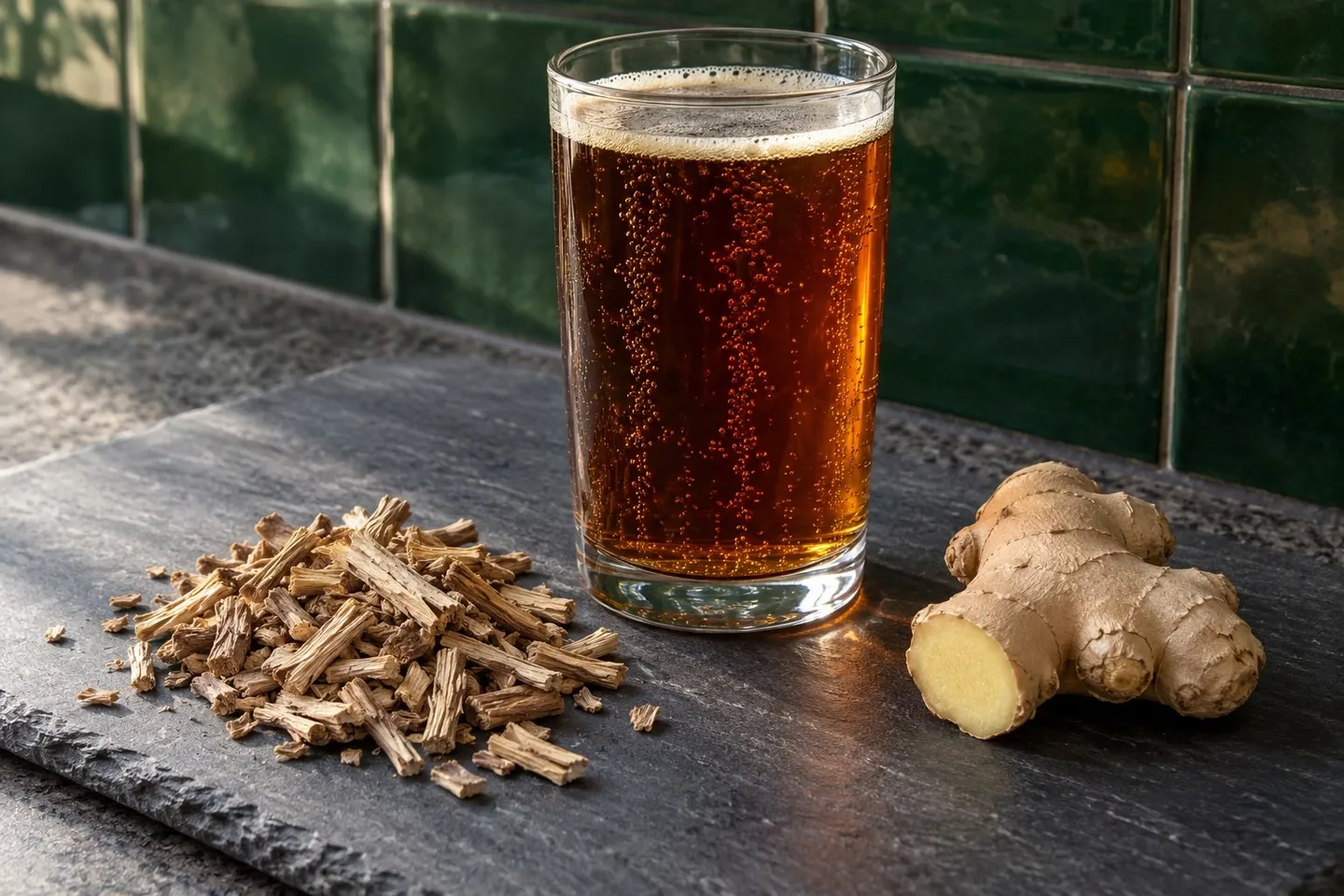
Root beer made with sarsaparilla syrup, beside chopped dried sarsaparilla root and a knob of fresh ginger.
The story behind the recipe
Sarsaparilla, roasted dandelion root and fresh ginger give this dark brown-sugar syrup its flavor, and it is served with cold soda water the way an 1890s soda fountain served its root beer. It is a modern recipe, made without sassafras, and the amounts are our own. The root beer extracts on pages 53 and 54 of A. Emil Hiss’s 1897 manual for druggists all call for sassafras, so this syrup takes its flavors from the safer end of the old lists.
Flavors from the old lists
Harvey W. Wiley, writing in 1919, named the materials used to flavor root beers: juniper berries, pipsissewa, sarsaparilla, spikenard, wintergreen, vanilla, “various barks and roots,” some of them, he noted, medicinal and listed in the Pharmacopœia. Hiss’s Ottawa root beer extract is made with ginger, dandelion and sarsaparilla, with oils of sassafras and wintergreen beside them. From those we keep sarsaparilla root, roasted dandelion root, fresh ginger and vanilla. Dark brown sugar stands in for the molasses that Albert A. Hopkins’s 1919 home root beers were brewed with.
We leave out sassafras in every form, since US law treats food with added safrole or oil of sassafras as adulterated. Oil of wintergreen, wild cherry bark, spikenard, pipsissewa and licorice root stay out too: we have no safe home amount to give for any of them.
Read more about this recipe
At the glass
The syrup is simmered, sweetened and kept cold, and the fizz comes from soda water at the glass. Household root beer of the period was left to work with yeast in closed bottles, and Did Root Beer Have Alcohol in It? shows what that did to them. Wiley called the old root beer flavorings “aromatic bitter principles,” and the sarsaparilla here is one of the roots on his list. For a version built on a bought extract, closer to the fountain’s own, make the fountain root beer. Sweet wort is another unfermented drink that borrowed the name of beer.
Recipe makes: About 550 ml syrup, enough for 12 drinks
Ingredients
For About 550 ml syrup, enough for 12 drinks. Quantities are shown as written.
Quantities as written here, for About 550 ml syrup, enough for 12 drinks.
Root beer syrup
- Dried sarsaparilla root, cut15 g
- Roasted dandelion root10 g
- Fresh ginger, sliced20 g
- Water500 ml
- Dark brown sugar300 g
- Alcohol-free vanilla flavoring1 metric tsp (5 ml per tsp)
- Citric acid (optional)1 pinch
Per drink
- Root beer syrup45 ml
- Soda water, very cold200 ml
Measurement notes
Ingredients as written here
- 15 g dried sarsaparilla root, cut
- 10 g roasted dandelion root
- 20 g fresh ginger, sliced
- 500 ml water
- 300 g dark brown sugar
- 1 tsp alcohol-free vanilla flavoring
- 1 pinch citric acid (optional)
- 45 ml root beer syrup
- 200 ml soda water, very cold
Equipment
 Saucepan with a lid
 Fine sieve, lined with a coffee filter or muslin
 Clean glass bottle or jar for the syrup
 Tall straight glass, about 250 ml
Instructions
Put the dried sarsaparilla root, roasted dandelion root, fresh ginger and water in a saucepan and bring to a boil. Cover, turn the heat down and simmer gently for 20 minutes.
Take the pan off the heat and leave it covered to steep for 30 minutes.
Strain through a fine sieve lined with a coffee filter or muslin into a jug, pressing on the roots, then pour the liquid back into the rinsed pan.
Add the dark brown sugar and stir over low heat until it has completely dissolved. Take the pan off the heat.
Leave the syrup to cool for about 30 minutes, then stir in the alcohol-free vanilla flavoring and the citric acid, if using. Pour into a clean bottle and refrigerate.
For each drink, pour the root beer syrup into a tall straight glass, pour in the very cold soda water slowly, stir once and serve at once.
Nutrition
95calories per serving
- Recipe makes
- About 550 ml syrup, enough for 12 drinks
- Servings
- 12
Estimated from USDA FoodData Central values for dark brown sugar, for one drink with 45 ml of the syrup; the roots, ginger and vanilla add almost nothing.
Recipe notes
When adjusting quantities
Scale the syrup ingredients together. The drink ingredients are for one glass; multiply them by the number of drinks.
Notes
Quantities mentioned in these notes don’t change when you adjust the batch.
The amounts of root, ginger and sugar are our first estimate, worked out to give a syrup a little lighter than a fountain syrup; taste a spoonful in soda water before bottling, and use more syrup per glass for a stronger drink.
Buy dried sarsaparilla root (Smilax) and roasted dandelion root from a supplier that sells them for teas. Both are permitted flavorings in US food rules: dandelion root is listed as generally recognized as safe (21 CFR 182.20), and sarsaparilla among natural flavoring substances (21 CFR 172.510).
US vanilla extract must contain at least 35 percent alcohol (21 CFR 169.175). A teaspoon of it in this syrup leaves a trace in each glass, so use an alcohol-free vanilla flavoring for a drink with no alcohol at all.
Never add sassafras bark, root, leaves or oil.
Storage
Keep the syrup in a clean, closed bottle in the fridge and use it within 2 weeks. Throw it out if it turns fizzy or cloudy in the bottle.
Scaling changes the ingredients only; glassware, ice and timings need their own judgment. To adapt this recipe further, try the recipe tool at TuneMyRecipe (opens in a new tab), our sister site.
Sources and attribution
A modern syrup after the root beer flavors listed in Harvey W. Wiley, Beverages and Their Adulteration (1919), p. 104, and A. Emil Hiss, The Standard Manual of Soda and Other Beverages (1897), pp. 54 and 87
Recipe details
- Drink
- Alcohol-free
- Drink family
- Sodas & Soft Drinks
- Region
- American
- Base
- Spices
- Difficulty
- Intermediate
- Occasion
- Dry January
- Season
- Summer