What Was Koumiss?
Koumiss was the fermented mare’s milk of the steppe. Victorian doctors prescribed it by the bottle, made it from cow’s milk and argued over the name.
Koumiss is fermented mare’s milk, the everyday drink of the horse-herding peoples of the Central Asian steppe: sour, fizzy and faintly alcoholic. In the 1870s and 1880s it became a medicine in Britain and America, prescribed for consumption and other wasting diseases. Hardly anyone there could get mare’s milk, so the koumiss they bought was made from cow’s milk, fermented in strong bottles and drawn off through a champagne tap. Doctors argued over whether that was koumiss at all, and nobody proved that it cured anyone.
Mare’s milk from the steppe
The fullest English book on it was written by George L. Carrick, physician to the British Embassy at St Petersburg, and published in 1881 as Koumiss, or Fermented Mare’s Milk, and Its Uses in the Treatment and Cure of Pulmonary Consumption and Other Wasting Diseases. Its title says almost everything about how Victorian doctors saw the drink. Russian doctors sent consumptive patients east to the steppes to drink it, and Carrick wrote to explain that cure to British readers.
He was firm about one thing. “It must be distinctly understood, then, that the therapeutic remedy and article of diet that has formed the subject of this essay is the fermented milk of the mare, not of any other animal,” he wrote. “It is to it that the name of koumiss has been applied from time immemorial, and that name should be reserved exclusively for it in the future.”
He had a rival in mind. On the same page he dismissed Dr. Jagielski, whose cow’s-milk koumiss was made to his directions “by one particular firm of druggists in London,” and who had joined “the ranks in which the floaters of Zoedone, Du Barry’s Revalenta, and Morrison’s Pills, compete for public favour”: the patent-medicine trade. Carrick quoted one claim made for that cow’s-milk drink, “the strengthening of memory and intellectual power,” and left it “to more appropriate and potent remedies.”
In champagne bottles
The name was not reserved for anything. In the United States, Mrs. Dr. S. Von Berg of Philadelphia registered a trade mark for “Kirghizian Kumys” in 1877, an engraving of a lady’s hand in a lace cuff holding a champagne-style bottle with a tap screwed through its cork.
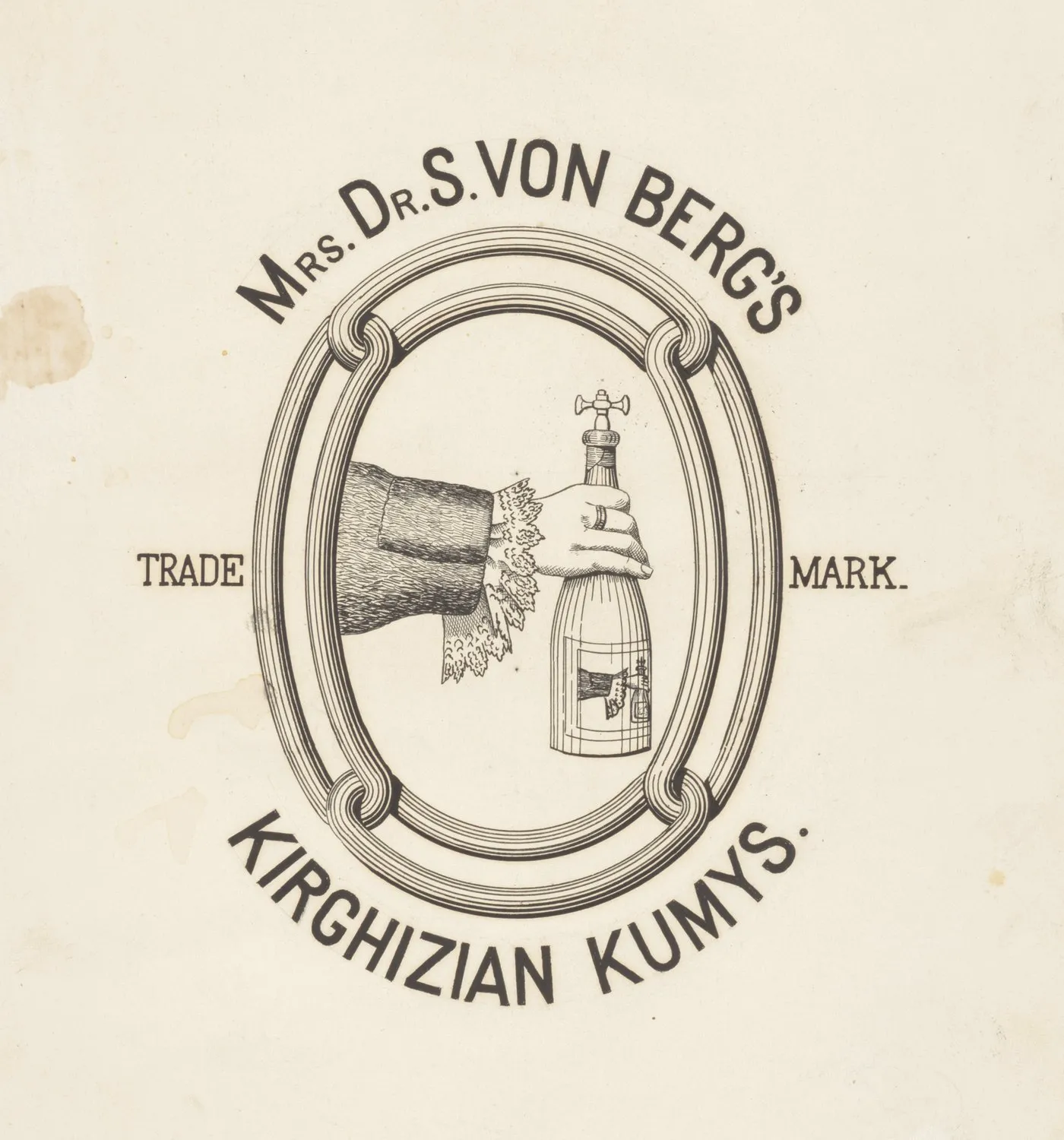 Trade mark of Mrs. Dr. S. Von Berg’s Kirghizian Kumys, Philadelphia, registered June 12, 1877. Library of Congress, Prints and Photographs Division.
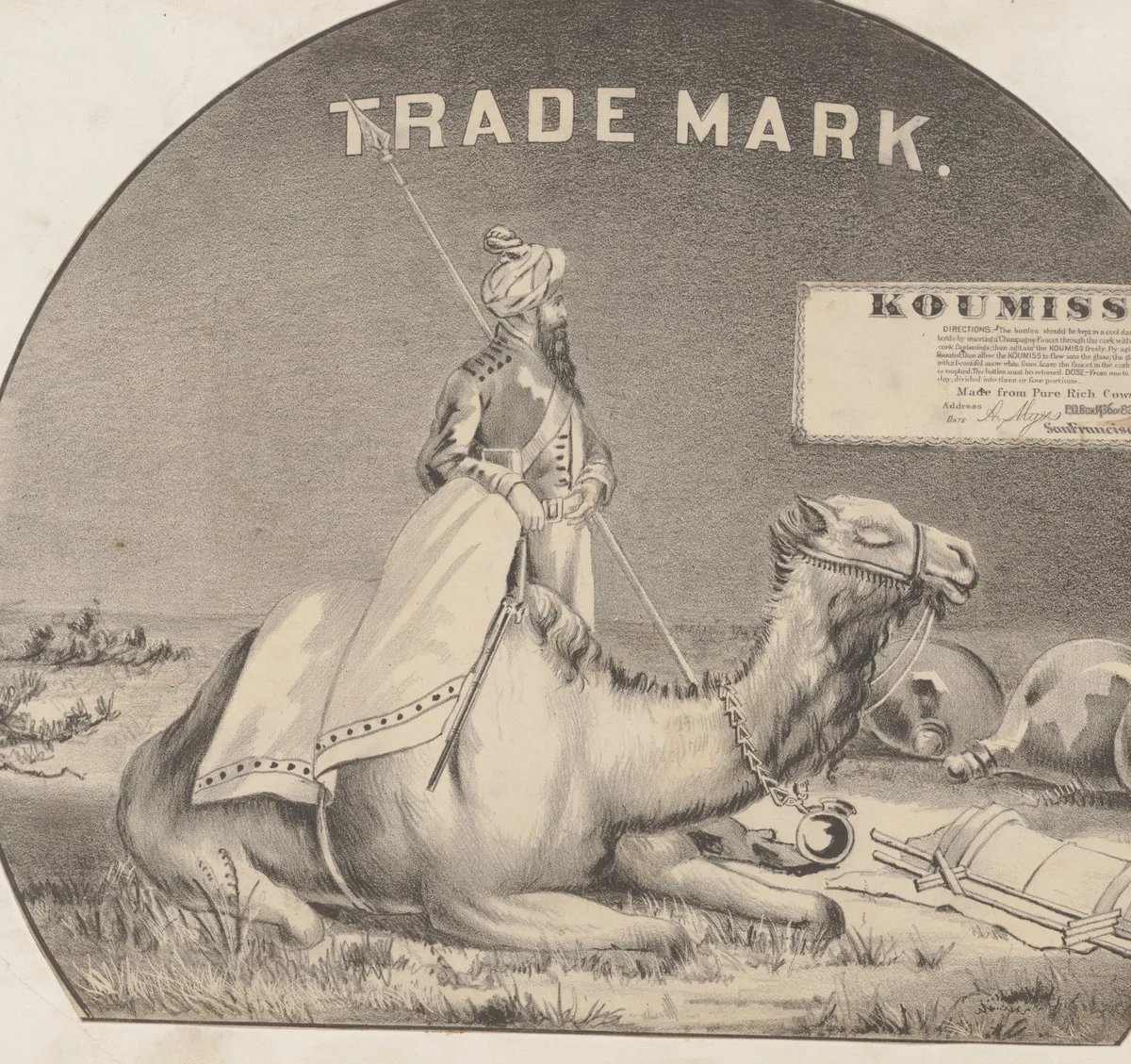
Two years later A. Myers of San Francisco registered the picture at the top of this page, a rider and a camel on the open plain. The label pasted onto it tells the real story. The bottles were to be kept “in a cool dark place.” To open one, the buyer pushed “a Champagne Faucet through the cork without loosening the cork fastenings,” shook the bottle, and let the koumiss run into the glass, which “will be filled with a beautiful snow white foam.” The dose was “From one to four bottles per day.” And at the bottom, in plain type: “Made from Pure Rich Cows’ Milk.”
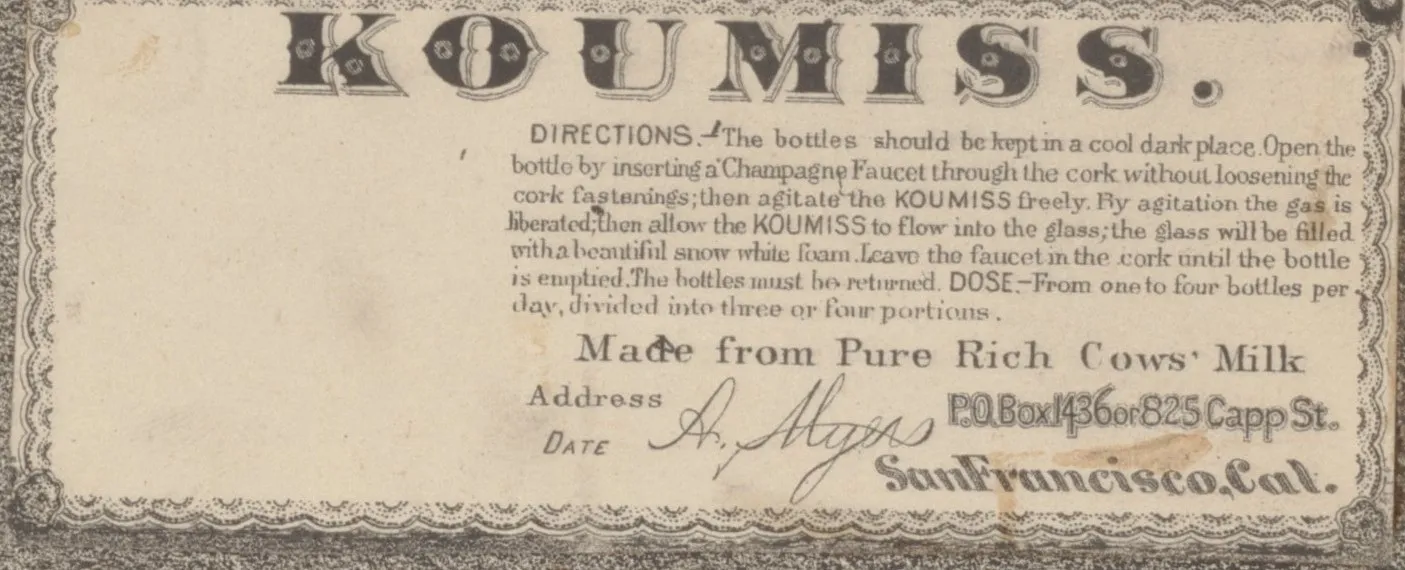 A. Myers’s koumiss label, San Francisco, from his trade mark registration of July 29, 1879. Library of Congress.
Carrick himself, for all his insistence on the name, gave recipes for fermented cow’s milk and wanted it made close to home: where good milk was easy to get, “it should be manufactured on the spot.” In London, he thought, a dairy company should make it on a large scale, “for it is no more a necessity that druggists should prepare it, than that they should brew the beer we drink.” He praised the Aylesbury Dairy Company for selling it “at a comparatively low price,” against makers who wrapped theirs in “the mystery of a nostrum” and charged as much as for Burgundy.
The second dozen
What that price meant to a patient comes through in a paper read to the British Medical Association in Dublin and printed in the British Medical Journal on December 3, 1887. Edward C. Anderson, a physician at Wolsingham in County Durham, opened it with a case from March 1881. A woman with chronic dysentery was in his care, “and, as a last resort, I recommended koumiss. I sent for and obtained one dozen champagne quarts, and my patient evidently derived benefit from the taking it.”
“The price was, however, so prohibitive (nearly £3 3s. by the time the first dozen was obtained and carriage paid), that I, with the greatest difficulty, and only after the lapse of a week or two, obtained the consent of my patient’s friends to send for a second supply.” That first dozen came to about £330 in today’s money, by UK consumer prices (Bank of England), or more than £25 a bottle. “Unfortunately, this interval was sufficiently great to cause a relapse to the most severe expressions of the disease; so that by the time this additional supply was received, she was too far gone for recovery.”
That is Anderson’s account, written six years later. He believed the gap killed her. There is no casebook, no record of her other treatment, and no way now to know whether more koumiss would have changed anything. What the story does show plainly is the problem: a drink prescribed by the day had to be bought by the dozen, sent for and paid for by someone.
Making it at home
The death, Anderson wrote, “determined me to penetrate, if possible, the secret of koumiss.” His first try, milk with German yeast and a large teaspoonful of sugar, gave “a highly charged and therefore effervescent carbonic acid drink, with much the odour and flavour of bad ginger beer.” Adding bicarbonates gave him fizzy sour milk, but no alcoholic fermentation.
The answer came, by his account, from an unlikely bottle: a sample of a diabetic patient’s urine left in his laboratory window, which fermented in the sun until it forced out its cork. Its sugar had fed the “sugar fungus,” yeast. So he made a fermenting solution of cane sugar, added “a drop or two” of it to a champagne quart of milk with about half an ounce of sugar, corked and tied the bottle, and kept it for twenty-four hours at about 90°F. The result, he wrote, was “highly effervescent” with “the pleasantly acid flavour due to lactic acid,” and “altogether free from the bad ginger-beeriness.” After that he started each new bottle with a little of the last.
Carrick had his own idea of how a household could manage. In families “where there are several young ladies with plenty of spare time on their hands,” he suggested, each could take “a turn at the churn-staff for a quarter of an hour or so, four or five times a-day,—a gentle exercise, which would prove a pleasant relief from the weary routine of piano-strumming.”
By the 1890s koumiss had moved into American cookbooks for invalids. Ella Eaton Kellogg’s Science in the Kitchen (1892), published at Battle Creek, Michigan, put it under “Preparations of Milk” for the sick: a little compressed yeast and sugar, a quart bottle of milk, six warm hours, then a week corked in a cool place. Her test for failure was blunt: “If there is any curd or thickening resembling cheese, the fermentation has been prolonged beyond the proper point, and the koumiss should not be used.”
Did it work?
Nobody showed that it did. Anderson’s first patient died. Carrick, its strongest advocate, still thought the claims made for cow’s-milk koumiss were nonsense and that mare’s milk on the steppe was another thing. What the patients drank was milk, a little sugar, a little alcohol and a lot of gas. The evidence goes no further than that.
Like the brewed ginger and lemon beers in What Were Victorian Non-Alcoholic Beers?, it was a fermented drink that held a little alcohol whatever its makers called it. Mare’s-milk kumis is still made and drunk in Central Asia today; the cow’s-milk invalid drink faded with the bottles and the champagne taps.
For a sickroom milk drink with no fermenting and no alcohol at all, Maria Rundell’s 1806 Lemon Whey turns boiling milk with lemon juice and thins the whey with hot water.
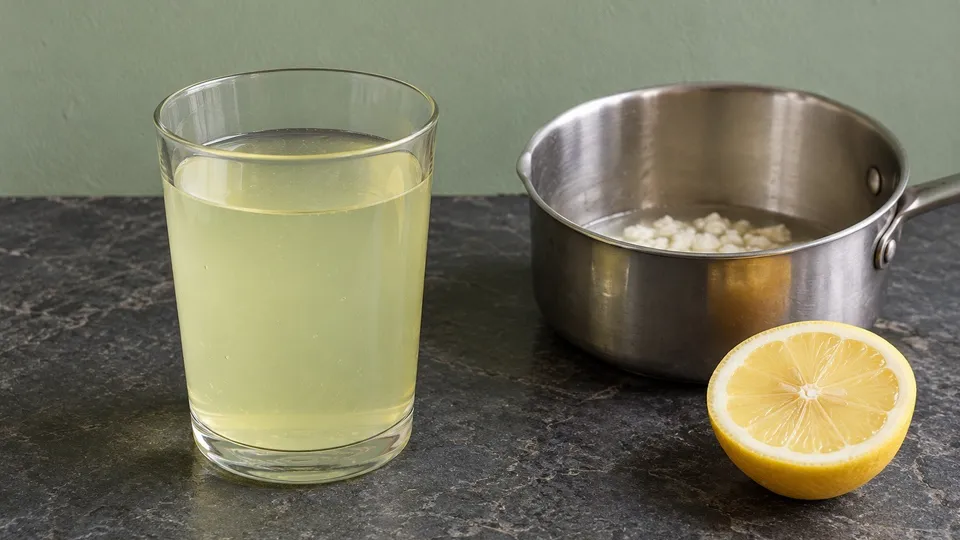 Always alcohol-freeLemon Whey, Hot Milk Turned with Lemon Juice
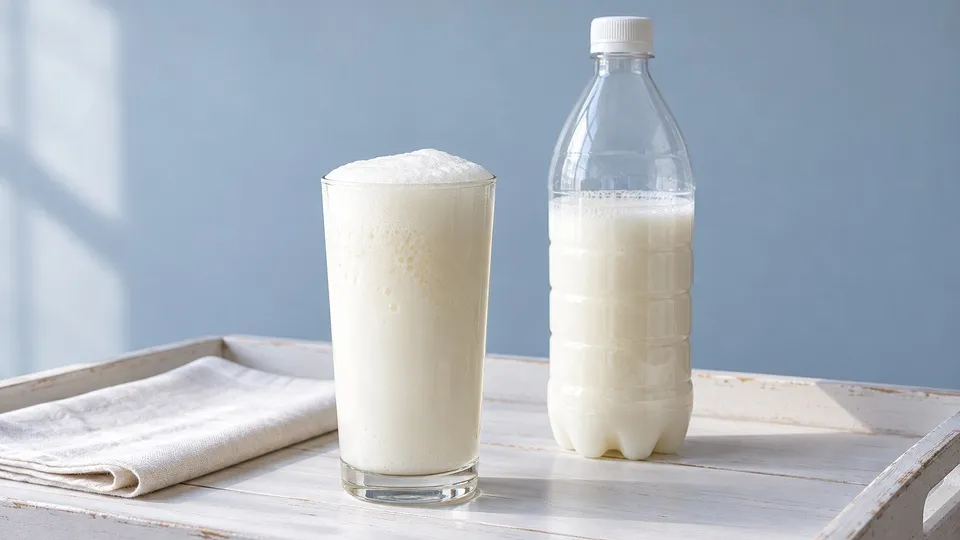
Kellogg’s version is the one to make at home, because it is the only one of these that tells you when to stop: Koumiss, the 1892 Fermented Milk Drink keeps her six warm hours and her cheese test, with a plastic bottle and the fridge in place of a tied cork and a cool cellar.
 Make it todayKoumiss, the 1892 Fermented Milk Drink
Sources
- George L. Carrick, Koumiss, or Fermented Mare’s Milk, and Its Uses in the Treatment and Cure of Pulmonary Consumption and Other Wasting Diseases (Edinburgh and London: William Blackwood and Sons, 1881), title page, pp. 267, 285.
- Edward C. Anderson, “Koumiss and Koumissised Peptones: Independent Discovery of Varieties, Physiological Uses, Etc.,” British Medical Journal, December 3, 1887, p. 1208.
- E. E. Kellogg, Science in the Kitchen (Battle Creek: Health Publishing Company, 1892), p. 425.
- Trade mark of M. S. Von Berg, “Effervescent Beverage” (Mrs. Dr. S. Von Berg’s Kirghizian Kumys), no. 4,742, registered June 12, 1877, Library of Congress, Prints and Photographs Division, https://www.loc.gov/pictures/item/2020748823/ (opens in a new tab).
- Trade mark of A. Myers, “Koumiss, a Medicinal Beverage,” no. 7,556, registered July 29, 1879, Library of Congress, Prints and Photographs Division, https://www.loc.gov/pictures/item/2022669637/ (opens in a new tab).