Victorian Mulled Wine, Claret with a Glass of Port
Reader ratingsCloves, cinnamon, lemon peel and sugar boiled in water, then a pint of claret and a glass of port, heated, never boiled: mulled wine from an 1869 London book.
- Recipe makes
- About 950 ml, 6 glasses
- Prep
- Cook
- Total
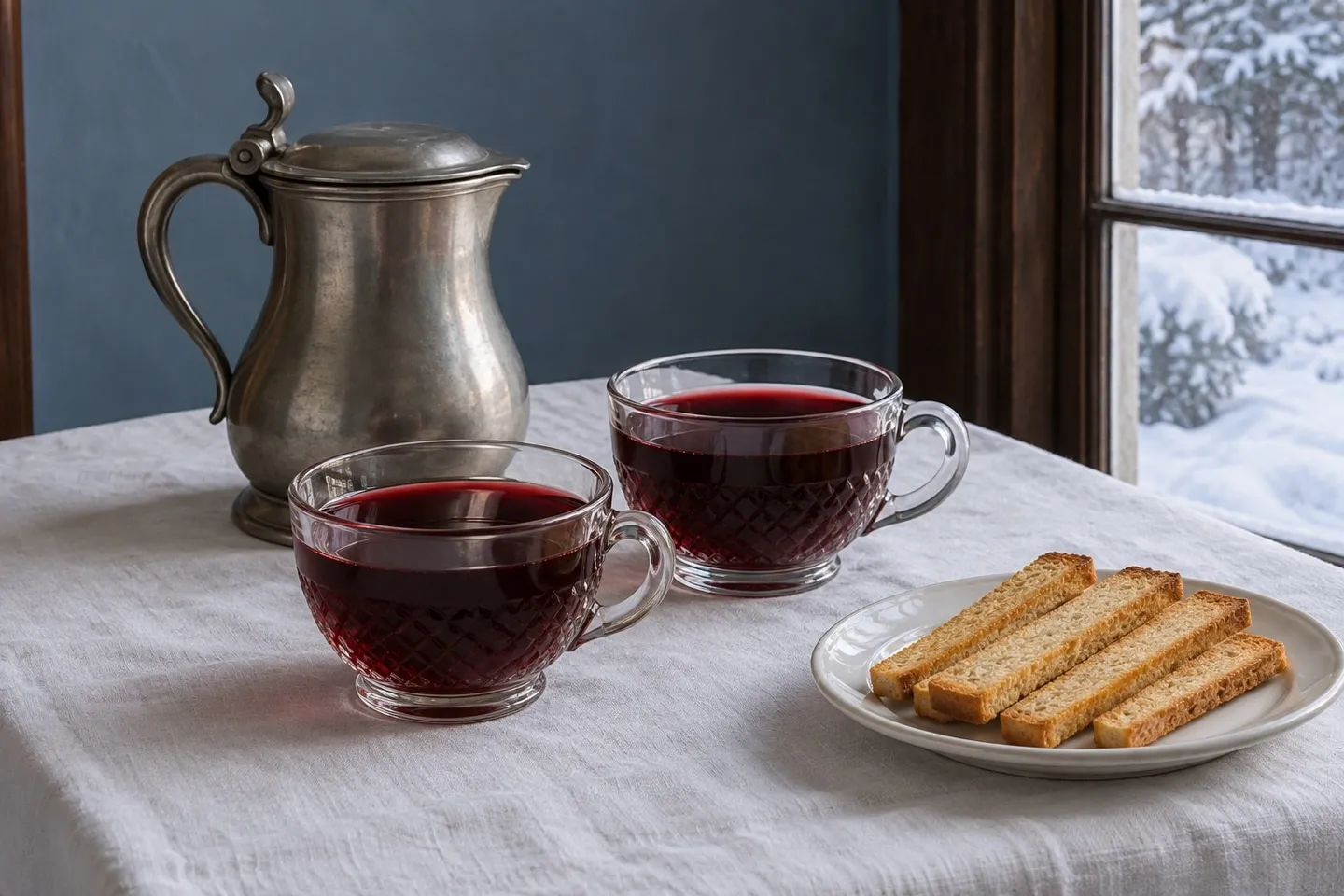
Mulled claret and port in two diamond-patterned glass punch cups, with a lidded pewter jug and strips of toast.
The story behind the recipe
This is Victorian mulled wine as William Terrington printed it in Cooling Cups and Dainty Drinks (1869): claret and a little port poured into water already boiled with sugar, cloves, cinnamon and lemon peel, heated almost to the boil and strained. Claret is what the British called red Bordeaux; the glass of port adds a little more sugar and strength.
Port, claret and a clean pan
Isabella Beeton, eight years earlier, had said the same two wines were the usual choice, “and the latter requires a very large proportion of sugar.” Terrington’s four ounces of sugar to a pint of claret bears her out. She also served it “with strips of crisp dry toast, or with biscuits,” the same habit as the toasted bread in Terrington’s last line. Her one firm rule was about the pan: “The vessel that the wine is boiled in must be delicately clean, and should be kept exclusively for the purpose,” because a pan used for cooking would give the wine “a very disagreeable flavour.” She preferred small tin warmers, sold “for a trifle,” kept for mulling and nothing else.
Wine heated with spice was an ordinary winter drink in a Victorian house. At Christmas it shared the table with punch, elder wine and bishop, and in Victorian Christmas Drinks, from Punch to Elder Wine it stands beside the hot elder wine that London’s poor bought by the glass in the street.
Read more about this recipe
Which wine, and how hot
Use a dry red Bordeaux, or any dry, medium-bodied red, and an everyday ruby port. Terrington’s sugar is printed as loaf sugar; ordinary granulated sugar does the same job, and this is a sweet drink, so start with three quarters of it if you prefer less. The spiced water boils, but the wine should only get hot: Terrington takes it off “when nearly boiled,” and that also keeps in more of the alcohol.
Worked out from the ingredients, the finished jug is about 9% ABV, weaker than the claret on its own, and a 150 ml glass holds about 1.4 UK units. For a hot, spiced jug with no alcohol in it, make the Alcohol-Free Bishop, which uses red grape juice and a roasted lemon.
Into a stewpan put 3 bruised cloves, ½ stick of cinnamon, ½ peel of a lemon, 4 oz. loaf sugar, ½ pint of water; boil for a quarter of an hour; then add a little grated nutmeg, pint of claret, wine-glass of port wine; when nearly boiled, strain, either on toasted bread or otherwise.

Recipe makes: About 950 ml, 6 glasses
Ingredients
For About 950 ml, 6 glasses. Quantities are shown as written.
Quantities as written here, for About 950 ml, 6 glasses.
- Cloves3
- Cinnamon stick, about 4 cm1/2
- Unwaxed lemon, for the peel1/2
- Sugar113 g
- Water285 ml
- Freshly grated nutmeg1 pinch
- Claret or other dry red Bordeaux wine570 ml
- Ruby port70 ml
- Bread, toasted and cut into strips, to serve (optional)1 slice
Measurement notes
Ingredients as written here
- 3 whole cloves
- 1/2 cinnamon stick, about 4 cm
- 1/2 unwaxed lemon, for the peel
- 113 g sugar
- 285 ml water
- 1 pinch freshly grated nutmeg
- 570 ml claret or other dry red Bordeaux wine
- 70 ml ruby port
- 1 slice bread, toasted and cut into strips, to serve (optional)
Equipment
 Vegetable peeler
 Medium saucepan
 Nutmeg grater
 Sieve
 Heatproof jug or bowl
 Small heatproof cups or glasses
Instructions
Lightly crush the whole cloves with the back of a spoon. Pare the peel from the unwaxed lemon in thin strips with a vegetable peeler, leaving the white pith behind.
Put the cloves, cinnamon stick, lemon peel, sugar and water in a medium saucepan. Bring to a boil, stirring until the sugar dissolves, then boil gently for 15 minutes.
Lower the heat and add the nutmeg, claret and ruby port. Heat until the wine is steaming and just starting to shiver at the edges, about 75°C. Do not let it boil.
Strain into a warmed heatproof jug or bowl, discarding the spices and peel.
Serve hot in small heatproof cups or glasses, with the toast strips on the side if you like, for dipping or floating on top.
Nutrition
170calories per serving
- Recipe makes
- About 950 ml, 6 glasses
- Servings
- 6
Roughly estimated from USDA FoodData Central values for red table wine, sweet dessert wine and granulated sugar, ignoring any alcohol lost to heat.
Recipe notes
When adjusting quantities
This is Terrington’s 1869 batch: one Imperial pint of claret. Double everything for a larger party.
Notes
Quantities mentioned in these notes don’t change when you adjust the batch.
Terrington’s half pint and pint are British Imperial measures, about 284 ml and 568 ml, rounded here to 285 ml and 570 ml. His wine-glass is taken as the Victorian “regular” glass of an eighth of a pint, about 71 ml, rounded to 70 ml. The 570 ml of claret is about three quarters of a standard 750 ml bottle.
The 9% strength is our own arithmetic, assuming claret at 13% and port at 20%, before any small loss to the heat. The NHS counts one UK unit as 10 ml of pure alcohol.
Hot wine gives off alcohol vapor that can catch light, so keep the pan away from open flames and never pour from the bottle near a gas burner. Serve it in heatproof cups, and keep it away from children.
Scaling changes the ingredients only; glassware, ice and timings need their own judgment. To adapt this recipe further, try the recipe tool at TuneMyRecipe (opens in a new tab), our sister site.
Sources and attribution
William Terrington, Cooling Cups and Dainty Drinks (London: Routledge, 1869), “Mulled Wine”, p. 201
See the original pages (scan at Internet Archive) (opens in a new tab)
Recipe details
- Drink family
- Hot Drinks
- Region
- British
- Era
- 19th century
- Source decade
- 1860s
- Difficulty
- Easy
- Occasion
- Christmas
- Season
- Winter