Mrs. Beeton’s Hot Punch, Rum and Brandy with Lemon
Reader ratingsEqual parts rum and brandy, sugar rubbed on a lemon, nutmeg and a pint of boiling water, mixed in a punchbowl: the hot punch of Mrs. Beeton’s 1861 book.
- Recipe makes
- About 1.25 liters, 12 small cups
- Prep
- Total
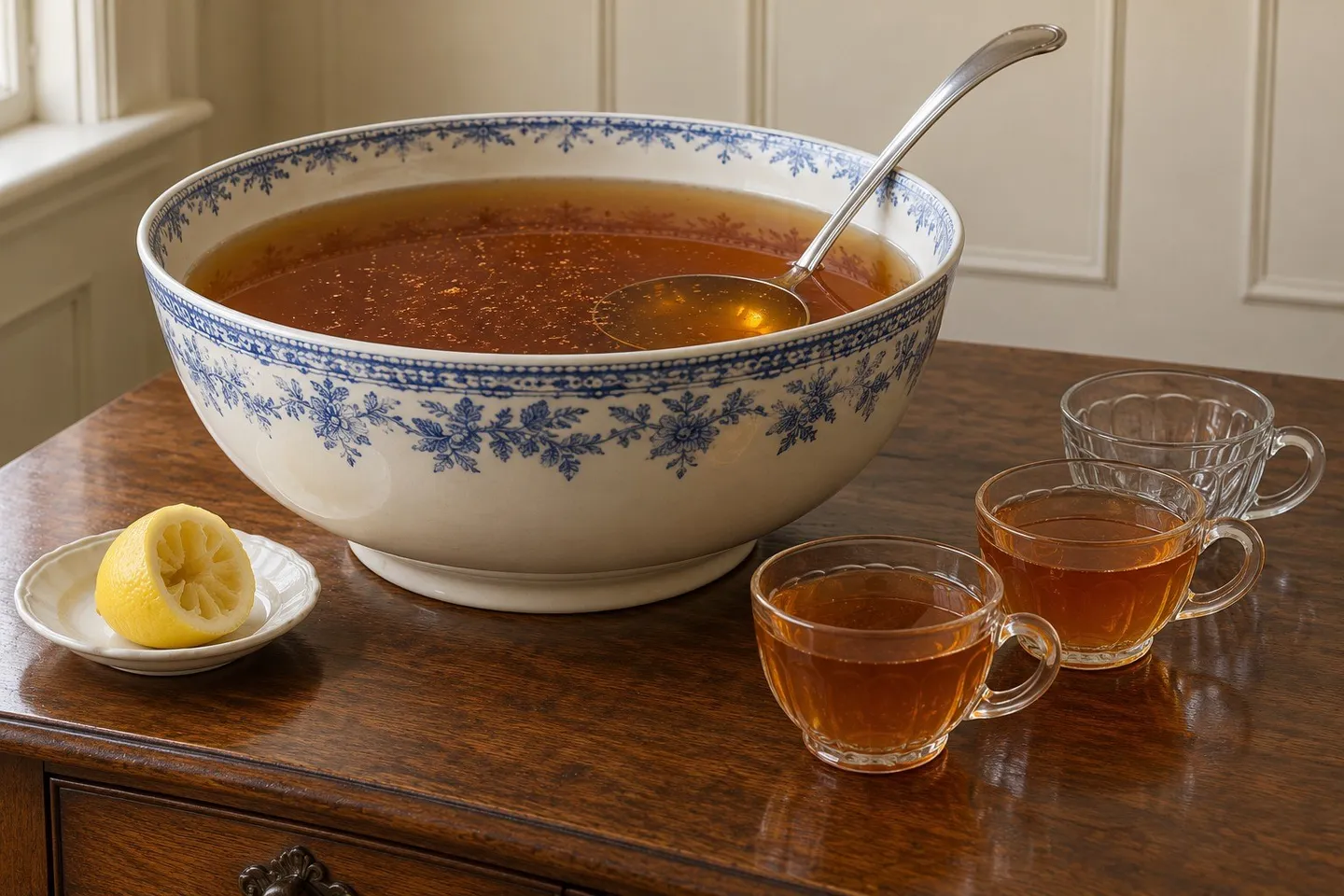
Hot rum and brandy punch in a blue-bordered china bowl with a silver ladle and small glass punch cups, beside half a squeezed lemon.
The story behind the recipe
Mrs. Beeton’s hot punch is equal parts rum and brandy poured into lemon-scented sugar, lemon juice and boiling water, with nutmeg grated over the top. She printed it in The Book of Household Management in 1861, at a time when, by her own account, the punchbowl was going out of fashion.
Already old-fashioned in 1861
Beeton wrote that punch had been “almost universally drunk among the middle classes about fifty or sixty years ago,” and that wine had since taken its place on the family table. She kept a recipe all the same, for the readers who still wanted a bowl, and set a small engraving of a punch-bowl and ladle beside it.
She also explained why punch had its reputation. “It is considered to be very intoxicating,” she wrote, “but this is probably because the spirit, being partly sheathed by the mucilaginous juice and the sugar, its strength does not appear to the taste so great as it really is.” Her serving size, a quart for four, came with a shrug in Latin: “this information must be taken cum grano salis.”
Read more about this recipe
Smaller cups than Beeton’s
Sugar rubbed on the lemon until it has “absorbed all the yellow part of the skin” carries the oil of the peel into the bowl without any bitter pith. Beeton only says rum; dark rum is our choice, and it gives a brown punch.
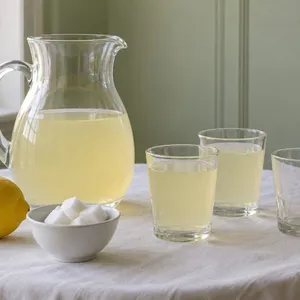
Her quart for four is about 284 ml each of a drink near 18% ABV, roughly five UK units a head. We suggest cups of 100 ml, which hold a little under 2 units, so the bowl serves about twelve. Her own lemonade, Mrs. Beeton’s Lemonade, starts with the same sugar rubbed on lemon peel and is a good alcohol-free jug to set beside it for anyone not drinking. Victorian Christmas Drinks, from Punch to Elder Wine puts this bowl among the other hot drinks of a Victorian Christmas.
½ pint of rum, ½ pint of brandy, ¼ lb. of sugar, 1 large lemon, ½ teaspoonful of nutmeg, 1 pint of boiling water.
Rub the sugar over the lemon until it has absorbed all the yellow part of the skin, then put the sugar into a punchbowl; add the lemon-juice (free from pips), and mix these two ingredients well together. Pour over them the boiling water, stir well together, add the rum, brandy, and nutmeg; mix thoroughly, and the punch will be ready to serve. It is very important in making good punch that all the ingredients are thoroughly incorporated; and, to insure success, the processes of mixing must be diligently attended to.

Recipe makes: About 1.25 liters, 12 small cups
Ingredients
For About 1.25 liters, 12 small cups. Quantities are shown as written.
Quantities as written here, for About 1.25 liters, 12 small cups.
- Sugar, as cubes or granulated113 g
- Large unwaxed lemon1
- Boiling water570 ml
- Dark rum285 ml
- Brandy285 ml
- Freshly grated nutmeg1/2 metric tsp (5 ml per tsp)
Measurement notes
Ingredients as written here
- 113 g sugar, as cubes or granulated
- 1 large unwaxed lemon
- 570 ml boiling water
- 285 ml dark rum
- 285 ml brandy
- 1/2 tsp freshly grated nutmeg
Equipment
 Kettle
 Fine grater
 Citrus juicer
 Tea strainer
 Punch bowl and ladle
 Small heatproof cups
Instructions
Put the kettle on. Warm the punch bowl by filling it with hot water from the tap, then empty and dry it.
If using cubes, rub them a few at a time hard over the skin of the unwaxed lemon until they turn pale yellow and smell of lemon, and drop them into the bowl with the rest of the sugar. If using granulated sugar, grate the lemon zest finely into the sugar in the bowl and work it in with a spoon.
Squeeze the lemon and pour the juice through a tea strainer into the bowl. Stir the juice into the sugar.
Pour in the boiling water and stir until the sugar has dissolved.
Add the dark rum, brandy and nutmeg, and stir thoroughly.
Ladle at once into small heatproof cups.
Nutrition
140calories per serving
- Recipe makes
- About 1.25 liters, 12 small cups
- Servings
- 12
Roughly estimated from USDA FoodData Central values for 80-proof distilled spirits, granulated sugar and lemon juice, for one of twelve 100 ml cups.
Recipe notes
When adjusting quantities
This is Beeton’s batch as printed. Keep rum and brandy equal, and the boiling water equal to the two spirits together, when you scale.
Notes
Quantities mentioned in these notes don’t change when you adjust the batch.
Beeton’s pints are British Imperial pints of about 568 ml: half a pint of each spirit is about 284 ml, rounded here to 285 ml, and a pint of boiling water to 570 ml. Her quarter pound of sugar is about 113 g, roughly 1/2 cup or 25 to 30 sugar cubes. Rubbing a handful of cubes on the lemon is enough to take up the oil; the rest can go in as they are.
The strength is our own arithmetic: about 227 ml of alcohol, assuming 40% spirits, in roughly 1.25 liters, or about 18% ABV before a little is lost to the heat. The NHS counts one UK unit as 10 ml of pure alcohol and advises not regularly drinking more than 14 units a week. A 100 ml cup is about 1.8 units.
Add the spirits off the heat and never set the punch alight. Hot spirits give off vapor that can catch fire, so keep the bowl away from candles and open flames, and keep it away from children.
Scaling changes the ingredients only; glassware, ice and timings need their own judgment. To adapt this recipe further, try the recipe tool at TuneMyRecipe (opens in a new tab), our sister site.
Sources and attribution
Isabella Beeton, The Book of Household Management (London: S. O. Beeton, 1861), “To Make Hot Punch”, recipe 1839, pp. 891–892
Recipe details
- Drink family
- Punches & Cups
- Region
- British
- Era
- 19th century
- Source decade
- 1860s
- Difficulty
- Easy
- Occasion
- Christmas
- Season
- Winter