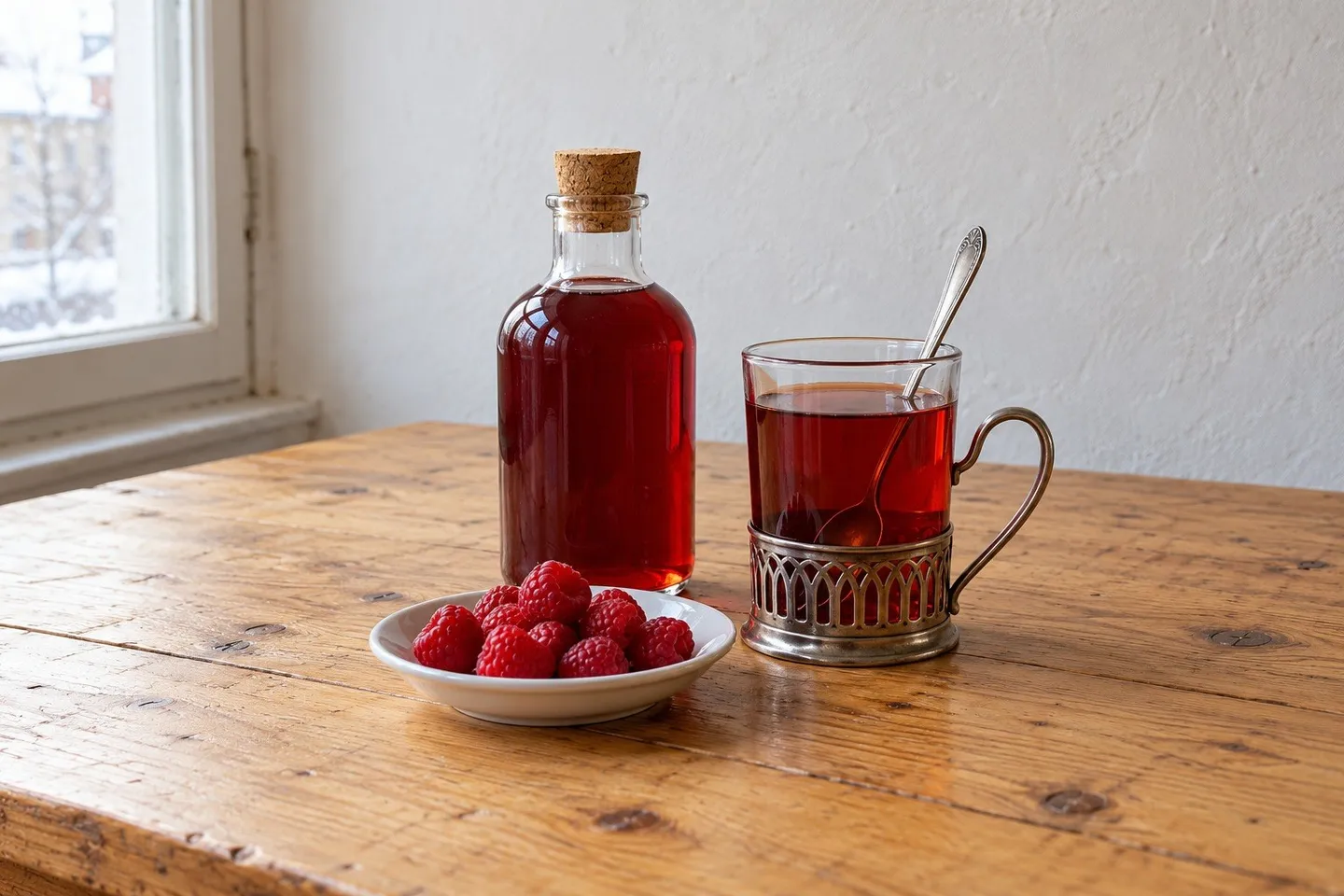
Sok Malinowy, Warsaw Raspberry Syrup from 1885
Reader ratingsRaspberries warmed in a pot standing in hot water until they give up their juice, then boiled with sugar into a bright syrup for cold water or hot tea: the sok malinowy of Lucyna Ćwierczakiewiczowa’s Warsaw household book of 1885.
- Recipe makes
- About 450 ml syrup, enough for about 15 glasses
- Prep
- Cook
- Total
About 2½ hours, most of it the raspberries standing warm for two hours. Each glass then takes a minute.
Raspberry syrup in a corked bottle, and a glass of tea sweetened with it in a metal holder.
The story behind the recipe
Sok malinowy is the raspberry syrup of the Polish kitchen, kept in a bottle and stirred into water, or into a glass of hot tea. Lucyna Ćwierczakiewiczowa, whose household book was in its eleventh edition in Warsaw by 1885, introduced it as a syrup “so loved for its scent and its many uses” that almost any way of making it was good, as long as the juice kept its aroma. Her first way does that gently: the raspberries are warmed in a pot standing in hot water until they give up their juice, and only the strained juice is boiled with sugar.
Raspberries without the press
She packs ripe raspberries into a glazed pot, pressing them down with a spoon, stands the pot in a pan of hot water and sets both on the fire. When the water boils hard she takes it off and leaves the pan in a warm place for two hours; by the time the water has cooled, “the raspberries will have given up all their juice.” The juice runs through a linen bag, and the syrup is boiled for twenty minutes, skimmed, and bottled cold.
Her book gives two more ways. A cheap one boils the fruit straight in a thick syrup. A third, used “usually in pharmacies,” lets the juice ferment first, and she warns that it loses a great deal of aroma and freshness. On the next page, a syrup made with raw fruit layered in sugar is so fragrant, she says, that when such a bottle is opened in winter “the whole room will be filled with the scent of raspberries.”
Read more about this recipe
Making it today
The same book’s Likier Malinowy is the raspberry with spirit; this is the raspberry without. Her syrup was very heavy, more than three times as much sugar as juice by weight, and we use about the same weight of sugar as juice, which keeps the color bright and stops it crystallizing but means it has to live in the fridge. Many Poles still stir a spoonful into hot tea in winter, and a glass of cold water takes it just as well. The country’s stronger drinks are in How Poland Made Vodka, and the English way of turning raspberries into a sour summer drink is Temperance Raspberry Vinegar.
Raspberry syrup. This syrup, so loved for its scent and its many uses, is made in various ways, and more or less every way is good, as long as the syrup keeps its aroma. First way. Put raspberries into a glazed pot, pressing them down hard with a spoon; set this pot in a kettle or a large saucepan of hot water and put them on the fire together; when the water boils hard, take it off the fire and set it in a warm place for two hours, together with the saucepan; when the water has cooled, the raspberries will have given up all their juice; pour it off, straining it through a linen bag, and for each kwaterka of juice take two funty of sugar chopped into small pieces, pour the juice over it, and when the sugar has dissolved, set it on the fire and boil as long as scum keeps forming, taking it off all the time with a skimming spoon, and taking the saucepan off the fire for 2 minutes each time it boils up; boil for 20 minutes from the first boil; take off the fire, pour into a tureen to cool, and pour it cold into bottles, stopping them with a cork. It is just as good to make a thick syrup first and only then pour the juice into it, skimming it as often as needed.

Recipe makes: About 450 ml syrup, enough for about 15 glasses
Ingredients
For About 450 ml syrup, enough for about 15 glasses. Quantities are shown as written.
Quantities as written here, for About 450 ml syrup, enough for about 15 glasses.
Raspberry syrup
- Ripe raspberries600 g
- White sugar, about300 g
For each glass
- Raspberry syrup2 metric tbsp (15 ml per tbsp)
- Cold water, or hot black tea200 ml
Measurement notes
Ingredients as written here
- 600 g ripe raspberries
- 300 g white sugar, about
- 2 tbsp raspberry syrup
- 200 ml cold water, or hot black tea
Equipment
 Heatproof bowl and a saucepan to stand it in
 Jelly bag or sieve lined with muslin
 Measuring jug
 Medium saucepan
 Clean glass bottle or jar for the syrup
 Tumbler
Instructions
Put the ripe raspberries in the heatproof bowl and press them down firmly with a spoon. Stand the bowl in the saucepan and pour hot water into the saucepan to come halfway up the bowl.
Set the saucepan over the heat. When the water is boiling hard, take the pan off the heat and leave it, bowl and all, in a warm place for 2 hours.
Pour the raspberries and their juice into the jelly bag and let the juice run through into the measuring jug. Don’t squeeze the bag, or the syrup will be cloudy.
Measure the juice and weigh out the same number of grams of white sugar as there are milliliters of juice.
Put the sugar and the juice in the medium saucepan and stir over a low heat until the sugar has dissolved. Bring it to the boil and let it bubble gently for 5 minutes, skimming off the froth as it rises.
Pour it into a jug and let it cool completely, then pour it into the clean bottle, close it and keep it in the fridge.
For each glass, stir the raspberry syrup into the cold water, or into a glass of hot black tea.
Nutrition
80calories per serving
- Recipe makes
- About 450 ml syrup, enough for about 15 glasses
- Servings
- 15
Roughly estimated from USDA FoodData Central values for raspberries and granulated sugar, for one glass made with 2 tablespoons of syrup.
Recipe notes
When adjusting quantities
A small batch. The sugar follows the juice: about 1 g of sugar for each ml. The glass ingredients are for one drink.
Notes
Quantities mentioned in these notes don’t change when you adjust the batch.
Measures: Warsaw cooks of the time used the “new Polish” measures introduced in 1819, in which a kwaterka is about 250 ml and a funt about 405 g. Period sizes varied, so treat these as rough guides.
Changes from the source: her two funty of sugar to a kwaterka of juice come to about 810 g of sugar for 250 ml, far more sugar than the juice can easily hold. We use about 1 g of sugar for each ml of juice and boil it for 5 minutes rather than 20, which gives a lighter syrup that must be kept cold. A heatproof bowl stands in for her glazed pot, and a jelly bag for her linen bag. Serving it in hot tea is today’s habit; her recipe doesn’t say how to drink it.
Storage
Keep the syrup in a clean, closed bottle in the fridge, or freeze it. Throw it out if it turns moldy or starts to ferment.
Scaling changes the ingredients only; glassware, ice and timings need their own judgment. To adapt this recipe further, try the recipe tool at TuneMyRecipe (opens in a new tab), our sister site.
Sources and attribution
Lucyna Ćwierczakiewiczowa, Jedyne praktyczne przepisy konfitur, różnych marynat, wędlin, wódek, likierów, win owocowych, miodów oraz ciast, 11th ed. (Warsaw: the author, 1885), No. 4, “Sok malinowy”, pp. 120–121; our translation
Recipe details
- Drink
- Alcohol-free
- Drink family
- Shrubs, Syrups & Cordials
- Region
- Polish
- Era
- 19th century
- Source decade
- 1880s
- Base
- Fruit & juice
- Difficulty
- Easy
- Occasion
- Christmas
- Season
- Winter