Sweet Iced Tea, the 1876 Buckeye Way
Reader ratingsGreen and black tea made strong and sweet in the morning, chilled in a stone jug and drunk from goblets over broken ice: the earliest printed iced tea yet traced, from Ohio in 1876.
- Recipe makes
- About 1 liter, 4 goblets
- Prep
- Cook
- Total
Includes about 1 hour for the tea to cool and 2 hours in the fridge. Make it in the morning for the afternoon, as the 1876 book did.
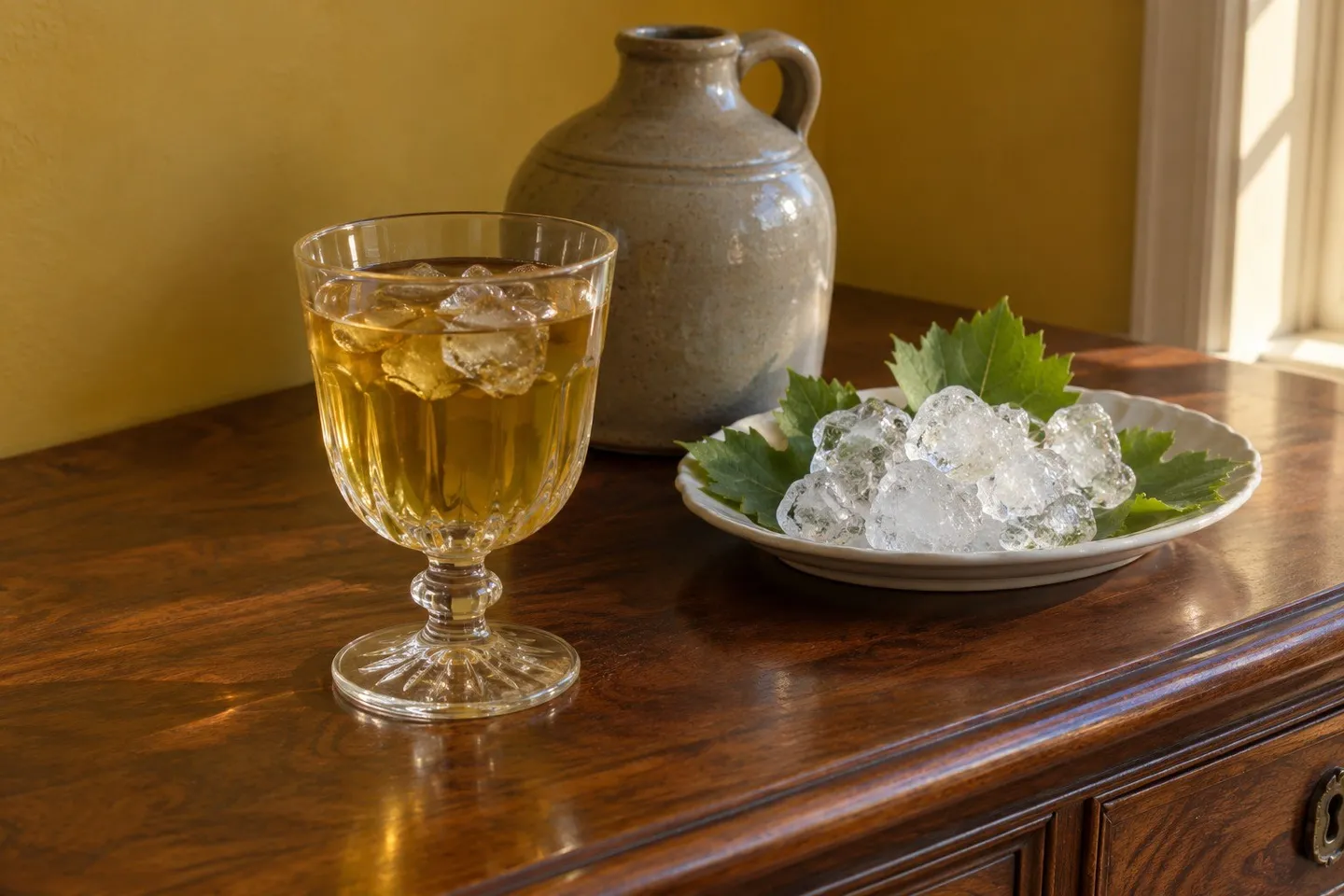
Sweet iced tea with broken ice in a stemmed pressed-glass goblet, with a stoneware jug and cracked ice on grape leaves.
The story behind the recipe
A church cookbook from Marysville, Ohio, sugared its iced tea in the jug in 1876, before the tea ever met ice, and no earlier printed recipe has turned up. The Centennial Buckeye Cook Book, put together by the women of the First Congregational Church, says to make the tea in the morning, “stronger and sweeter than usual,” and keep it in the ice chest in “a nice clean stone jug or glass bottle.” It came to the table in goblets, “without cream,” with broken ice on a platter beside it, dressed with grape leaves.
Ohio before Virginia
The recipe usually called the first is Marion Cabell Tyree’s, from Housekeeping in Old Virginia. Its copyright line reads 1877, the title page of the Library of Congress copy 1878, and most copies are dated 1879, so Ohio came first on any of those dates. Tyree sugared each goblet, not the jug, and left her green tea on the leaves all day. The recipe is signed “Mrs. S. T.,” very probably the editor herself, and ends with a remedy for that long steep: “A squeeze of lemon will make this delicious and healthful, as it will correct the astringent tendency.”
Iced tea was already familiar. A Raleigh housekeeping book of 1871 warns against cold tea, “unless persons desire iced tea,—then it should be well iced.” Neither early recipe says sweet tea; the sugar simply belonged in it. The 1904 St. Louis World’s Fair, often handed the credit for iced tea, came twenty-eight years later. How ice shipped from New England ponds made the habit possible is in How America Learned to Drink Its Tea Cold.
Read more about this recipe
Stronger and sweeter, in numbers
The Buckeye book gives no amounts, so our amounts read its comparisons, stronger and sweeter. Tyree’s two teaspoons of green tea to a quart come to about 5 grams a liter, but that tea stands all day; for a brew of four minutes we double it, about 10 grams of tea to the liter, half green and half black, because the book calls mixing the two “an improvement.” Green tea turns bitter on long steeping, so the brew stays short. Tyree’s two teaspoons of sugar a goblet come to about 40 grams a liter; “sweeter than usual” gets 70 here, our choice. A 1996 CDC advisory, as Food Safety News reports it, says brewed iced tea should be held no more than eight hours, so keep the jug cold and drink it the same day.
In 1878 a London coffee-tavern manual left its tea to stand exactly ten minutes, to be served hot. Two centuries before Ohio, the Jesuit Alexander of Rhodes, quoted in How Were Coffee, Tea and Chocolate Made in 1685?, wanted tea drunk hot, “for if it should cool it would be good for nothing.”
ICED TEA. Prepare tea in the morning, making stronger and sweeter than usual; strain and pour into a nice clean stone jug or glass bottle, set aside in the ice chest until ready to use. Drink from goblets without cream. Serve ice broken in small pieces on a platter nicely garnished with well washed grape leaves. Iced tea may be prepared from either green or black alone, but it is considered an improvement to mix the two.

Recipe makes: About 1 liter, 4 goblets
Ingredients
For About 1 liter, 4 goblets. Quantities are shown as written.
Quantities as written here, for About 1 liter, 4 goblets.
- Loose green tea5 g
- Loose black tea5 g
- Water1000 ml
- Sugar70 g
- Cracked ice, to serve
- Grape leaves, well washed (optional)4
- Lemon, cut in wedges (optional)1
Measurement notes
Ingredients as written here
- 5 g loose green tea
- 5 g loose black tea
- 1000 ml water
- 70 g sugar
- cracked ice, to serve
- 4 grape leaves, well washed (optional)
- 1 lemon, cut in wedges (optional)
Equipment
 Kitchen scale
 Kettle
 Teapot or heatproof jug
 Timer
 Tea strainer
 Large jug or bottle with a lid, for the fridge
Instructions
Warm a teapot or heatproof jug with hot water and pour the water away. Put in the loose green tea and loose black tea.
Bring the water to the boil, let it stand for 1 minute, then pour it over the leaves. Steep for 4 minutes.
Strain the tea through a tea strainer into a large jug or bottle, leaving the leaves behind. Stir in the sugar until it has dissolved.
Leave the tea to cool to room temperature, about 1 hour, then cover it and chill it in the fridge for at least 2 hours.
To serve, lay the grape leaves on a platter and pile the cracked ice on them. Put a few pieces of ice in each goblet or tall glass and pour the cold tea over, without milk or cream. Pass the lemon wedges for anyone who wants Tyree’s squeeze.
Nutrition
70calories per serving
- Recipe makes
- About 1 liter, 4 goblets
- Servings
- 4
Estimated from USDA FoodData Central values for brewed tea and granulated sugar, for one of four goblets.
Recipe notes
When adjusting quantities
Keep about 10 g of tea and 70 g of sugar to every liter of water when you scale.
Notes
Quantities mentioned in these notes don’t change when you adjust the batch.
The book allows green or black tea alone. For black alone, use 10 g; for green alone, the same weight, steeped no longer than 4 minutes.
Tyree’s version (Virginia, 1878): steep 2 teaspoons of green tea in a quart (950 ml) of water, strain and chill, then put 2 teaspoons (8 g) of granulated sugar in each ice-filled goblet and pour the tea over. Stir well, as sugar dissolves slowly in cold tea. We steep it for 4 to 5 minutes, not from breakfast to dinner: a day on the leaves at room temperature is longer than brewed tea should stand.
The grape leaves are only a garnish for the ice platter.
Storage
Keep the tea covered in the fridge and drink it the day it is made.
Scaling changes the ingredients only; glassware, ice and timings need their own judgment. To adapt this recipe further, try the recipe tool at TuneMyRecipe (opens in a new tab), our sister site.
Sources and attribution
[Women of the First Congregational Church, Marysville, Ohio], Centennial Buckeye Cook Book (Marysville, Ohio: J. H. Shearer & Son, 1876), p. 164; Marion Cabell Tyree, ed., Housekeeping in Old Virginia (Louisville: John P. Morton & Co., 1878), p. 64
Recipe details
- Drink
- Alcohol-free
- Drink family
- Sodas & Soft Drinks
- Region
- American
- Era
- 19th century
- Source decade
- 1870s
- Difficulty
- Easy
- Occasion
- Summer party
- Season
- Summer