How America Learned to Drink Its Tea Cold
Iced tea was an ordinary American drink by the late 1860s, in print from 1876, and decades older than the 1904 World’s Fair story. Ice came first.
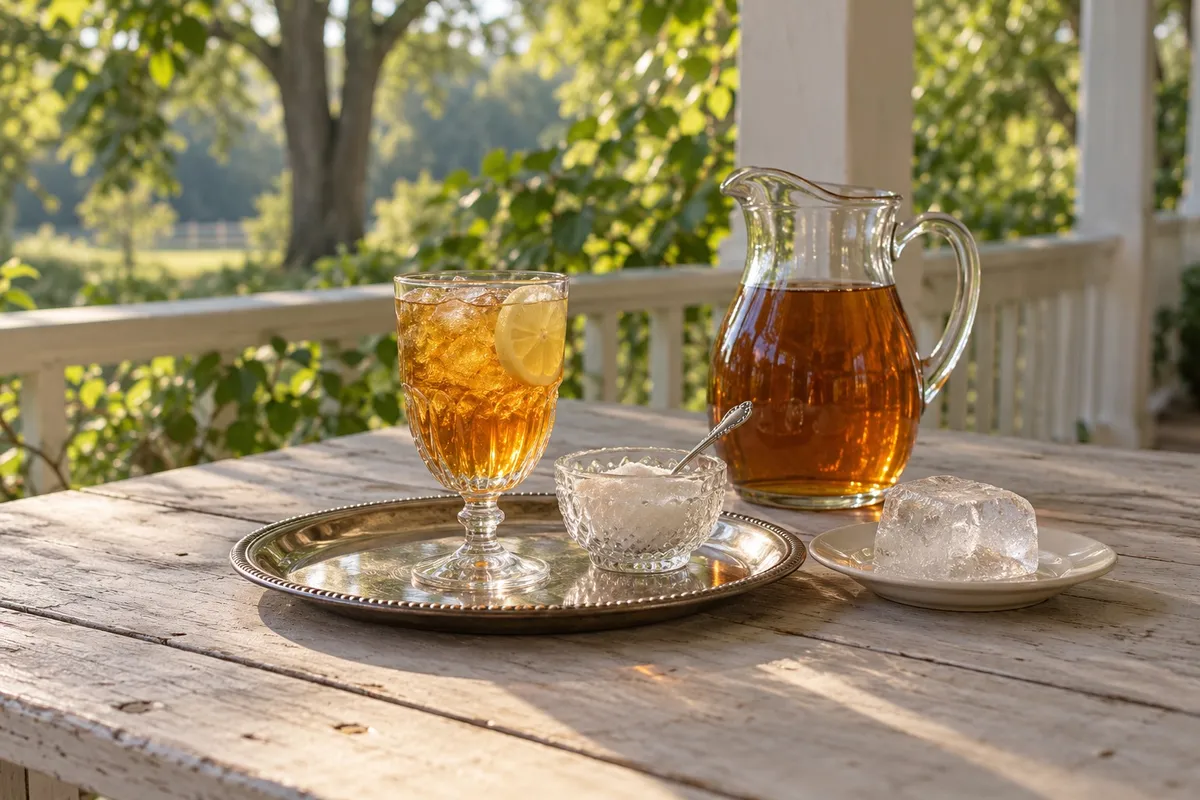
Americans were drinking their tea iced by the late 1860s, and they sweetened it as a matter of course. A Southern novelist could put “a goblet of iced tea” on a supper tray in 1869 without explaining it, and the first printed recipe we have found came from an Ohio church cookbook in 1876. What made the habit possible was not tea but ice, cut from New England ponds and shipped south from about 1820. The story that iced tea was invented at the St. Louis World’s Fair of 1904 came long after all of this.
Ice for the South
Henry David Thoreau watched a crew of a hundred men cut ice on Walden Pond in the winter of 1846–47, and in Walden (1854) he followed it out of New England: “Thus it appears that the sweltering inhabitants of Charleston and New Orleans, of Madras and Bombay and Calcutta, drink at my well.”
The trade was already old by then. The historian Samuel Eliot Morison, writing from the Boston ice merchant Frederic Tudor’s letter-books in 1921, dates Tudor’s first cargo to Martinique in 1805, and says that “between 1817 and 1820 he extended the business to Charleston, Savannah, and New Orleans.” Selling the ice was only half the work. “No one in Southern ports knew how to store ice during hot weather,” Morison writes, so Tudor shipped the materials for ice-houses and the men to build them. In 1834 he was selling ice in Charleston at 1¼ cents a pound, roughly 40 cents in today’s money by US consumer prices.
By the 1870s ice was part of the daily routine in a comfortable Virginia kitchen. Marion Cabell Tyree’s Housekeeping in Old Virginia (1878) tells readers to wash the refrigerator every morning and air it “before filling with ice for the day.” Not every house had one. Later, in its chapter on meats, the same book tells anyone without an ice-house to keep meat in a cool cellar, wrapped in wet cloths.
A goblet on the tray
Iced tea turns up first as something people already drank. In Augusta J. Evans’s novel Vashti (1869), a character named Elsie comes in with a tray holding “a silver epergne filled with fruit, a basket of cake, and a goblet of iced tea.” Two years later a Raleigh housekeeping book warned against cold tea, “unless persons desire iced tea,—then it should be well iced.”
The earliest recipe we have found is in the Centennial Buckeye Cook Book, put together by the women of the First Congregational Church in Marysville, Ohio, in 1876. It tells the cook to make the tea in the morning, “stronger and sweeter than usual,” keep it in a stone jug or glass bottle in the ice chest, and “Drink from goblets without cream.” That is our Sweet Iced Tea the 1876 Buckeye Way.
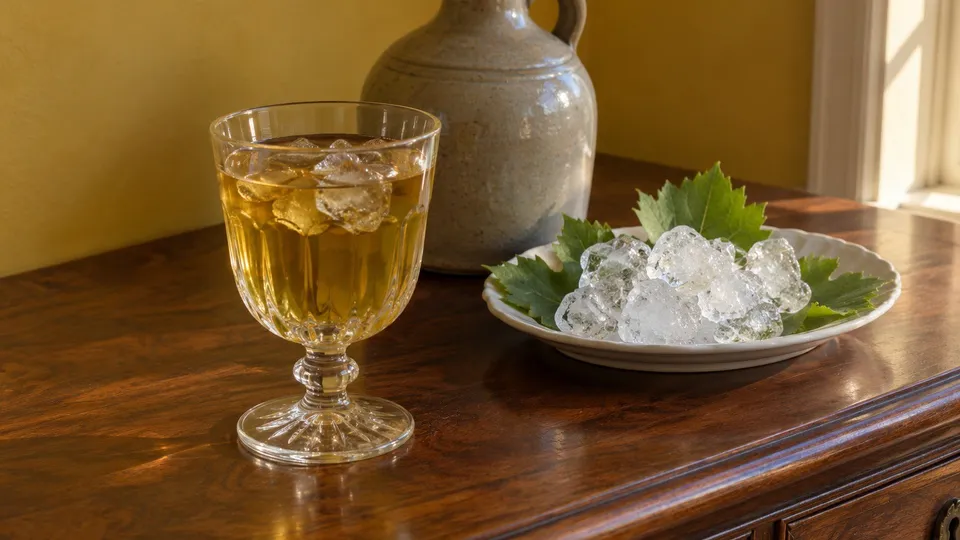 Always alcohol-freeSweet Iced Tea, the 1876 Buckeye Way
Tyree’s Virginia recipe, the one usually called the first, came two years later. It steeps green tea from breakfast to dinner, fills the goblets with ice, and puts “two teaspoonfuls granulated sugar in each” before the tea goes in. Its “squeeze of lemon,” the recipe says, “will correct the astringent tendency.” Both books serve iced tea in goblets, not tall glasses.
Sweetened while hot
The two early recipes sweeten in different places: Ohio sugared the whole jug, Virginia each goblet. The method many Southern families use now, sugar stirred into the hot tea and the whole batch left to cool, is in print in Nashville in 1914. Mrs. Wilson’s Cook Book says simply: “In making ice tea, sweeten while hot.”
None of these books calls it sweet tea. They call it iced tea and sweeten it because that was how it was drunk. The Ohio recipe also shows that the first printed sweetened iced tea we know of is not Southern at all. What the Southern books record is the habit growing up around it, from the goblets of Virginia to the big batches of Tennessee.
By 1935 the tea trade’s own encyclopedia, William H. Ukers’s All About Tea, could treat it as a national drink: “Iced tea, drunk in tall glasses, without milk or cream, is popular as a summertime drink in America.”
Russian tea, from lemon to cloves
Tea with lemon came into American cookbooks under a Russian name. Russians did drink iced tea: J. G. Kohl reported in 1844 that in Russian towns in summer “even iced tea is drunk in immense quantities.” In Boston, Mrs. Lincoln’s cookbook of 1883 heads a recipe “Iced Tea, or Russian Tea,” a glass of cold tea over broken ice with block sugar and a slice of lemon. In 1896 Fannie Farmer served Russian tea “hot or cold, but always without milk.”
The spice came later, a clove at a time. In December 1914 a syndicated hostess column in a Daytona, Florida, paper made Russian tea with lemon and added that “some prefer the addition of three whole cloves.” The same year Mrs. Wilson’s Nashville book still meant a plain slice of lemon in a cup of sweetened tea. By Christmas 1917 the column’s line had become “Many prefer the addition of three whole cloves,” and that month a Raleigh church cookbook, Sweets and Meats, printed a Russian tea of strong tea, orange and lemon juice and a bag of cloves and cinnamon simmered in the pot. That is our Russian Tea, Lemon Tea to Spiced Orange. By 1935 Ukers’s recipe for American iced tea notes that “Sometimes cloves, grated orange peel, and sprigs of mint are added to the brew in the making.”
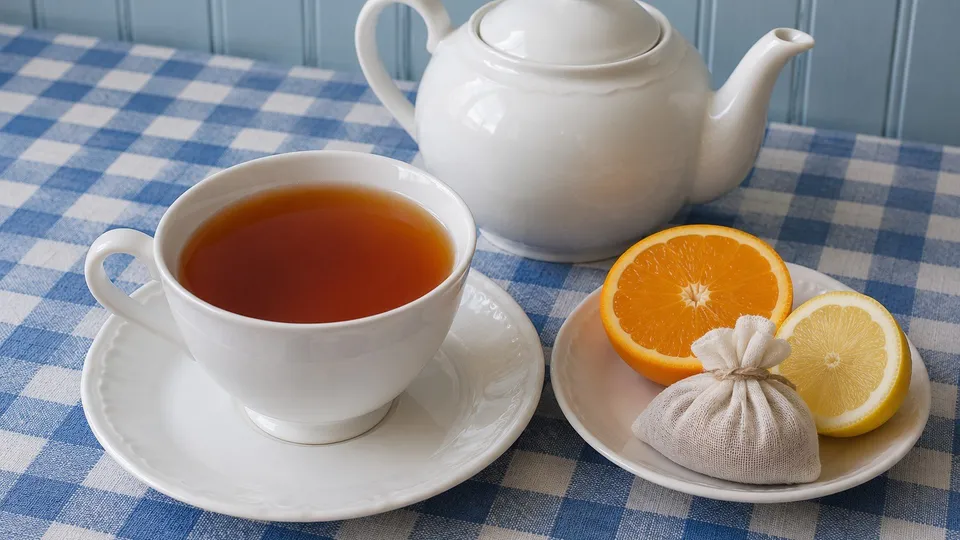 Always alcohol-freeRussian Tea, Spiced with Orange and Cloves
The 1904 story
The usual story says Richard Blechynden, who ran the India tea pavilion at the 1904 St. Louis World’s Fair, poured his hot tea over ice on a hot day and invented iced tea. Every recipe above is older than the Fair, the Ohio one by twenty-eight years. Ukers tells Blechynden’s career in some detail, including his work at St. Louis, and nowhere in either volume credits him with iced tea. At most the Fair made a known drink better known.
Tea had come a long way from the cup of 1685, when a London handbook still had to explain how to make it hot, as How Were Coffee, Tea and Chocolate Made in 1685? shows. For a cold party bowl in the same spirit, the alcohol-free tea punch keeps the green tea, lemon and sugar of an 1862 bar recipe and leaves out the spirits.
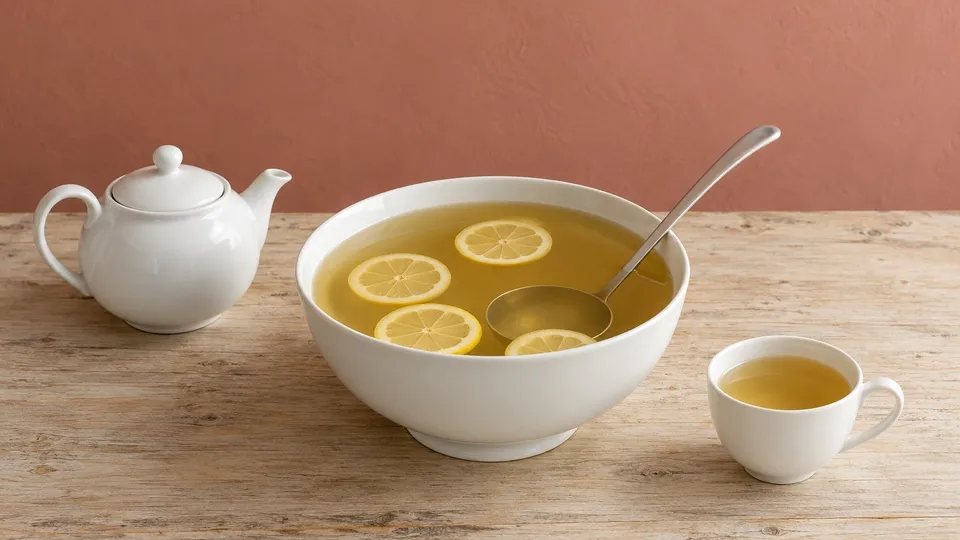 Alcohol-free versionAlcohol-Free Tea Punch, Green Tea, Lemon and Sugar
Start with the Ohio jug: brew the Buckeye iced tea in the morning, stronger and sweeter than you would drink it hot, and by the afternoon it is cold enough to pour over broken ice, the way the cookbook says.
Sources
- Henry D. Thoreau, Walden; or, Life in the Woods (Boston: Ticknor and Fields, 1854), p. 318.
- Samuel Eliot Morison, The Maritime History of Massachusetts, 1783–1860 (Boston: Houghton Mifflin, 1921), pp. 280–281.
- Augusta J. Evans, Vashti; or, “Until Death Us Do Part” (New York: Carleton, 1869), p. 85.
- Mrs. Mary Mason, The Young Housewife’s Counsellor and Friend (Philadelphia: J. B. Lippincott, 1871), p. 127.
- [Women of the First Congregational Church, Marysville, Ohio], Centennial Buckeye Cook Book (Marysville, Ohio: J. H. Shearer & Son, 1876), p. 164.
- Marion Cabell Tyree (ed.), Housekeeping in Old Virginia (Louisville: John P. Morton & Co., 1878), pp. 64, 67–68, 115.
- J. G. Kohl, Russia (London: Chapman and Hall, 1844), p. 16.
- Mrs. D. A. Lincoln, Mrs. Lincoln’s Boston Cook Book (Boston: Roberts Brothers, 1883), p. 112.
- Fannie Merritt Farmer, The Boston Cooking-School Cook Book (Boston: Little, Brown, 1896), p. 38.
- “The New Year’s Hostess,” The Daytona Daily News (Daytona, Fla.), December 28, 1914, p. 7.
- “Christmas Dainties,” The Port Gibson Reveille (Port Gibson, Miss.), December 13, 1917, p. 6.
- Mrs. W. H. Wilson, Mrs. Wilson’s Cook Book (Nashville: Foster & Parkes, 1914), p. 144.
- [Woman’s Missionary Society, Pullen Memorial Baptist Church], Sweets and Meats and Other Good Things to Eat (Raleigh, N.C., 1917), “Ices and Drinks.”
- William H. Ukers, All About Tea (New York: Tea and Coffee Trade Journal, 1935), vol. 1, p. 242; vol. 2, p. 456.