Russian Tea, Spiced with Orange and Cloves
Reader ratingsStrong black tea simmered with a bag of cloves and cinnamon, then sweetened and sharpened with orange and lemon juice: Russian tea from a 1917 Raleigh church cookbook.
- Recipe makes
- About 4 1/2 cups, 6 teacups
- Prep
- Cook
- Total
Includes 5 minutes for the tea to steep and 10 minutes for the spice bag to simmer in it.
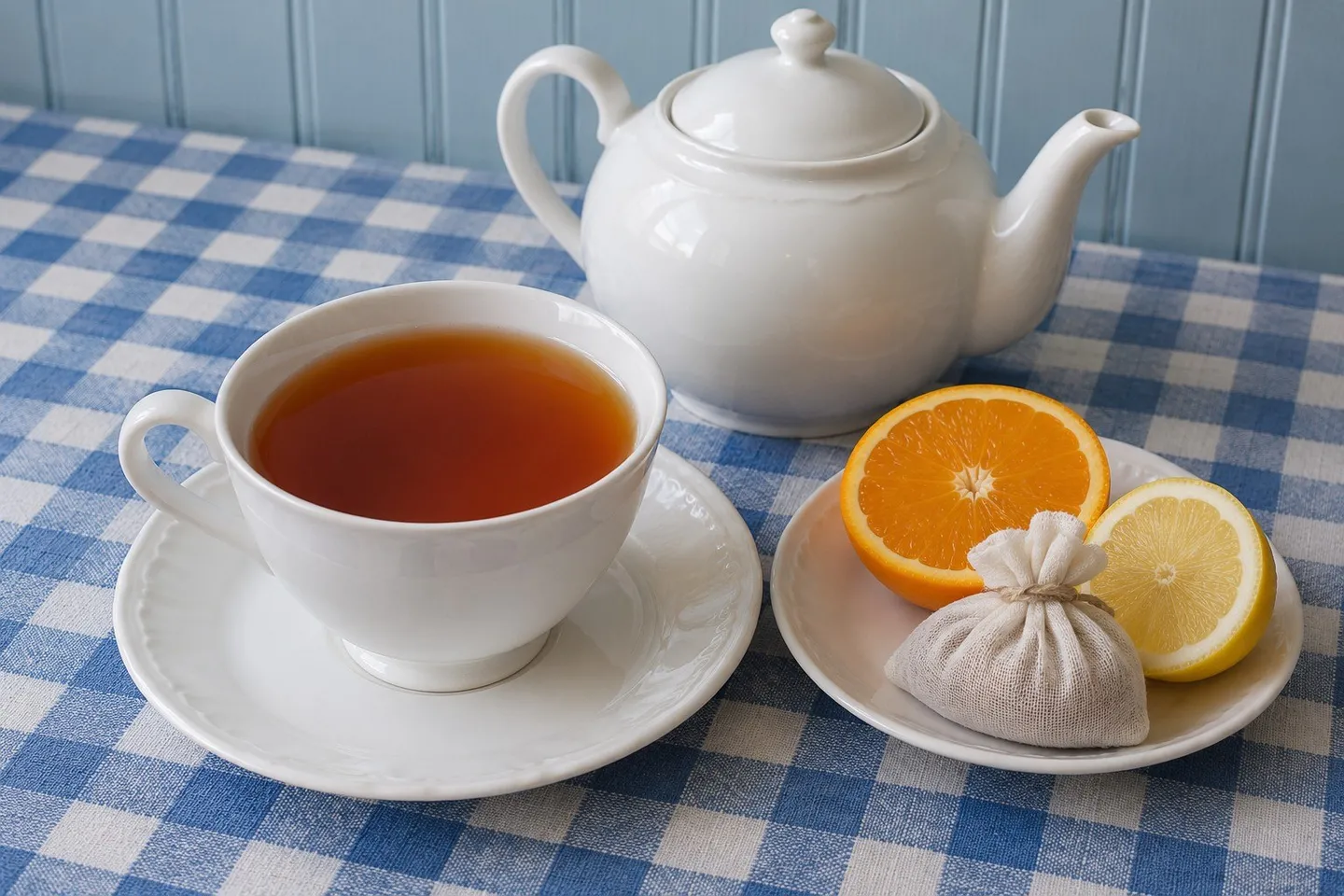
Russian tea in a white china teacup, with the teapot, half an orange, half a lemon and a tied muslin spice bag.
The story behind the recipe
Only the name and the lemon in this Russian tea are Russian. Hot black tea simmered with cloves and cinnamon and finished with orange and lemon juice is a Southern church-supper drink, and the oldest printed recipe for it so far comes from Raleigh, North Carolina, in 1917. It is in Sweets and Meats and Other Good Things to Eat, a fundraising book of Pullen Memorial Baptist Church, signed by Mrs. Mollie Neal: sixteen cups of strong tea, which she specified as Lipton’s, two teacups of sugar, and half a “5c package” each of cloves and cinnamon. A nickel then is about $1.30 in today’s money, by US consumer prices.
Lemon, and no milk
Before the spices, Russian tea in American cookbooks was tea with lemon and without milk. Mrs. Lincoln’s Boston Cook Book (copyright 1883) heads one recipe “Iced Tea, or Russian Tea,” built from block sugar, broken ice, a lemon slice and cold tea. Fannie Farmer’s Boston Cooking-School Cook Book (1896) serves it “hot or cold, but always without milk,” a thin slice of lemon to each cup, and adds: “We imitate our Russian friends by garnishing with a candied cherry.”
Russians did drink their tea with lemon. A Russian birth for the orange-and-clove version is legend, though: the period accounts of tea in Russia mention lemon, even a preserved strawberry, but not cloves and orange juice, and the name followed the lemon. The road from Mrs. Lincoln’s iced glass to the spiced Raleigh pot is part of How America Learned to Drink Its Tea Cold. The spiced drink turns up in Southern church cookbooks by the 1940s, and some community cookbooks printed instant versions by the late 1960s, stirred together from powdered orange drink, instant tea and ground spices.
Read more about this recipe
A quarter of Mrs. Neal’s pot
Sixteen cups suits a church hall, so this version is a quarter of it. Her spices were bought by the nickel’s worth, and what a nickel package of cloves or cinnamon weighed in 1917 is not recorded; half a teaspoon of whole cloves and half a stick of cinnamon is our estimate, and whole spices fit her instruction to tie them in a bag. A teacup of sugar we take as three-quarters of a US cup, which makes the tea sweet, about 75 grams to the liter. She simmered the bag “in tea before serving,” so it is drunk hot.
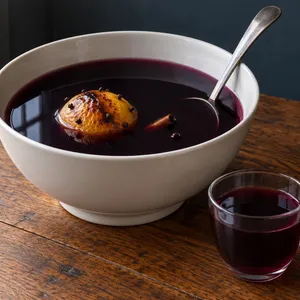
Cloves and hot citrus are older than the name. Oxford’s 1847 recipe for Bishop roasted a clove-studded lemon for its hot port, and the alcohol-free bishop does the same with grape juice.
Russian Tea.—Sixteen cups strong tea (Lipton’s). juice of 2 oranges, juice of 3 lemons, ... Mrs. Mollie Neal.

Recipe makes: About 4 1/2 cups, 6 teacups
Ingredients
For About 4 1/2 cups, 6 teacups. Quantities are shown as written.
Quantities as written here, for About 4 1/2 cups, 6 teacups.
- Water4 cups
- Black tea bags4
- Whole cloves1/2 tsp
- Cinnamon stick1/2
- Sugar6 tbsp
- Fresh orange juice3 tbsp
- Fresh lemon juice2 1/2 tbsp
Measurement notes
Ingredients as written here
- 4 cups water
- 4 black tea bags
- 1/2 tsp whole cloves
- 1/2 cinnamon stick
- 6 tbsp sugar
- 3 tbsp fresh orange juice
- 2 1/2 tbsp fresh lemon juice
Equipment
 Small saucepan with a lid
 Muslin or cheesecloth and kitchen string
 Citrus juicer
 Tea strainer
 Ladle and heatproof cups
Instructions
Bring the water to the boil in a small saucepan, take it off the heat and add the black tea bags. Cover and steep for 5 minutes, then lift out the bags.
Tie the whole cloves and cinnamon stick in a small square of muslin with kitchen string.
Put the spice bag in the tea, cover the pan and simmer very gently over low heat for 10 minutes. Lift out the bag.
Stir in the sugar until it has dissolved, then the fresh orange juice and fresh lemon juice. Pour through a tea strainer if any pulp has gone in.
Ladle into teacups or heatproof cups and serve hot.
Nutrition
55calories per serving
- Recipe makes
- About 4 1/2 cups, 6 teacups
- Servings
- 6
Estimated from USDA FoodData Central values for brewed black tea, granulated sugar, orange juice and lemon juice, for one of six teacups.
Recipe notes
When adjusting quantities
This is a quarter of the 1917 batch. Multiply everything by four for Mrs. Neal’s sixteen cups, about 20 to 25 teacups.
Notes
Quantities mentioned in these notes don’t change when you adjust the batch.
The older Russian tea needs no spices. Fannie Farmer’s of 1896: steep 3 teaspoons of tea (black, for this) in 2 cups of boiling water for 5 minutes, strain, and add a thin seeded slice of lemon and sugar to taste to each cup, with no milk; garnish with a candied cherry, or, as she says was done in Russia, a preserved strawberry. For Mrs. Lincoln’s iced version, put two sugar cubes in a glass, half fill it with broken ice, add a slice of lemon and fill with cold tea.
For a party, the USDA Food Safety and Inspection Service’s rule applies: keep the tea hot, at 140°F (60°C) or above, over low heat, or cool it and refrigerate it within 2 hours, then reheat it to serve.
Mrs. Neal’s full batch, for a crowd: 16 cups of strong tea, the juice of 2 oranges and 3 lemons, about 2 tsp whole cloves and 2 cinnamon sticks in a bag, and 2 teacups (about 1 1/2 US cups) of sugar.
Scaling changes the ingredients only; glassware, ice and timings need their own judgment. To adapt this recipe further, try the recipe tool at TuneMyRecipe (opens in a new tab), our sister site.
Sources and attribution
[Womans Missionary Society, Pullen Memorial Baptist Church], Sweets and Meats and Other Good Things to Eat (Raleigh, N.C., 1917), Ices and Drinks, recipe signed Mrs. Mollie Neal
Recipe details
- Drink
- Alcohol-free
- Drink family
- Hot Drinks
- Region
- American
- Source decade
- 1910s
- Difficulty
- Easy
- Season
- Winter