Stewed Vinegar, a Warm Honey and Ginger Drink from 1839
Reader ratingsVinegar thinned with water, seasoned highly with butter, honey and ginger and boiled a few minutes in a covered pan, taken warm by the teacup at bedtime: Lettice Bryan’s 1839 cold remedy.
- Recipe makes
- About 500 ml, 4 teacups of 120 ml
- Prep
- Cook
- Total
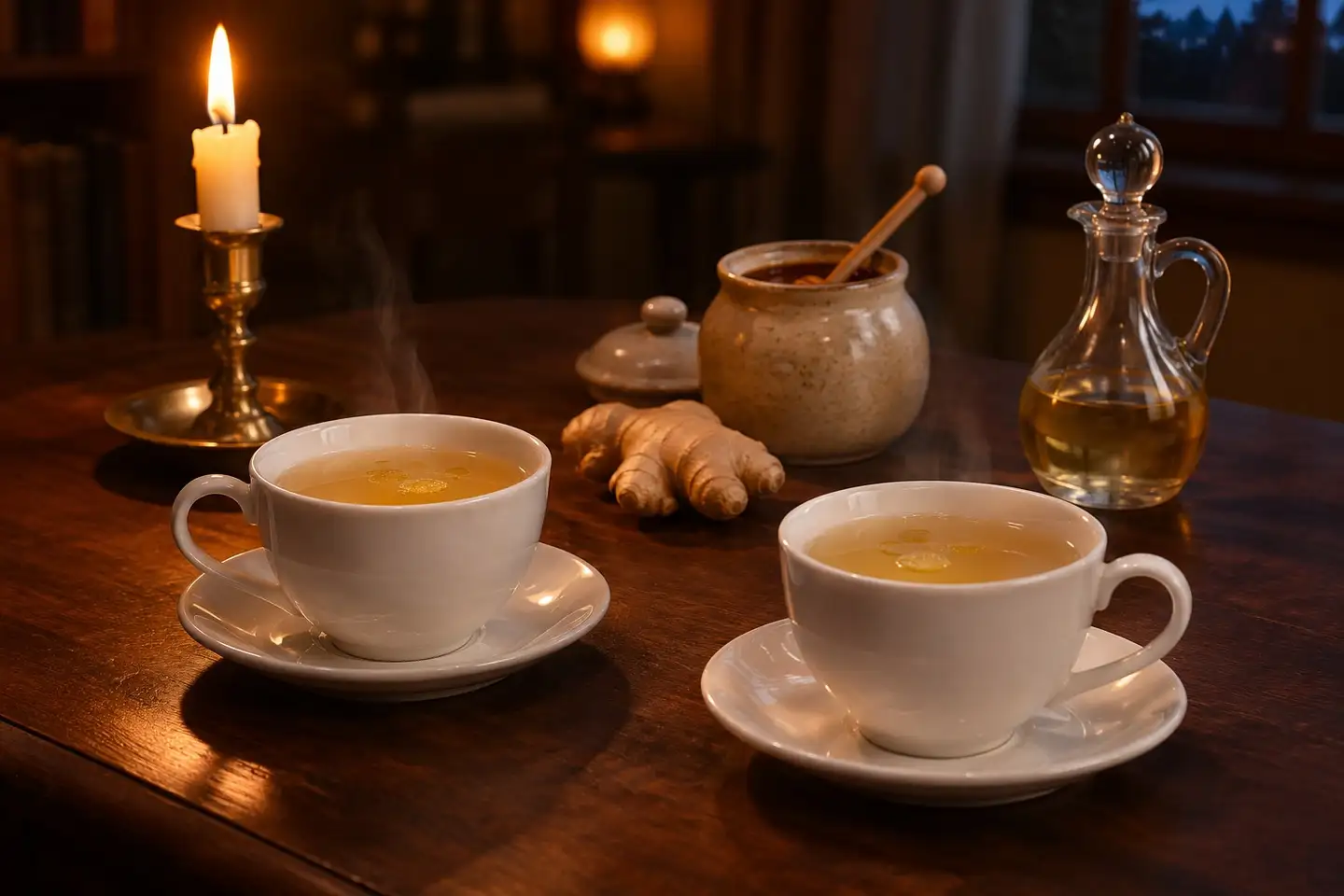
Stewed vinegar in two china cups by candlelight, with ginger, honey and a vinegar cruet.
The story behind the recipe
Stewed vinegar is a warm, sweet-sour drink of vinegar, water, honey and ginger with a knob of butter melted in. Lettice Bryan printed it in The Kentucky Housewife in 1839, and her instruction is short: dilute good vinegar “to the strength you like it with water, season it highly with butter, honey and ginger, and boil it for a few minutes in a covered vessel.” The dose was “a tea-cupful of it warm on going to bed.”
A remedy, in her words
Bryan put it forward as medicine: “It is a good remedy for a bad cold or sore throat.” That is her claim, and we pass it on as hers. Honey and vinegar were an old pair by then. Pliny wrote down oxymel, a Roman syrup of honey, vinegar and salt, and Bryan’s own book calls a sweetened fruit vinegar for iced water a “shrub.” Her stewed vinegar is the warm, plain one, with no fruit, and the butter is the odd touch: it melts and floats in a thin layer on top.
There is no yeast in it, no wine and no spirit, and nothing is left to ferment, so it is a drink without alcohol. The only alcohol it could carry is the trace that any vinegar keeps from its own making.
Read more about this recipe
Making it today
Bryan leaves every amount to the cook, so ours are a starting point: one part cider vinegar to about fifteen of water, which by our arithmetic leaves it only gently sharp, about a third of a percent of acid, with honey to round it off. We strain out the ginger before serving and whisk the butter back in, since it floats. Adjust the vinegar and honey to your taste, as she says. The two drinks that share the name shrub, the brandy cordial and the fruit vinegar Bryan wrote down, are in Shrub: One Name, Two Very Different Drinks.
STEWED VINEGAR.
Take some good vinegar, dilute it to the strength you like it with water, season it highly with butter, honey and ginger, and boil it for a few minutes in a covered vessel. Take a tea-cupful of it warm on going to bed. It is a good remedy for a bad cold or sore throat.

Original: About 500 ml, 4 teacups of 120 ml
Ingredients
My drinksFor About 500 ml, 4 teacups of 120 ml. Quantities are shown as written.
Quantities as written here, for About 500 ml, 4 teacups of 120 ml.
- Cider vinegar2 metric tbsp (15 ml per tbsp)
- Water420 ml
- Runny honey1 1/2 metric tbsp (15 ml per tbsp)
- Unsalted butter1 metric tsp (5 ml per tsp)
- Fresh ginger, about 1 cm (1/2 in), sliced1
Measurement notes
Ingredients as written here
- 2 tbsp cider vinegar
- 420 ml water
- 1 1/2 tbsp runny honey
- 1 tsp unsalted butter
- 1 piece fresh ginger, about 1 cm (1/2 in), sliced
Equipment
 Small saucepan with a lid
 Fine sieve
 Whisk
 Teacups
Instructions
Put the cider vinegar, water, runny honey, unsalted butter and fresh ginger in the small saucepan and cover it.
Warm it over low heat, stirring now and then, until the honey and butter have melted.
Bring it to a gentle boil, cover it and simmer for 5 minutes.
Strain out the ginger, whisk it briefly to mix the butter back in, and pour it into teacups. Drink it warm.
Nutrition
30calories per serving
- Servings
- 4
Roughly estimated from USDA FoodData Central values for honey and butter, for one 120 ml teacup; the vinegar and ginger add almost nothing.
Recipe notes
When adjusting quantities
Bryan gives no amounts. Keep about 1 part vinegar to 15 of water and season to taste.
Notes
Quantities mentioned in these notes don’t change when you adjust the batch.
Changes from the source: Bryan gives no amounts, so all of them, the cider vinegar and the 5-minute simmer are our choices. Taste it before serving and add a little more honey or vinegar as you like.
Keep any left over in the fridge and use it within 3 days. Reheat it until steaming, then let it cool to a comfortable drinking temperature.
Honey isn’t suitable for babies under one year old. For the Roman honey and vinegar syrup, see Oxymel, Pliny’s Honey and Vinegar Drink.
Scaling changes the ingredients only; glassware, ice and timings need their own judgment. To adapt this recipe further, try the recipe tool at TuneMyRecipe (opens in a new tab), our sister site.
Sources and attribution
Lettice Bryan, The Kentucky Housewife (Cincinnati, 1839), “Stewed Vinegar,” p. 425
Recipe details
- Drink
- Alcohol-free
- Drink family
- Hot Drinks
- Region
- American
- Era
- 19th century
- Difficulty
- Easy
- Season
- Winter