Calda, Roman Hot Wine and Water
Reader ratingsWine mixed with hot water, more water than wine: the Roman winter drink, sometimes kept hot in bronze urns.
- Recipe makes
- 1 drink, about 250 ml
- Prep
- Total
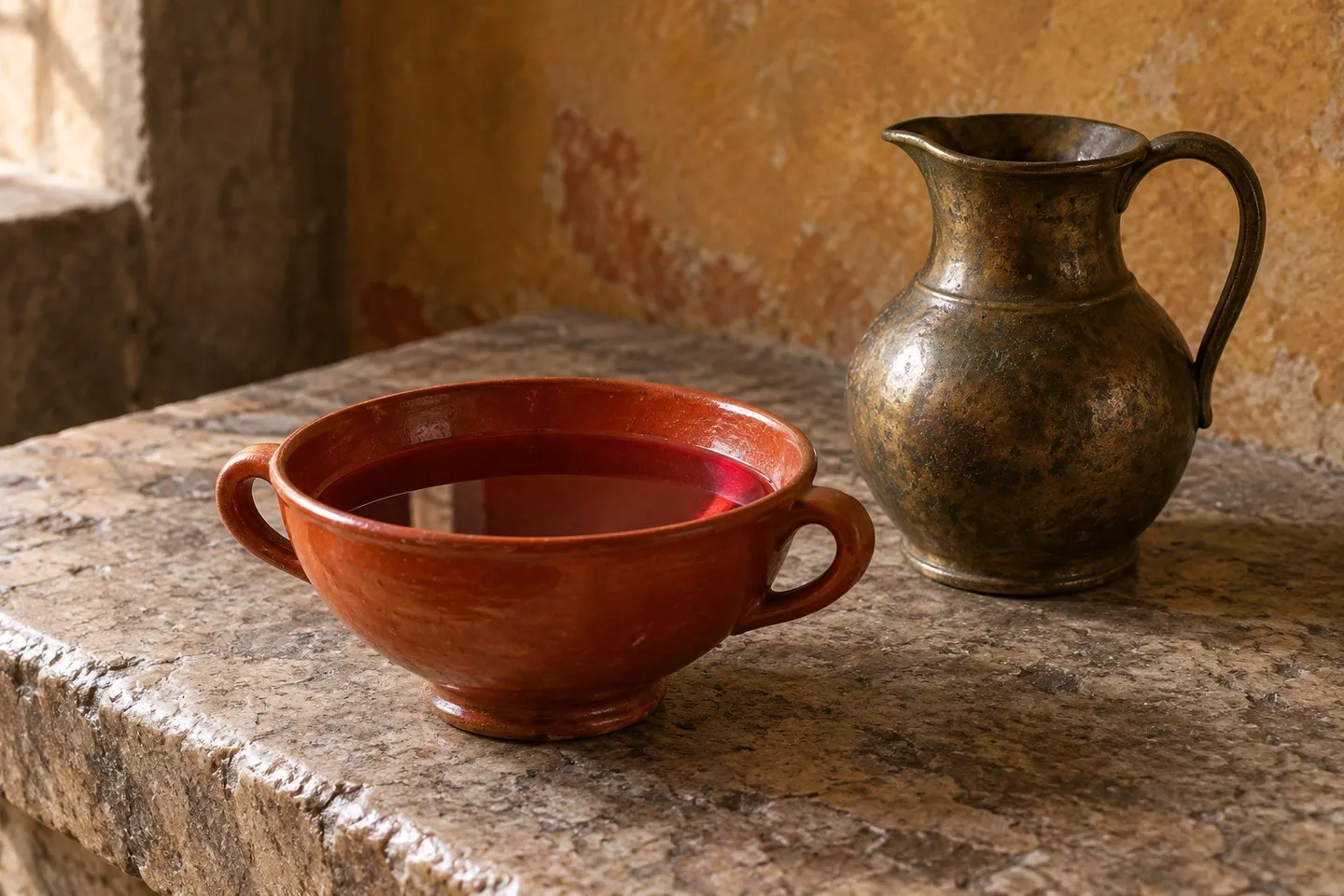
Calda in a shallow red-glazed two-handled cup, with a bronze jug of hot water on a stone counter.
The story behind the recipe
“The only warm drink among the ancients,” the German scholar Wilhelm Adolf Becker called calda: wine mixed with hot water, drunk most in winter. Some tables kept it hot in bronze urns, which Becker offers as support for an older scholar’s suggestion that the ancients “had something to match our tea and coffee services.”
A hot drink for a cold dinner
At Trimalchio’s dinner in Petronius’s Satyricon, the guest Dama grumbles about the weather: “Even a bath scarcely warms me up. In fact, a hot drink is my wardrobe.” That is Harry Thurston Peck’s 1898 translation, and Dama goes on to admit that the wine has gone to his head.
Becker’s Gallus (English edition, 1891) puts calda among the drinks of the midday meal, “especially the seductive calda,” and describes an elegant bronze heater: a central tube for burning coals, a tap at one side and a little cup on the rim so the urn could be topped up without lifting the lid. Usually, he adds, the hot water simply came round in jugs. Hot water had its politics too. The historian Cassius Dio records that the emperor Claudius shut the taverns where people gathered to drink and ordered that “no boiled meat or hot water should be sold.”
Read more about this recipe
Mixing a cup
None of these sources gives proportions, so Becker’s description is the nearest thing to a recipe: warm water and wine, “perhaps with the addition of spice.” Harold Whetstone Johnston’s rule for Roman wine in general, that they “used more water than wine,” sets the mix here at three parts hot water to two of wine, about 5% ABV with a 12% wine, the strength of an ordinary beer. The red wine, the water just off the boil, and the honey and pepper are ours. Johnston also notes that defrutum, grape juice boiled down to a syrup, was “used as a basis for various beverages,” and the defrutum cooler makes an alcohol-free one with cold water and no wine. Romans almost never drank wine unmixed, and Seawater, Pine Resin and Honey: How Roman Wine Tasted explains how far they cut it.
Recipe makes: 1 drink, about 250 ml
Ingredients
For 1 drink, about 250 ml. Quantities are shown as written.
Quantities as written here, for 1 drink, about 250 ml.
- Dry red wine100 ml
- Hot water150 ml
- Honey, optional5 ml
- Ground black pepper, optional1 pinch
Measurement notes
Ingredients as written here
- 100 ml dry red wine
- 150 ml hot water
- 5 ml honey, optional
- 1 pinch ground black pepper, optional
Equipment
 Kettle
 Heatproof cup or glass
Instructions
Bring a kettle of water to the boil and let it stand for about a minute. Fill the cup with some of the hot water to warm it, then pour that away.
Pour the dry red wine into the warm cup and add the hot water. Stir.
Taste it plain first: hot water and wine is the drink at its simplest. Then, if you like, stir in the honey until it dissolves and add the ground black pepper. Drink it hot.
Nutrition
105calories per serving
- Recipe makes
- 1 drink, about 250 ml
Estimated from the ingredients using USDA FoodData Central values for dry red wine and honey, including the optional honey.
Recipe notes
When adjusting quantities
Keep two parts wine to three parts hot water by volume.
Notes
Quantities mentioned in these notes don’t change when you adjust the batch.
Romans mixed to taste. Two parts wine to three of water is a starting point; make it weaker if you prefer.
A spoonful of a Roman spiced wine such as conditum paradoxum, stirred in, is another way to follow Becker’s “perhaps” spice.
Calda and the bronze heaters that kept its water hot appear in What Did Romans Drink Besides Wine?.
Scaling changes the ingredients only; glassware, ice and timings need their own judgment. To adapt this recipe further, try the recipe tool at TuneMyRecipe (opens in a new tab), our sister site.
Sources and attribution
Wilhelm Adolf Becker, Gallus; or, Roman Scenes of the Time of Augustus, trans. Frederick Metcalfe, 10th ed. (London: Longmans, Green, and Co., 1891), Excursus IV to Scene IX, The Drinks, p. 493
Recipe details
- Drink family
- Hot Drinks
- Era
- Ancient Rome
- Base
- Wine
- Difficulty
- Easy
- Season
- Winter