Mary Randolph’s Hydromel, a Plain Virginia Mead of 1838
Reader ratingsThirty-six ounces of honey to four quarts of warm water, fermented in a cask until clear and bottled: the plain hydromel of Mary Randolph’s Virginia Housewife.
- Recipe makes
- About 3.4 liters, 10 bottles of 330 ml
- Prep
- Cook
- Total
Brew day is about an hour. It ferments 3 to 5 weeks, then rests about 6 weeks in the bottle.
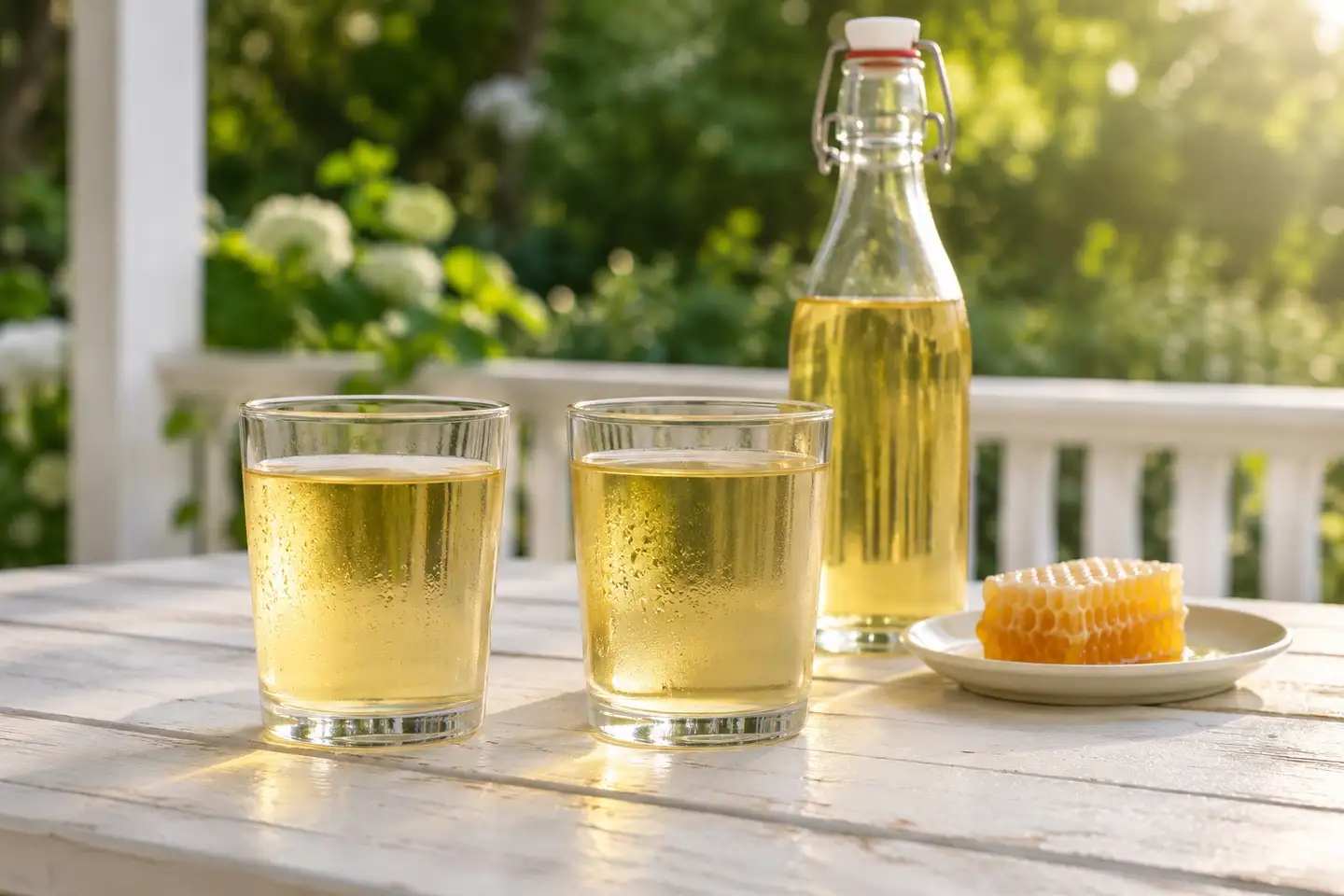
Hydromel in two tumblers on a porch table, with a swing-top bottle and honeycomb.
The story behind the recipe
Mary Randolph’s hydromel is the plainest mead there is: honey and warm water, “thirty-six ounces of honey to four quarts,” fermented in a cask until clear and then bottled and corked. There is no spice, no herb and no fruit. It is in The Virginia Housewife, first published in 1824; we follow a Baltimore printing of 1838.
Bottled for the gas
What Randolph liked about it was the fizz. Properly made, she wrote, it is “a pleasant and wholesome drink; and in summer particularly grateful, on account of the large quantity of carbonic acid gas which it contains.” Corked in the bottle with some of its fermentation still to go, the gas stayed in the drink. She was honest about how hard that was to get right: “Its goodness, however, depends greatly on the time of bottling, and other circumstances, which can only be acquired by practice.” Bottle too early and the corks fly; too late and the drink is flat.
Her heading gives it two names, hydromel or mead. Sir Kenelm Digby’s book of 1669 used the first for a much weaker drink, one part honey to eighteen of water, boiled with ginger, clove and rosemary. Chilled before the yeast goes in, that drink has no alcohol at all, and it is our Spiced Honey Water from Digby’s 1669 Mead.
Read more about this recipe
Making it today
We read her ounces as ordinary avoirdupois ounces and her four quarts as American quarts, which gives 610 ml of honey for a 4.5 liter demijohn and, by our arithmetic, about 9% ABV once it ferments dry. Getting a sparkling mead safe in the bottle takes the practice she mentions, so this version is still: it ferments out completely before bottling, and loses the gas she praised. That is the biggest change from her drink. The Madeira, punch and small beer of Virginia’s founders are in What Did the Founding Fathers Drink?. Randolph’s hydromel beside the older meads is in What Was Mead?
HYDROMEL, OR MEAD.
MIX your mead in the proportion of thirty-six ounces of honey to four quarts of warm water; when the honey is completely held in solution, pour it into a cask. When fermented, and become perfectly clear, bottle and cork it well. If properly prepared, it is a pleasant and wholesome drink; and in summer particularly grateful, on account of the large quantity of carbonic acid gas which it contains. Its goodness, however, depends greatly on the time of bottling, and other circumstances, which can only be acquired by practice.

Original: About 3.4 liters, 10 bottles of 330 ml
Ingredients
My drinksFor About 3.4 liters, 10 bottles of 330 ml. Quantities are shown as written.
Quantities as written here, for About 3.4 liters, 10 bottles of 330 ml.
- Water3.2 l
- Runny honey610 ml
- Yeast nutrient1 1/2 metric tsp (5 ml per tsp)
- Dried champagne yeast5 g
Measurement notes
Ingredients as written here
- 3.2 l water
- 610 ml runny honey
- 1 1/2 tsp yeast nutrient
- 5 g dried champagne yeast
Equipment
 Large saucepan
 Wooden spoon
 Instant-read thermometer
 Funnel
 Glass demijohn with an airlock, 4.5 liters
 Hydrometer
 No-rinse sanitizer
 Siphon tube
 Swing-top bottles or jugs
Instructions
Clean the demijohn, airlock, funnel, siphon tube and bottles well, without soap, and sanitize them with a no-rinse brewing sanitizer, following its label.
Warm about six sevenths of the water in the large saucepan until hand-hot, about 104 °F (40 °C). Take it off the heat and stir in the runny honey until it has dissolved completely.
Let it cool to 68 °F (20 °C), pour it through the funnel into the demijohn and top it up with the rest of the water, boiled and cooled, to the shoulder.
Add a quarter of the yeast nutrient and the dried champagne yeast, fit the airlock and set the demijohn somewhere at 64 to 70 °F (18 to 21 °C).
Add another quarter of the nutrient on each of the next three days, a little at a time, as it may foam.
Leave it until fermentation has finished and the mead is clear, usually 3 to 5 weeks. Check with the hydrometer: when two readings taken a week apart are the same, and at 1.000 or below, it is done.
Siphon the hydromel into beer-grade swing-top bottles, made to hold pressure, leaving the yeast sediment behind, and close them. Add no sugar.
Keep the bottles somewhere cool for about 6 weeks before drinking. Serve it chilled, as a summer drink.
Nutrition
170calories per serving
- Servings
- 10
Estimated from the planned starting gravity (about 1.066) and a dry finish, with the standard brewers’ calorie formula, for one 330 ml bottle.
Recipe notes
When adjusting quantities
Randolph’s proportion is 36 ounces of honey to four quarts of water. Keep about 610 ml of honey (about 860 g) to 3.2 liters of water, which makes 3.8 liters of must. The yeast and nutrient are for one 4.5 liter demijohn.
Notes
Quantities mentioned in these notes don’t change when you adjust the batch.
Changes from the source: we add wine yeast and nutrient, where Randolph left the honey water to ferment on its own in the cask, and we ferment it dry before bottling, so it is still, not sparkling. The amounts are her proportion at a smaller scale; a different ounce or quart would change them a little.
Bottling before fermentation has finished is what makes bottles burst. Wait for the steady hydrometer readings, and don’t add sugar or honey at bottling to make it fizz.
For that much lighter hydromel, see Digby’s Weak Hydromel, a Light Mead of 1669.
Storage
Keep the bottles somewhere cool and dark and drink them within a year. Once a bottle is open, keep it in the fridge and finish it within a few days.
Scaling changes the ingredients only; glassware, ice and timings need their own judgment. To adapt this recipe further, try the recipe tool at TuneMyRecipe (opens in a new tab), our sister site.
Sources and attribution
Mary Randolph, The Virginia Housewife; or, Methodical Cook, stereotype edition with amendments and additions (Baltimore: Plaskitt, Fite & Co., 1838), “Hydromel, or Mead,” p. 174
Recipe details
- Drink family
- Wine, Beer & Mead
- Region
- American
- Era
- 19th century
- Difficulty
- Intermediate
- Season
- Summer