Small White Mead with Lemon and Rosemary from 1739
Reader ratingsHoney and loaf sugar boiled in spring water, poured over lemon, cloves, ginger and rosemary and started with ale yeast spread on toast: Eliza Smith’s small white mead of 1739.
- Recipe makes
- About 3.4 liters, 20 small glasses
- Prep
- Cook
- Total
Brew day is about 3 hours with steeping and cooling. It ferments 4 to 6 weeks, then rests about 8 weeks in the bottle, our choice since the book bottles it after four or five days.
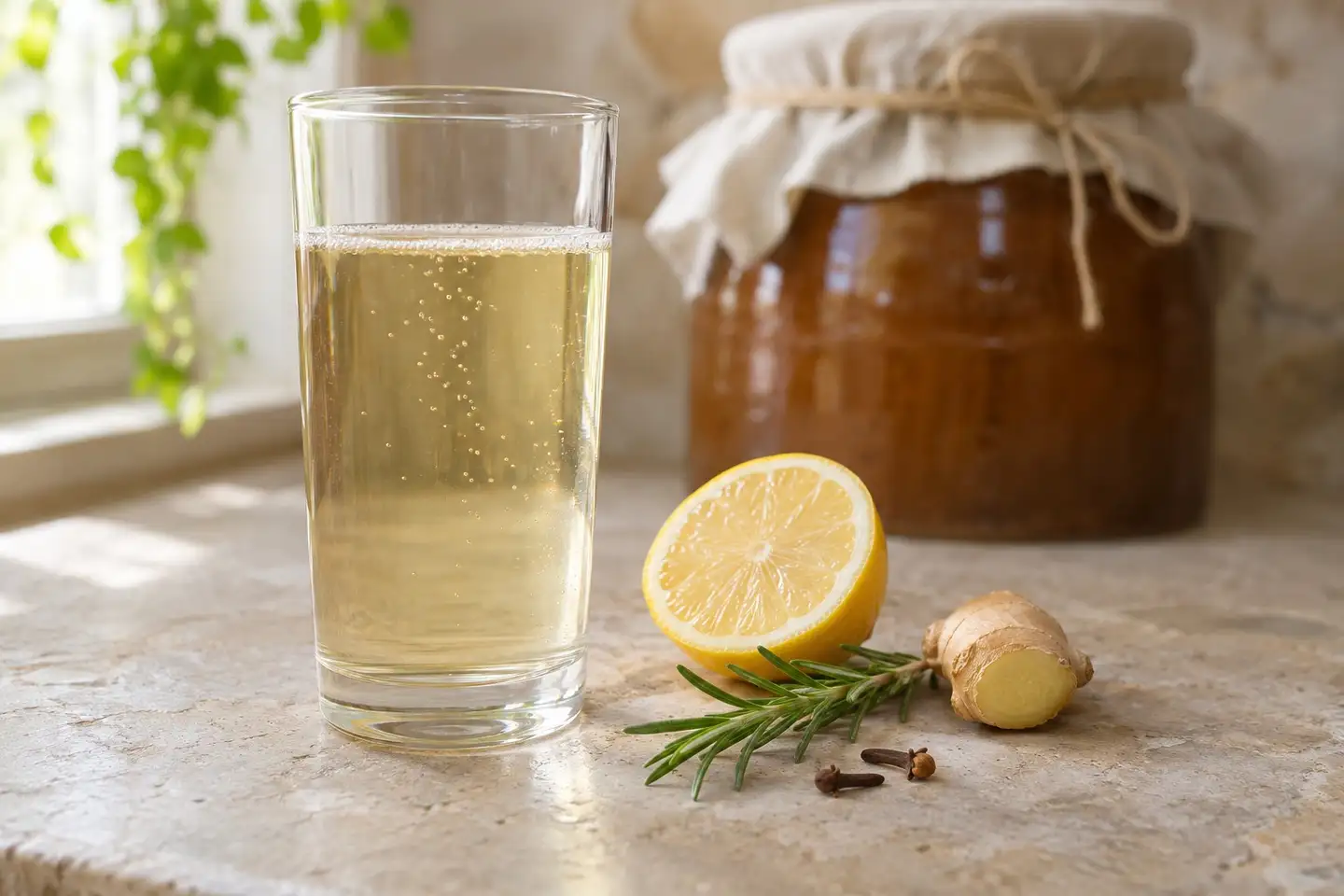
Small white mead in a tall glass, with lemon, rosemary, cloves and ginger and a covered crock.
The story behind the recipe
Eliza Smith’s small white mead is honey and sugar boiled in spring water, poured over lemon, spice and herbs, and started with ale yeast spread on a slice of brown toast. It comes from The Compleat Housewife, a London cookbook that ran through many editions and was reprinted in Williamsburg, Virginia, in 1742. We follow the ninth London edition, of 1739.
Small, but not by much
“Small” is the book’s word, as in small beer. The recipe itself is generous: three quarts of honey and a pound of loaf sugar to three gallons of water, boiled half an hour and skimmed, then the juice of four lemons, the rinds of two, 20 cloves, two “races” (roots) of ginger, a top of sweet-brier and a top of rosemary. The sugar is the surprise. Honey alone would have done the work, and the sugar adds to the strength.
The yeast goes in on toast. When the liquor is “but blood-warm,” the cook makes “a brown toast,” spreads it with two or three spoonfuls of ale yeast and puts it in. Four or five days later the mead is bottled, long before it could ferment dry, so we read the book’s drink as young and still sweet. That is our reading; the book says only “bottle it out.”
Read more about this recipe
Making it today
We keep the book’s proportion, one part honey in five, and its pound of sugar scaled down, which by our arithmetic ferments out at about 13% ABV, a strong drink despite the name. Wine yeast replaces the toast, and the mead is bottled only when it has finished. We leave out the sweet-brier, a wild rose that is hard to buy as food, and lose a little of the scent with it. Smith’s brandy, citrus and sugar cordial from the same edition is in Shrub: One Name, Two Very Different Drinks. Smith’s mead beside the older ones is in What Was Mead? For honey and rosemary without the alcohol, there is our Spiced Honey Water from Digby’s 1669 Mead: honey simmered in water with ginger, a clove and rosemary, then chilled, the weak mead of 1669 stopped before it ferments.
To make small white Mead.
TAKE three gallons of spring-water, and make it hot, and dissolve in it three quarts of honey, and a pound of loaf-sugar; and let it boil about half an hour, and scum it as long as any rises; then pour it out into a tub, and squeeze in the juice of four lemons, put in the rinds of but two, 20 cloves, two races of ginger, a top of sweet-brier, and a top of rosemary; let it stand in a tub till it is but blood-warm; then make a brown toast, and spread it with two or three spoonfuls of ale-yeast, put it into a vessel fit for it; let it stand four or five days, then bottle it out.

Original: About 3.4 liters, 20 small glasses
Ingredients
My drinksFor About 3.4 liters, 20 small glasses. Quantities are shown as written.
Quantities as written here, for About 3.4 liters, 20 small glasses.
- Water3.5 l
- Runny honey760 ml
- Sugar120 g
- Lemon1
- Cloves5
- Fresh ginger, sliced5 g
- Small sprig fresh rosemary, about 3 cm1
- Yeast nutrient2 metric tsp (5 ml per tsp)
- Dried champagne yeast5 g
Measurement notes
Ingredients as written here
- 3.5 l water
- 760 ml runny honey
- 120 g sugar
- 1 lemon
- 5 whole cloves
- 5 g fresh ginger, sliced
- 1 small sprig fresh rosemary, about 3 cm
- 2 tsp yeast nutrient
- 5 g dried champagne yeast
Equipment
 Large saucepan
 Wooden spoon
 Vegetable peeler
 Citrus juicer
 Fine sieve
 Instant-read thermometer
 Funnel
 Glass demijohn with an airlock, 4.5 liters
 Hydrometer
 No-rinse sanitizer
 Siphon tube
 Swing-top bottles or jugs
Instructions
Clean the demijohn, airlock, funnel, siphon tube and bottles well, without soap, and sanitize them with a no-rinse brewing sanitizer, following its label.
Heat four fifths of the water in the large saucepan until hot, take it off the heat and stir in the runny honey and the sugar until dissolved.
Bring it to a gentle boil and simmer for 30 minutes, skimming off the foam as long as any rises.
While it simmers, peel thin strips of zest from half of the lemon with the peeler, then squeeze the juice of the whole lemon.
Take the pan off the heat and add the lemon juice and zest, the whole cloves, the fresh ginger and the fresh rosemary. Cover it and leave it to steep while it cools.
Stand the covered pan in a sink of cold water, changing the water as it warms, until it is at 68 °F (20 °C). Pour it through the sieve and funnel into the demijohn.
Top it up with the rest of the water, boiled and cooled, to the shoulder. Add a quarter of the yeast nutrient and the dried champagne yeast, fit the airlock and set the demijohn somewhere at 64 to 70 °F (18 to 21 °C).
Add another quarter of the nutrient on each of the next three days, a little at a time, as it may foam.
Leave it until fermentation has finished, usually 4 to 6 weeks. Check with the hydrometer: when two readings taken a week apart are the same, and at 1.000 or below, it is done. If it stops sweet, well above 1.000, leave it under the airlock somewhere warmer and don’t bottle it.
Siphon the mead into beer-grade swing-top bottles, made to hold pressure, leaving the yeast sediment behind, and close them. Add no sugar.
Keep the bottles somewhere cool for about 8 weeks before drinking. Serve it cool, in small glasses.
Nutrition
110calories per serving
- Servings
- 20
Estimated from the planned starting gravity (about 1.093) and a dry finish, with the standard brewers’ calorie formula, for one 150 ml glass.
Recipe notes
When adjusting quantities
The book’s ratio is three quarts of honey to three gallons of water, with a pound of sugar. Keep the honey at about one part in five of the must. The yeast and nutrient are for one 4.5 liter demijohn.
Notes
Quantities mentioned in these notes don’t change when you adjust the batch.
Changes from the source: the book’s quantities are scaled to one demijohn by its own proportions, with the lemon, clove and ginger rounded; its gallon may not be ours, so the strength is our choice. Wine yeast and nutrient replace the ale yeast on toast, the flavorings are strained out after steeping, the sweet-brier is left out, and the mead is bottled when finished instead of after four or five days.
Bottling before fermentation has finished is what makes bottles burst. Wait for the steady hydrometer readings. For a plainer mead a century later, with honey and water only, see Mary Randolph’s Hydromel, a Plain Virginia Mead of 1838.
Storage
Keep the bottles somewhere cool and dark and drink them within two years. Once a bottle is open, keep it in the fridge and finish it within a week.
Scaling changes the ingredients only; glassware, ice and timings need their own judgment. To adapt this recipe further, try the recipe tool at TuneMyRecipe (opens in a new tab), our sister site.
Sources and attribution
Eliza Smith, The Compleat Housewife: or, Accomplish’d Gentlewoman’s Companion, 9th ed. (London: J. and J. Pemberton, 1739), “To make small white Mead,” p. 216
Recipe details
- Drink family
- Wine, Beer & Mead
- Region
- British
- Era
- 18th century
- Difficulty
- Advanced