Lettice Bryan’s Mead, Cider and Honey Fortified with Brandy, 1839
Reader ratingsFresh sweet cider boiled with honey, fermented clear in a cask and then fortified with a quart of white brandy to the gallon: the mead of The Kentucky Housewife, 1839.
- Recipe makes
- About 3.8 liters, 38 small glasses of 100 ml
- Prep
- Cook
- Total
Brew day is about 2 hours with cooling. The cider and honey ferment 4 to 8 weeks before the brandy goes in, then the mead rests about 2 weeks under the airlock before bottling.
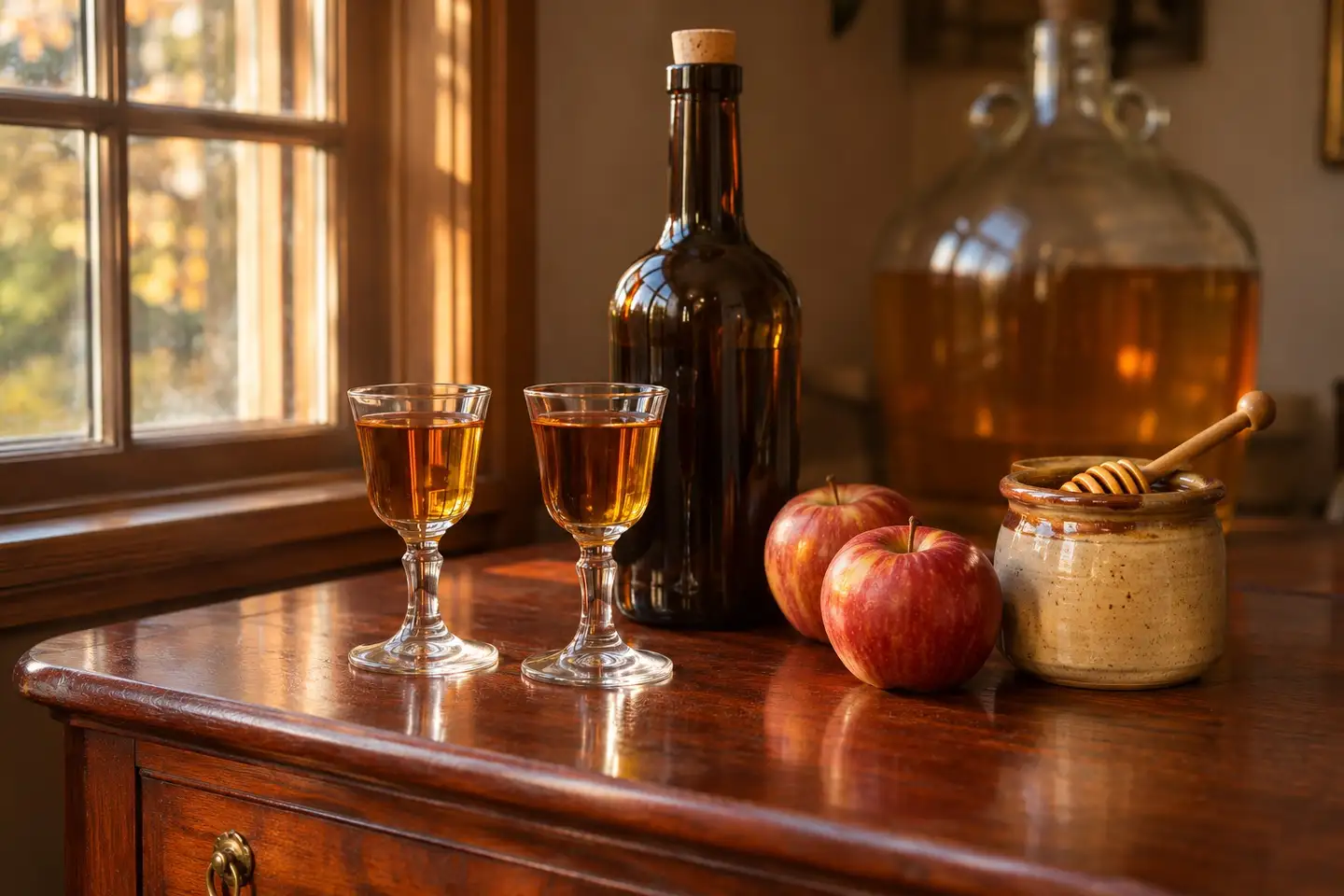
Lettice Bryan’s cider mead in two small glasses, with a bottle, a demijohn, apples and honey.
The story behind the recipe
Lettice Bryan’s mead is apple cider and honey, fermented and then fortified. She takes “sweet cider, just from the press,” boils and skims it, adds a quart of clarified honey to each gallon and leaves it in a cask with the bung loose until it has finished working and cleared. Then comes a quart of “the best white brandy or rectified spirits” to each gallon, and it is corked up. “It will keep well,” she wrote in The Kentucky Housewife of 1839, “and is very much liked.”
A mead made of apples
Bryan calls it plain “Mead.” There is no water in it at all: the cider takes the water’s place, so the drink starts with the sugar of the apples as well as the honey. Brewers today would call a cider and honey mead a cyser, a name she doesn’t use. The brandy goes in only at the end, a quart to the gallon of the fermented mead, not of the original cider, so it makes up a fifth of the finished drink.
Read more about this recipe
Making it today
Fresh cider straight from a press is rare now, so we use pasteurized cloudy apple juice with no preservatives, which would stop the yeast. We boil it for 5 minutes, as Bryan says, and keep her two ratios: one part honey to four of juice, then one part brandy to four of the finished base. By our arithmetic the base ferments to about 16 or 17% ABV and the brandy takes it to about 21%, the strength of a port. All of that depends on the juice; a hydrometer reading of your own juice before you start tells you more than our numbers. How cider kept its place on the American table, long after this book, is in Cider and Switchel. Bryan’s mead beside the older English ones is in What Was Mead?
MEAD.
Take sweet cider, just from the press, and boil and skim it well. Mix with each gallon one quart of clarified honey, put it in a cask, and leave the bung loose till it is done fermenting, and becomes clear. Then mix with it a quart of the best white brandy or rectified spirits to each gallon of the fermented mixture, and cork it up for use. It will keep well, and is very much liked.

Original: About 3.8 liters, 38 small glasses of 100 ml
Ingredients
My drinksFor About 3.8 liters, 38 small glasses of 100 ml. Quantities are shown as written.
Quantities as written here, for About 3.8 liters, 38 small glasses of 100 ml.
- Pasteurized apple juice, cloudy, with no preservatives2.8 l
- Runny honey700 ml
- Yeast nutrient4 g
- Dried champagne yeast5 g
- White brandy, 40% ABV750 ml
Measurement notes
Ingredients as written here
- 2.8 l pasteurized apple juice, cloudy, with no preservatives
- 700 ml runny honey
- 4 g yeast nutrient
- 5 g dried champagne yeast
- 750 ml white brandy, 40% ABV
Equipment
 Large saucepan
 Wooden spoon
 Instant-read thermometer
 Funnel
 Glass demijohn with an airlock, 4.5 liters
 Hydrometer
 No-rinse sanitizer
 Siphon tube
 Measuring jug
 Clean, dry glass bottles with stoppers
Instructions
Clean the demijohn, airlock, funnel, siphon tube, measuring jug and bottles well, without soap, and sanitize them with a no-rinse brewing sanitizer, following its label.
Bring the pasteurized apple juice to a boil in the large saucepan and boil it gently for 5 minutes, skimming off the foam.
Take it off the heat and stir in the runny honey until dissolved.
Cover the pan and stand it in a sink of cold water, changing the water as it warms, until it is at 68 °F (20 °C).
Pour it through the funnel into the demijohn. Take a hydrometer reading and write it down. Add a quarter of the yeast nutrient and the dried champagne yeast, fit the airlock and set the demijohn somewhere at 64 to 70 °F (18 to 21 °C).
Add another quarter of the nutrient on each of the next three days, a little at a time, as it may foam.
Leave it until fermentation has finished and the mead has cleared, usually 4 to 8 weeks. Check with the hydrometer: when two readings taken a week apart are the same, and at 1.000 or below, it is done. If it stops sweet, well above 1.000, leave it under the airlock somewhere warmer and don’t add the brandy yet.
Siphon the clear mead into a clean jug, leaving the sediment behind, and measure it. Stir in a quarter of that amount of white brandy; for a full batch that is all of it.
Return it to the clean demijohn under the airlock for 2 weeks. If the hydrometer reading hasn’t changed, siphon it into the clean bottles and stopper them.
Serve it at room temperature or cool, in small glasses.
Nutrition
120calories per serving
- Servings
- 38
Estimated from the planned strength (about 21% ABV) and a dry base, with the standard brewers’ calorie formula, for one 100 ml glass.
Recipe notes
When adjusting quantities
Bryan’s ratios are one quart of honey to a gallon of cider, then one quart of brandy to each gallon of the fermented mead. Measure what you recover and add a quarter of that in brandy.
Notes
Quantities mentioned in these notes don’t change when you adjust the batch.
Changes from the source: we use pasteurized apple juice in place of fresh cider from the press, wine yeast and nutrient where Bryan relied on the cider’s own yeast, a demijohn with an airlock for her loosely bunged cask, and a white grape brandy at 40% for her best white brandy or rectified spirits. The amounts are her ratios at a smaller scale.
Don’t add the brandy to stop a fermentation that has stuck. Wait for a finished, steady reading first, so the bottles stay still.
For a lighter apple drink with no alcohol, see Apple and Quince Water Sweetened with Honey from 1869.
Storage
Bryan says it keeps well. Keep the bottles corked somewhere cool and dark and drink them within two years. Once a bottle is open, keep it closed and finish it within a few months.
Scaling changes the ingredients only; glassware, ice and timings need their own judgment. To adapt this recipe further, try the recipe tool at TuneMyRecipe (opens in a new tab), our sister site.
Sources and attribution
Lettice Bryan, The Kentucky Housewife (Cincinnati, 1839), “Mead,” p. 404
Recipe details
- Drink family
- Wine, Beer & Mead
- Region
- American
- Era
- 19th century
- Difficulty
- Advanced
- Season
- Autumn