What Did the Founding Fathers Drink?
Madeira, claret, punch, porter, cider and small beer: what the founders really drank, from Washington’s 1757 beer recipe to a 1787 Philadelphia tavern bill.
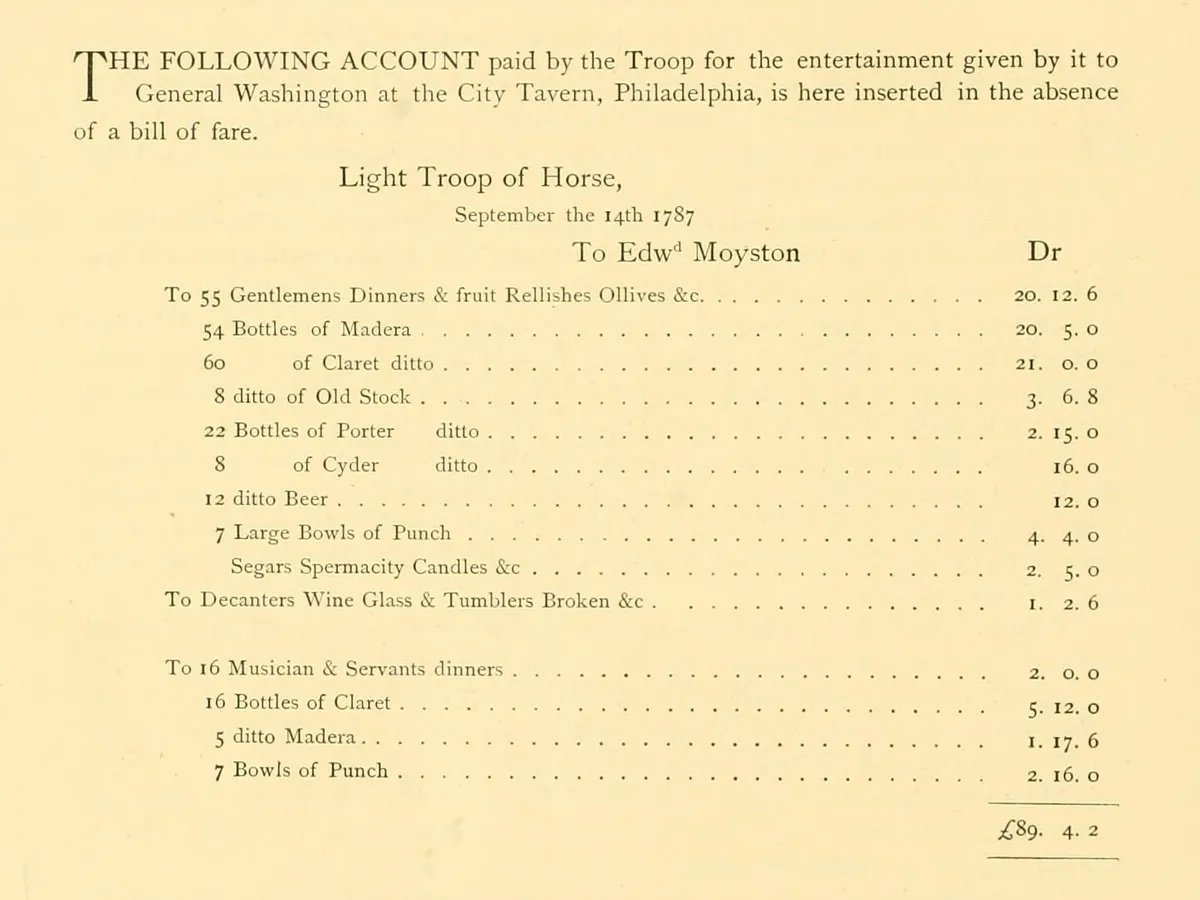
America’s founders drank what well-off colonists drank: Madeira and claret at the table, punch by the bowl, porter, cider and beer, with small beer as the everyday drink of the household. Tea they gave up, at least on paper, in the boycott of 1774. The best record of a founders’ evening is a tavern bill. Three days before the Constitution was signed in 1787, a Philadelphia cavalry troop gave George Washington a dinner at the City Tavern, and the bill counts 59 bottles of Madeira, 76 of claret and 14 bowls of punch.
This story is part of our Colonial Drinks guide.
A dinner for the General
The bill was printed in 1875 in the history of the First Troop Philadelphia City Cavalry, “in the absence of a bill of fare.” It is addressed by the tavern keeper, Edward Moyston, to the “Light Troop of Horse,” dated “September the 14th 1787,” and it begins “To 55 Gentlemens Dinners & fruit Rellishes Ollives &c.”
Then the drink. “54 Bottles of Madera,” £20 5s, about $1,000 today. “60 of Claret,” £21, about $1,050. Eight bottles “of Old Stock,” 22 of porter, 8 of cider, 12 of beer, and “7 Large Bowls of Punch.” Sixteen musicians and servants had their own dinners, with 16 more bottles of claret, 5 of Madeira and 7 more bowls of punch. “Segars Spermacity Candles &c” came to £2 5s, and “Decanters Wine Glass & Tumblers Broken &c” to £1 2s 6d. The total was £89 4s 2d in Pennsylvania money, about $238 at the rate fixed by the Mint Act of 1792, or roughly $4,500 today by US consumer prices (using 1800, the earliest year in the Minneapolis Fed table).
The story told about this bill online is bigger than the page. It is often called the framers’ farewell party “after signing the Constitution,” because the Convention also had 55 delegates. The book says only that the Troop gave the entertainment for General Washington; it names no other guest, and the Constitution was signed three days later, on September 17. Some retellings also turn the porter into port and add whiskey. The 1875 print has porter, and the eight bottles of “Old Stock” are not explained.
Madeira and claret were the wines of the colonial table, and punch was the drink of the club and the tavern. Philadelphia’s own was the Fish House Punch, here in the recipe Jerry Thomas printed in 1862.
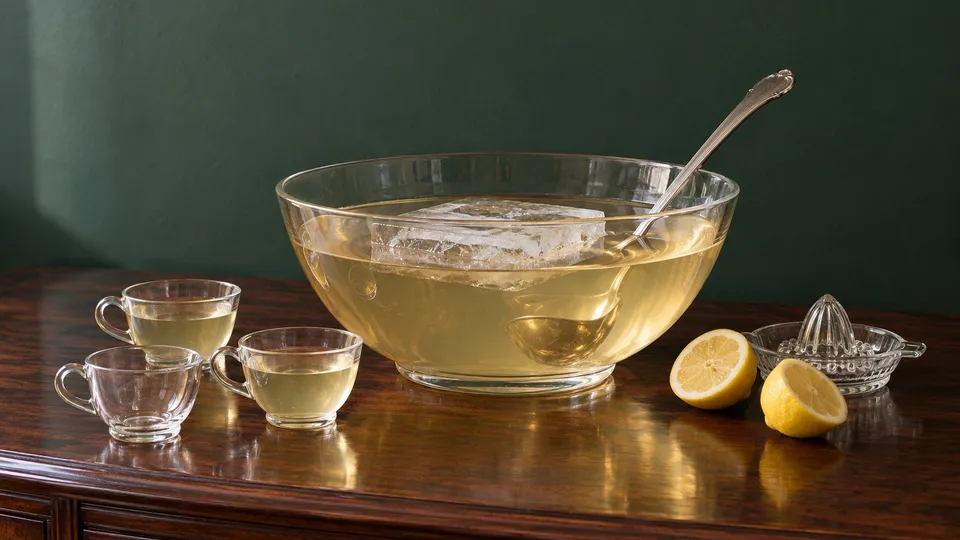 Make it todayPhiladelphia Fish House Punch, Cognac, Peach Brandy and Rum from 1862
Small beer in a colonel’s notebook
Thirty years earlier Washington had written down a much humbler drink. In 1757, as a Virginia colonel raising two regiments in the war with the French, he kept a small pocket notebook of army business: stores to fetch from the magazine at Williamsburg, accounts to settle, a claim for a horse. Among the memoranda is a recipe headed “To make Small Beer.”
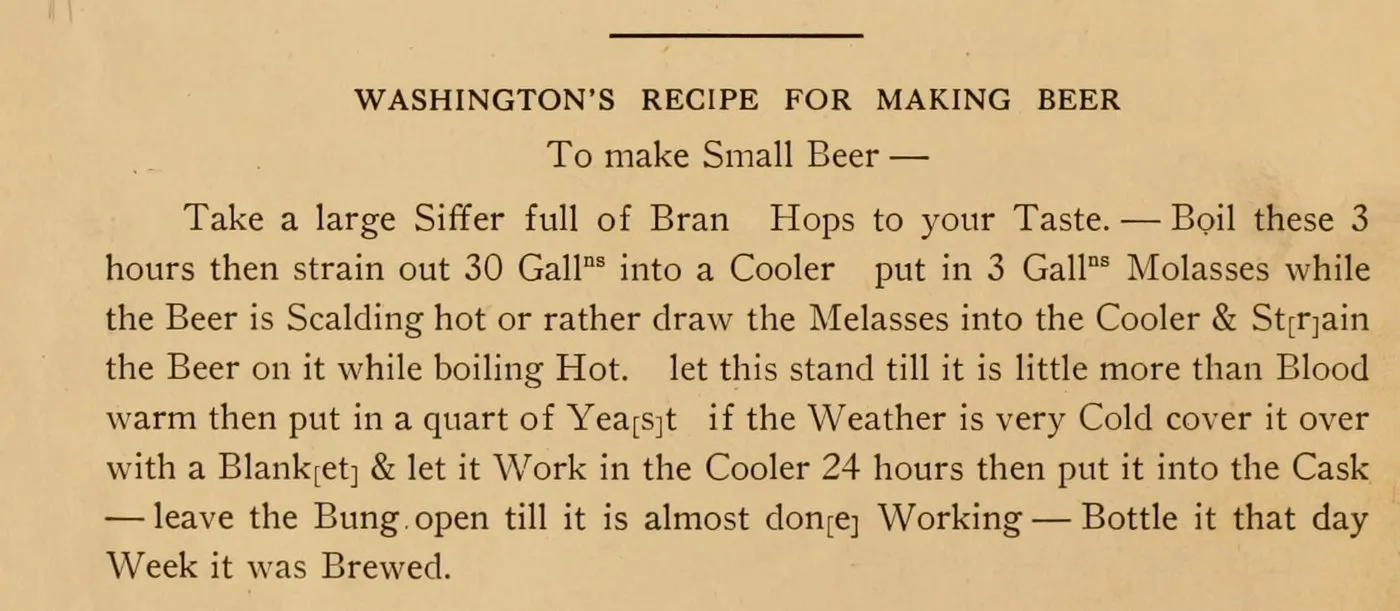 The small beer recipe in Washington’s notebook of 1757, as printed by Victor Hugo Paltsits in Washington’s Note Book (New York Public Library, 1920), p. 6. The heading is Paltsits’s; the recipe starts at “To make Small Beer.”
“Take a large Siffer full of Bran Hops to your Taste,” it begins. Boil them three hours, strain 30 gallons onto 3 gallons of molasses “while boiling Hot,” add “a quart of Yea[s]t” when it is “little more than Blood warm,” and “Bottle it that day Week it was Brewed.” The words in square brackets were supplied by Paltsits, who printed the notebook in 1920, where the page is torn.
Small beer was the weak everyday beer of the household, and molasses, cheap from the West Indies, took the place of malt. The page doesn’t say whether Washington brewed it himself, who drank it, or where; the stories that he wrote it at Mount Vernon or brewed it for his troops go further than the notebook. We brew a gallon of it in George Washington’s Small Beer from His 1757 Notebook. On American farms the everyday drinks were cider and switchel, molasses and water taken to the hayfield, the subject of What Did Early Americans Drink at Harvest?.
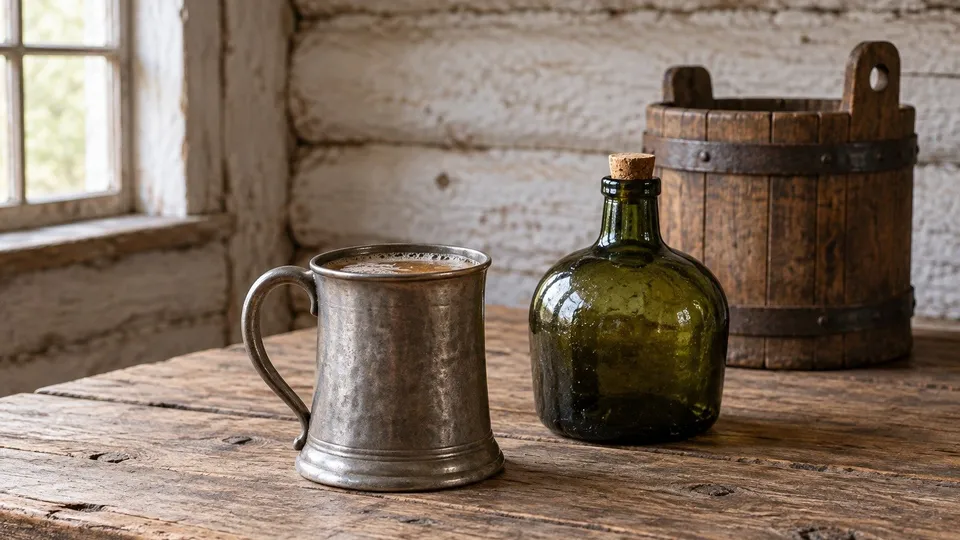 Make it todayGeorge Washington’s Small Beer from His 1757 Notebook
Madeira at a great rate
John Adams kept a diary of the First Continental Congress in Philadelphia in 1774, and the dinners fill it. On September 8 he called one at Mr. Powell’s “a most sinful feast again!”, with twenty sorts of tarts, “whipped sillabubs,” and then “Parmesan cheese, punch, wine, porter, beer, &c.” On September 14, at Dr. Cox’s, there was “nothing less than the very best of Claret, Madeira, and Burgundy.” At Chief Justice Chew’s on September 22: “Wines most excellent and admirable. I drank Madeira at a great rate, and found no inconvenience in it.”
Tea was the one drink they gave up. On the road to Falmouth, in what is now Maine, that July, Adams had asked his landlady whether “a weary traveller” might have “a dish of tea, provided it has been honestly smuggled, or paid no duties?” “No, sir,” said she, “we have renounced all tea in this place, but I’ll make you coffee.” He wrote to Abigail: “Accordingly I have drank coffee every afternoon since, and have borne it very well. Tea must be universally renounced, and I must be weaned, and the sooner the better.” In late September the Congress went further and agreed that from December 1 there would be no imports at all from Great Britain or Ireland, tea included.
Twenty-two years later Adams, by then vice-president, tried a lighter habit at home in Quincy. “In conformity to the fashion,” he wrote on July 26, 1796, “I drank this morning and yesterday morning about a gill of cider; it seems to do me good.” Two days later he was still at it. A gill is a quarter of a pint, about 120 milliliters: a small glass, not the “tankard of hard cider” before breakfast that later books give him.
Porter made in America
By 1789 beer had become a matter of politics. On January 29, three months before he took office as president, Washington wrote to the Marquis de Lafayette from Mount Vernon: “Indeed, we have already been too long subject to British prejudices. I use no porter or cheese in my family but such as is made in America. Both those articles may now be purchased of an excellent quality.”
That is the letter as Jared Sparks printed it in 1835; Sparks was known to tidy Washington’s wording, so the sense is safer than the commas. Porter was the dark London beer, and buying it from American brewers was a small act of independence.
Jefferson’s wine and ale
Thomas Jefferson was the founders’ great wine buyer, and he thought wine kept a nation sober. “No nation is drunken where wine is cheap,” he wrote to a French friend in 1818, “and none sober, where the dearness of wine substitutes ardent spirits as the common beverage. It is, in truth, the only antidote to the bane of whiskey.” The line often quoted, that he called beer or wine America’s “national drink,” has no source we can find.
He also brewed. “I am lately become a brewer for family use,” he wrote in 1815, “having had the benefit of instruction to one of my people by an English brewer of the first order.” The brewer was Peter Hemings, enslaved at Monticello, taught by Joseph Miller, an English captain stranded in Virginia by the War of 1812. Jefferson’s letters judge Hemings’s work closely: one batch of corn beer was spoiled “by over-hopping,” but “a little more experience however will make him a good brewer.” By 1821 they brewed “100. galls. of ale in the fall & 100. galls. in the spring,” from wheat rather than barley, “taking 8. galls. only from the bushel of wheat. the public breweries take 15. which makes their liquor meagre and often vapid.”
The Water-American
Benjamin Franklin, as a young printer in London in 1725, was the odd one out. “I drank only water; the other workmen, near fifty in number, were great guzzlers of beer,” he wrote in his Autobiography. They called him “the Water-American.” His press-mate put away six pints a day, and “had four or five shillings to pay out of his wages every Saturday night for that muddling liquor,” about £35 to £45 a week today by UK consumer prices (Bank of England).
He is also credited with saying that beer is proof that God loves us. He did not say it. In a playful letter to a French friend, the Abbé Morellet, around 1779, it is the rain falling on the vineyards to be “changed into wine” that is “a constant proof that God loves us, and loves to see us happy,” in a 1906 English translation. He did not stay a water drinker, either. In 1763 he sent his friend James Bowdoin a receipt for a big batch of brandy punch made clear with boiling milk, the story in How Milk Made Franklin’s Punch Clear.
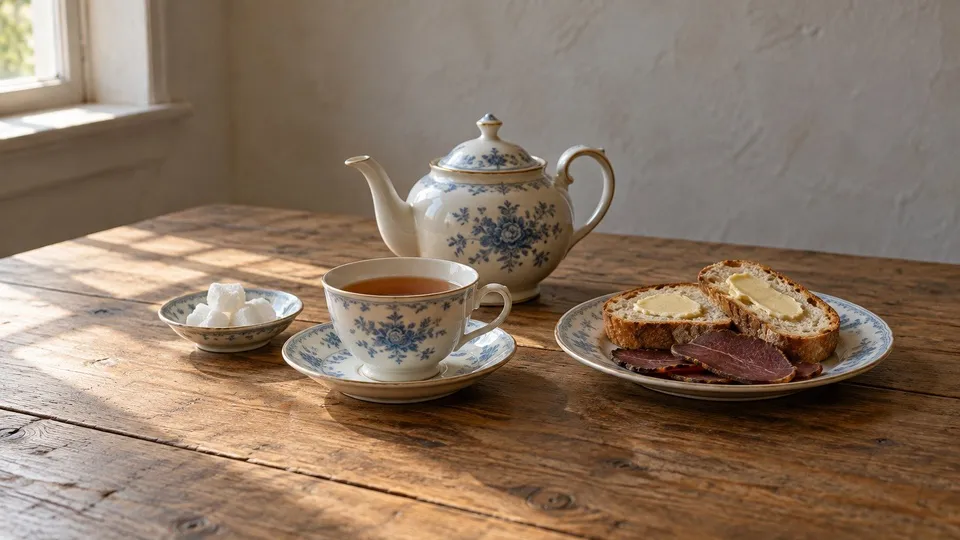
Water was not the only sober glass of Franklin’s century. In 1749 a Swedish visitor watched the Dutch of Albany take their breakfast tea black, with a lump of sugar held in the mouth: our Albany Breakfast Tea.
 Always alcohol-freeAlbany Breakfast Tea with Sugar in the Mouth, 1749
Of everything on these pages, the drink you can make most cheaply at home is the humblest. George Washington’s Small Beer needs only bran, hops, molasses and yeast, and a week, as his notebook says, to be ready to bottle.
For what was on the plate, our sister site The Forgotten Menu has the soup John Adams ate in France in 1778 (opens in a new tab).
Sources
- History of the First Troop Philadelphia City Cavalry (Philadelphia: Hallowell & Co., 1875), appendix, City Tavern bill of September 14, 1787.
- Victor Hugo Paltsits, ed., Washington’s Note Book: Selections from a Newly-Discovered Manuscript Written by Him While a Virginia Colonel, in 1757 (New York: New York Public Library, 1920), pp. 3, 6.
- John Adams, The Works of John Adams, ed. Charles Francis Adams, vol. 2 (Boston: Little & Brown, 1850), pp. 370, 379–382; vol. 3 (1851), p. 421.
- Familiar Letters of John Adams and His Wife Abigail Adams, ed. Charles Francis Adams (New York: Hurd & Houghton, 1876), p. 18.
- Jared Sparks, ed., The Writings of George Washington, vol. 9 (Boston, 1835), pp. 462, 465.
- Benjamin Franklin, Autobiography, ed. John Bigelow (Philadelphia: J. B. Lippincott & Co., 1868), pp. 146–147.
- Thomas Jefferson to M. de Neuville, December 13, 1818, in The Writings of Thomas Jefferson, ed. Andrew A. Lipscomb and Albert Ellery Bergh, vol. 15 (Washington: Thomas Jefferson Memorial Association, 1905), p. 178.
- Thomas Jefferson to Joseph Coppinger, April 25, 1815; to Joseph Miller, June 26, 1815; to James Barbour, May 11, 1821, as transcribed in Edwin M. Betts, ed., Thomas Jefferson’s Farm Book (Philadelphia: American Philosophical Society, 1953), pp. 418, 420–421.
- Benjamin Franklin to the Abbé Morellet, in The Wisdom of Benjamin Franklin, ed. John J. Murphy (New York: Brentano’s, 1906), p. 179.