Lime Rickey, the Soda Fountain Rickey Without Gin
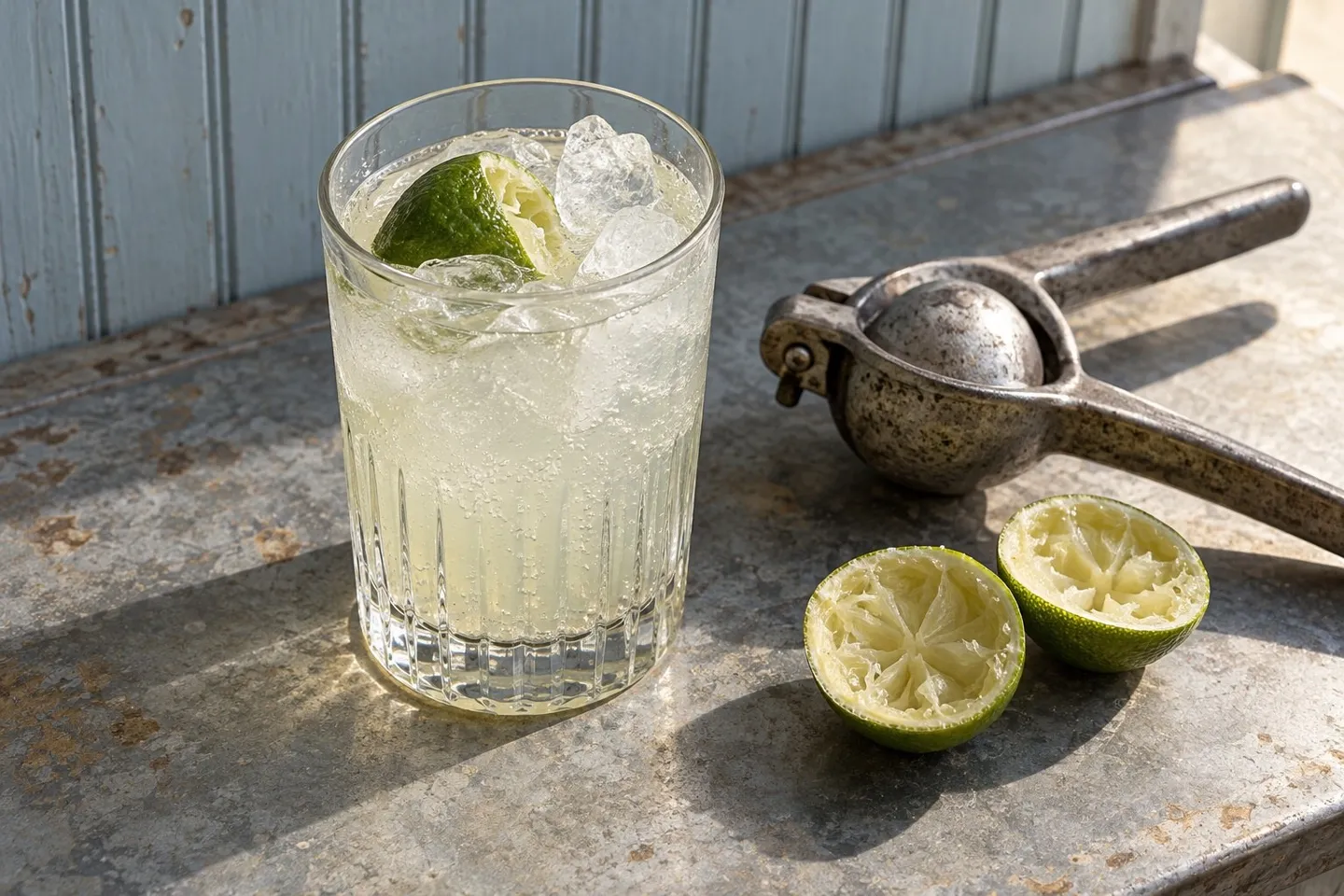
Reader ratingsA whole lime squeezed over pineapple syrup, then cracked ice and a fill of soda water: the alcohol-free lime rickey from a San Francisco druggists’ journal of 1912.
- Recipe makes
- About 3/4 cup pineapple syrup, enough for 12 drinks
- Prep
- Cook
- Total
Includes about 30 minutes for the pineapple syrup to cool. Each drink then takes a couple of minutes.
A lime rickey over cracked ice in a fluted tumbler, with a hand squeezer and two squeezed lime halves.
The story behind the recipe
Take the gin out of a gin rickey, keep the fresh lime, ice and soda water, add a little syrup at the soda fountain, and you have a lime rickey. A London trade paper put it in just those terms in 1901. Reporting on New York soda fountains, The Chemist and Druggist explained to British chemists that “the man who thinks it is too hot to drink his usual ‘gin rickey’ will not be disinclined to sample a ‘lime rickey,’ which is the former minus the gin.”
Minus the gin
The bar drink came first. When Colonel Joseph K. Rickey was found dead at the Hoffman House in New York in April 1903, the wire report called him “the inventor of the gin rickey.” Whether he was is not settled. Harry Johnson’s bar recipe of 1900 is on TuneMyRecipe as the Gin Rickey (opens in a new tab). The fountains borrowed the name and kept the lime.
Read more about this recipe
Pineapple and mint
A fountain recipe was in print by August 1912, in the soda fountain pages of The Pacific Pharmacist in San Francisco. It sweetens the lime with half an ounce of pineapple syrup, a pairing the soda trade already knew: A. Emil Hiss’s 1897 manual for dispensers allows pineapple syrup in place of lime essence in his lime phosphate syrup.
In St. Louis the drink came with mint. A St. Louis Post-Dispatch round-up of fountain drinks in March 1907 credited a Broadway fountain with lime punch “and a Locust street one for lime rickey,” and added: “Mint syrup or mint sprigs are used in both.” The mint is an option here. The same paper put a plain limeade at 5 cents, about $1.70 in today’s money by US consumer prices, though it gave no price for the rickey. It was a hot-weather glass; once the cold came, fountains drew hot lemon and ginger from a heated urn instead, as What Did Soda Fountains Sell in Winter? explains.
By 1920 the rickey had moved into the home as well. Bertha E. L. Stockbridge’s What to Drink, which supplies the Grape Juice Highball in Five Alcohol-Free Drinks for a 1920s Party, gives a short section of rickeys made from fruit juices. While the fountain poured this one at home, Americans who could travel went where the drinks were legal, as Cocktails in 1920s London and Paris tells.
Lime Rickey. Pineapple Syrup, ½ ounce. Lime, One. Squeeze the lime into a glass with the pineapple syrup, add some cracked ice and fill with carbonated water.

Recipe makes: About 3/4 cup pineapple syrup, enough for 12 drinks
Ingredients
For About 3/4 cup pineapple syrup, enough for 12 drinks. Quantities are shown as written.
Quantities as written here, for About 3/4 cup pineapple syrup, enough for 12 drinks.
Pineapple syrup
- Unsweetened pineapple juice1/2 cup
- Sugar1/2 cup
Per drink
- Lime1
- Pineapple syrup1 tbsp
- Fresh mint (optional)2 sprigs
- Cracked ice1 cup
- Soda water, chilled2/3 cup
Measurement notes
Ingredients as written here
- 1/2 cup unsweetened pineapple juice
- 1/2 cup sugar
- 1 lime
- 1 tbsp pineapple syrup
- 2 sprigs fresh mint (optional)
- 1 cup cracked ice
- 2/3 cup soda water, chilled
Equipment
 Small saucepan
 Clean bottle or jar for the syrup
 Citrus juicer
 Tumbler
 Bar spoon
Instructions
For the syrup, put the unsweetened pineapple juice and sugar in a small saucepan and warm over low heat, stirring, until the sugar has dissolved. Do not let it boil. Leave to cool for about 30 minutes, then pour into a clean bottle and keep it in the fridge.
For each drink, cut the lime in half and squeeze both halves into a tumbler, then add the pineapple syrup. If you like, drop one squeezed lime shell into the glass.
For the St. Louis touch, add the fresh mint and press it gently against the glass with a bar spoon to bruise it.
Add the cracked ice, fill the glass with cold soda water and stir once. Serve at once.
Nutrition
45calories per serving
- Recipe makes
- About 3/4 cup pineapple syrup, enough for 12 drinks
- Servings
- 12
Estimated from USDA FoodData Central values for granulated sugar, pineapple juice and lime juice, for one drink with 1 tablespoon of the syrup.
Recipe notes
When adjusting quantities
Scale the syrup ingredients together. The drink ingredients are for one glass; multiply them by the number of drinks.
Notes
Quantities mentioned in these notes don’t change when you adjust the batch.
Half an ounce is 1 tbsp. One lime gives about 2 tbsp of juice, so the glass is sharper than sweet: about 8 g of sugar against the juice of a whole lime. For a softer drink, use 1 1/2 tbsp of syrup.
The 1912 recipe doesn’t say whether the squeezed lime goes into the glass. The bar’s gin rickey keeps the shell in, which is why it is offered here.
For a plainer glass in the fountain’s 1890 manner, James W. Tufts’ limeade takes the juice of half a lime, his usual quantity of plain syrup (about 2 tbsp is our estimate), a few drops of citric acid solution, shaved ice and soda water to fill.
Storage
Keep the pineapple syrup in a clean, closed bottle in the fridge and use it within a week.
Scaling changes the ingredients only; glassware, ice and timings need their own judgment.
Sources and attribution
The Pacific Pharmacist (San Francisco), vol. 6, no. 4, August 1912, p. 98; The Chemist and Druggist (London), August 17, 1901, p. 302; St. Louis Post-Dispatch, March 24, 1907, p. 15; James W. Tufts, Book of Directions (Boston, 1890), p. 51
Recipe details
- Drink
- Alcohol-freeMocktail
- Drink family
- Sodas & Soft Drinks
- Region
- American
- Source decade
- 1910s
- Base
- Fruit & juice
- Difficulty
- Easy
- Season
- Summer