The Aviation as Ensslin Printed It (1916)
Reader ratingsTwo-thirds gin to one-third lemon juice, with two dashes of maraschino and two of crème de violette, shaken with cracked ice and strained: the Aviation as Hugo Ensslin printed it in New York, before the violette went missing.
- Recipe makes
- 1 drink, about 3 1/4 fl oz
- Prep
- Total
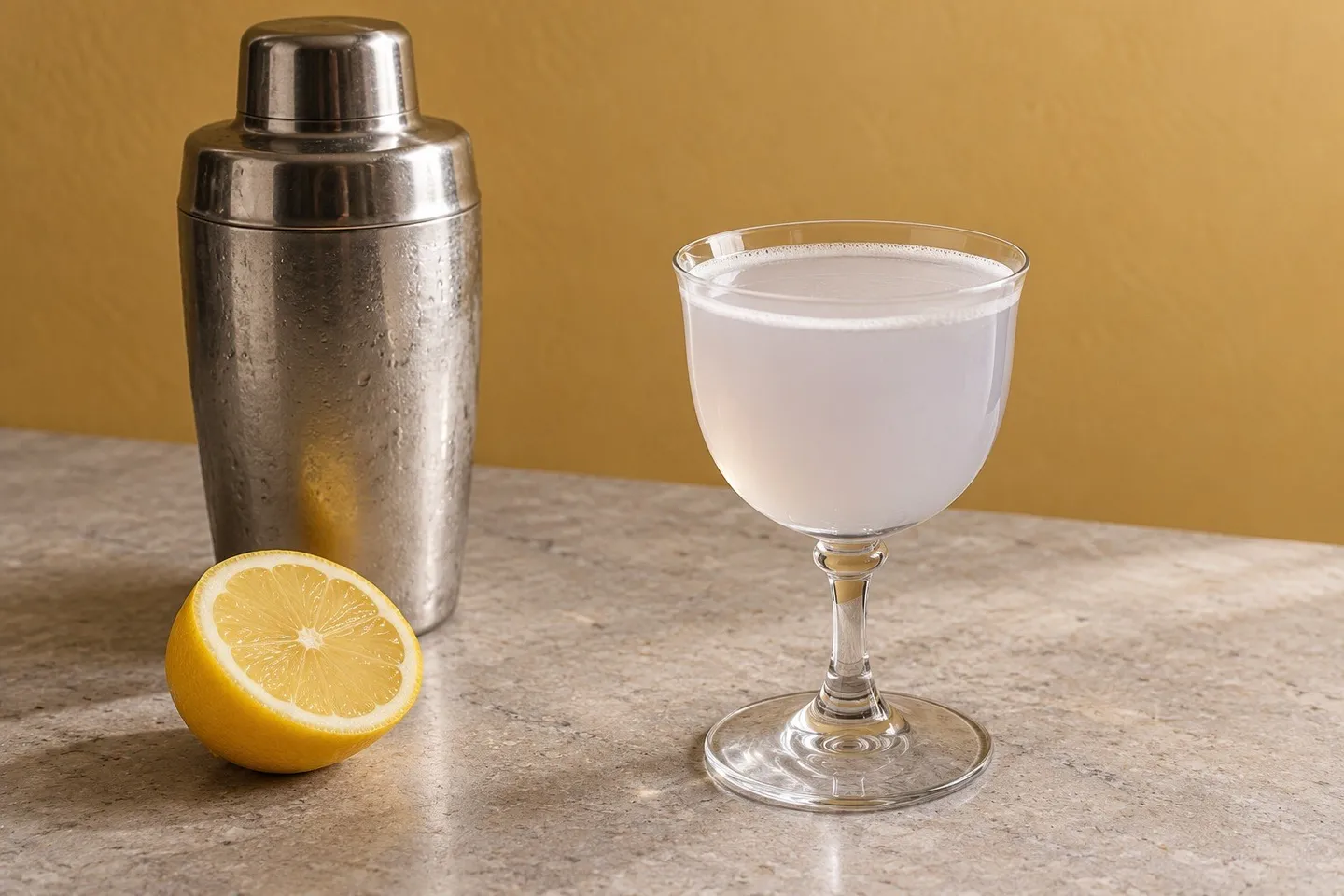
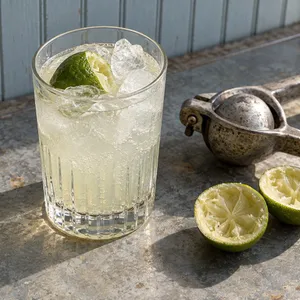
Ensslin’s 1916 Aviation, pale with a hint of violet, in a small rounded stemmed glass beside a shaker and a halved lemon.
The story behind the recipe
Hugo Ensslin, a bartender in New York hotels, made the first printed Aviation a pale gin sour with only a touch of violet: two parts gin to one of lemon juice, with two dashes of maraschino and two of crème de violette, shaken with cracked ice and strained. It appeared in his Recipes for Mixed Drinks, first copyrighted in 1916, which the Oxford Companion to Spirits and Cocktails credits with the earliest Aviation. We quote his second edition of 1917, which he sold from his own address on Fifth Avenue: “Price of book fifty cents,” about $13 today, by US consumer prices.
The violet that went missing
Ensslin wanted “a complete list of the standard mixed drinks that are in use at present in New York City,” and his Aviation has only the faintest color: two dashes of violette in a shaken gin sour. It was one of the last big American cocktail books before Prohibition closed the bars he wrote for in 1920, after which the cocktail book moved to London and Paris, as Cocktails in 1920s London and Paris tells.
London kept the drink and lost the flower. Harry Craddock’s Savoy Cocktail Book of 1930, which the Oxford Companion says drew heavily on Ensslin, gives the Aviation as lemon juice, dry gin and two dashes of maraschino, with no violette at all, though the Atty Cocktail printed just above it still takes three dashes. That violet-free sour is the Aviation the Savoy passed on. Recipes today put the violette back, often far more than Ensslin’s two dashes.
Read more about this recipe
Tart and pale
Ensslin gives fractions, not ounces, so 1 1/2 fl oz of gin and 3/4 fl oz of lemon juice keep his two to one, and a dash is about 1 ml. Shaken with ice, the drink comes to about 3 1/4 fl oz at roughly 19% ABV, a little over one US standard drink. With only about 4 ml of liqueur against the lemon, it is a tart drink, pale and cloudy, with no more than a hint of violet. El Bart is the gin he names; any London dry gin fits. Bars now pour a sweeter Aviation with nearly four times his violette, and the South Side is another gin and lemon drink of the period, with mint.
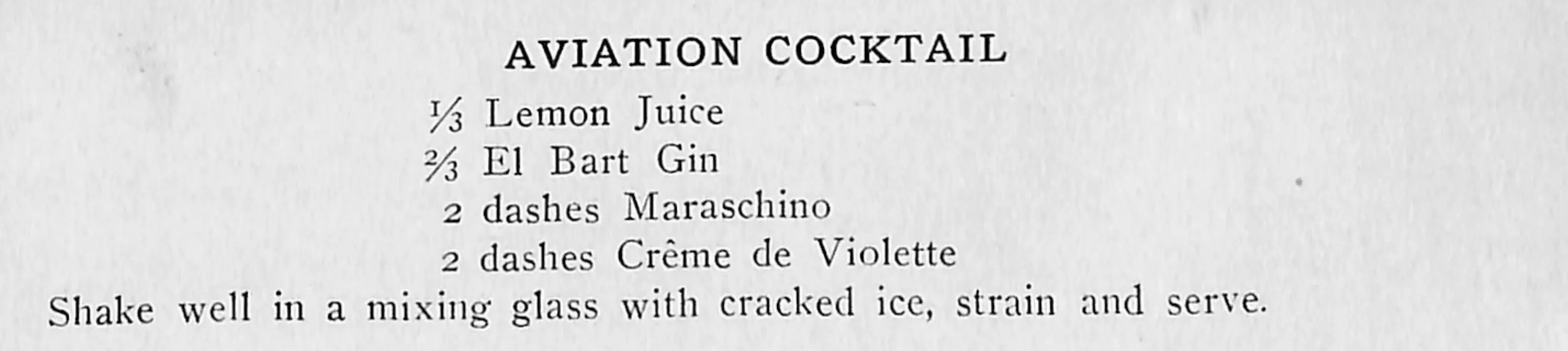
AVIATION COCKTAIL
⅓ Lemon Juice
⅔ El Bart Gin
2 dashes Maraschino
2 dashes Crême de Violette
Shake well in a mixing glass with cracked ice, strain and serve.

Recipe makes: 1 drink, about 3 1/4 fl oz
Ingredients
For 1 drink, about 3 1/4 fl oz. Quantities are shown as written.
Quantities as written here, for 1 drink, about 3 1/4 fl oz.
- London dry gin1 1/2 fl oz
- Fresh lemon juice3/4 fl oz
- Maraschino liqueur2 dashes
- Crème de violette2 dashes
- Ice cubes
Measurement notes
Ingredients as written here
- 1 1/2 fl oz London dry gin
- 3/4 fl oz fresh lemon juice
- 2 dashes maraschino liqueur
- 2 dashes crème de violette
- ice cubes
Equipment
 Citrus juicer
 Cocktail shaker
 Strainer
 Cocktail glass
Instructions
Chill a cocktail glass in the freezer or with ice water.
Squeeze the fresh lemon juice.
Pour the London dry gin, the lemon juice, the maraschino liqueur and the crème de violette into a cocktail shaker and fill it two-thirds with ice cubes.
Shake hard for about 10 seconds, until the shaker is very cold.
Strain into the chilled glass and serve without garnish, as Ensslin does.
Nutrition
110calories per serving
- Recipe makes
- 1 drink, about 3 1/4 fl oz
Estimated from USDA FoodData Central values for 80-proof gin (64 calories per fl oz) and lemon juice, plus the two liqueurs.
Recipe notes
When adjusting quantities
Keep two parts gin to one of lemon juice, with 2 dashes of each liqueur per drink; shake no more than two at a time.
Notes
Quantities mentioned in these notes don’t change when you adjust the batch.
A dash here is about 1 ml (a scant 1/4 tsp), a few drops from a bottle with a pourer.
Craddock’s 1930 Savoy version leaves out the crème de violette; the rest is the same.
The modern serve: shake 1 3/4 fl oz London dry gin, 1/2 fl oz fresh lemon juice, 1/2 fl oz maraschino liqueur and 1/4 fl oz crème de violette with ice, strain into a chilled cocktail glass and add a lemon twist if you like. It is a sweeter drink.
For an alcohol-free glass, our suggestion: shake 3/4 fl oz fresh lemon juice, 1 1/2 fl oz cold water, 1 tsp violet syrup and 1 tsp juice from a jar of maraschino cherries with ice and strain into a cocktail glass. Both liqueurs in the original contain alcohol, so leave them out entirely.
Scaling changes the ingredients only; glassware, ice and timings need their own judgment. To adapt this recipe further, try the recipe tool at TuneMyRecipe (opens in a new tab), our sister site.
Sources and attribution
Hugo R. Ensslin, Recipes for Mixed Drinks, second edition (New York: the author, 1917), p. 7; first copyrighted 1916
Recipe details
- Drink family
- Cocktails & Mixed Drinks
- Region
- American
- Source decade
- 1910s
- Difficulty
- Easy