Tom Collins, the 1876 Gin and Soda
Reader ratingsGin, lemon juice and a few dashes of syrup, shaken with shaved ice and filled up with soda: the Tom Collins as Jerry Thomas first printed it in 1876.
- Recipe makes
- 1 tall drink
- Prep
- Total
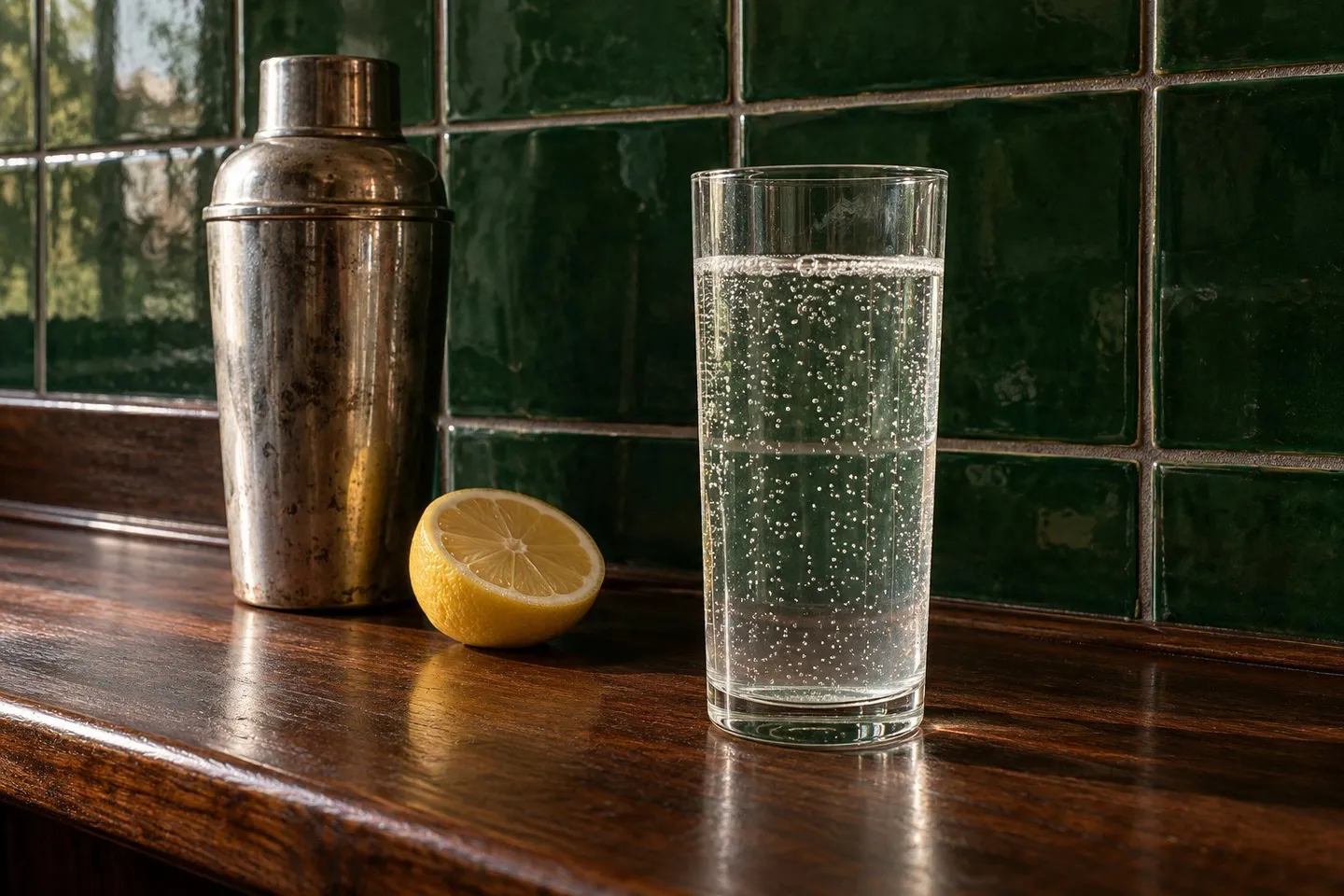
Jerry Thomas’s Tom Collins, strained and filled with soda in a tall bar glass, with a tin shaker and half a lemon.
The story behind the recipe
The first printed Tom Collins was a whiskey drink. Jerry Thomas put three of them on one page of his 1876 Bar-Tender’s Guide: Tom Collins Whiskey first, then brandy, then gin, each a large wineglass of spirit with lemon juice and gum syrup, made long with soda water. The gin version, No. 250, takes one line, “The same as Tom Collins Whiskey, substituting gin for whiskey,” and it is the one that lasted.
A joke and a waiter
In May 1874 “Tom Collins” was a prank. The Kingston Daily Freeman in New York reported that “the latest joke uptown is to ask a man if he has seen Tom Collins,” then tell him Tom Collins had been calling him names all over town and send him off to find the man, who was “a mere myth.” Nobody has shown that the prank named the drink, or the drink the prank; they are simply close in time.
The other story, told in many drinks books though we know of no period source for it, makes the name a variant of John Collins, a head waiter at Limmer’s Hotel in London. A “John Collins (English)” was a real drink, though: it was on the price list of the American bars at the Vienna World’s Fair in 1873. By 1895 George Kappeler’s Modern American Drinks could tell them apart by the gin, a Tom Collins being made “in the same manner as John Collins, using Tom gin in place of Holland gin.”
Read more about this recipe
Lively in the glass
Thomas’s sweetening is light, five or six dashes of syrup against the juice of a small lemon, so the drink is sharp. Old Tom gin, a lightly sweetened style, is the gin Kappeler named for it in 1895. Strained and filled with soda, it comes to about 10% ABV, and Thomas’s instruction to “imbibe while it is lively” means drinking it while it still fizzes.
Fifty years on, the South Side kept the idea and added mint, and TuneMyRecipe’s 1900 Gin Rickey (opens in a new tab) is a close tall cousin made with lime. Take the gin away altogether and “Lemonade and soda water” was already on the price list of London’s coffee taverns in 1878. The Collins’s own place among the long drinks of the 1870s is in The Bartenders Who Wrote Down the Classic Cocktails.
248. Tom Collins Whiskey.
(Use large bar glass.)
5 or 6 dashes of gum syrup.
Juice of a small lemon.
1 large wineglass of whiskey.
Fill the glass half full of shaved ice, shake up well and strain into a large bar glass.
Fill up the glass with plain soda water and imbibe while it is lively.
250. Tom Collins Gin.
The same as Tom Collins Whiskey, substituting gin for whiskey.

Recipe makes: 1 tall drink
Ingredients
For 1 tall drink. Quantities are shown as written.
Quantities as written here, for 1 tall drink.
- Old Tom gin2 fl oz
- Fresh lemon juice1 fl oz
- Simple syrup1 1/4 tsp
- Chilled soda water1/2 cup
- Crushed ice1 cup
Measurement notes
Ingredients as written here
- 2 fl oz Old Tom gin
- 1 fl oz fresh lemon juice
- 1 1/4 tsp simple syrup
- 1/2 cup chilled soda water
- 1 cup crushed ice
Equipment
 Cocktail shaker
 Strainer
 Tall straight glass, about 12 fl oz
Instructions
Pour the Old Tom gin, fresh lemon juice and simple syrup into a cocktail shaker.
Add the crushed ice, filling the shaker about half full, and shake hard for about 10 seconds, until the shaker is very cold.
Strain into a tall straight glass, without ice.
Fill up with the chilled soda water and serve at once.
Nutrition
145calories per serving
- Recipe makes
- 1 tall drink
Estimated from USDA FoodData Central values for 80-proof gin (64 calories per fl oz), lemon juice and simple syrup.
Recipe notes
When adjusting quantities
Scale by whole drinks; shake no more than two at a time and fill each glass with soda separately.
Notes
Quantities mentioned in these notes don’t change when you adjust the batch.
A large wineglass is taken here as 2 fl oz (about 60 ml), and Thomas’s juice of a small lemon as about 1 fl oz. His five or six dashes of gum syrup come to about 1 1/4 teaspoons; for a sweeter drink, use up to 1 tablespoon. London dry gin works too and makes it drier. Thomas strains the drink and serves it without ice; a few fresh ice cubes in the glass keep it cold longer.
For Thomas’s first version, use rye or other whiskey in place of the gin, and for No. 249, brandy.
For an alcohol-free glass, The Cocktail Book (Boston, 1901) prints a Soda Lemonade in its “Non-Alcoholic Drinks” section: “Tablespoonful sugar; three or four dashes lemon juice; three or four lumps ice; bottle plain soda. Stir well with spoon, remove ice and serve.” Stir 1 tablespoon superfine sugar and 1 teaspoon lemon juice with three or four ice cubes in a tall glass, add about 3/4 cup chilled soda water, stir until the sugar dissolves, then lift out the ice. Up to 1 fl oz of lemon juice, our option, makes it as sharp as the Collins.
Scaling changes the ingredients only; glassware, ice and timings need their own judgment.
Sources and attribution
Jerry Thomas, The Bar-Tender’s Guide; or, How to Mix All Kinds of Plain and Fancy Drinks, new and enlarged edition (New York: Dick & Fitzgerald, 1876), p. 91, Nos. 248 and 250
Recipe details
- Drink family
- Cocktails & Mixed Drinks
- Region
- American
- Era
- 19th century
- Source decade
- 1870s
- Base
- GinFruit & juice
- Difficulty
- Easy