Goldwasser, the Danzig Gold-Leaf Liqueur from 1869
Reader ratingsClean spirit steeped for a week with mace, cinnamon, citron, aniseed and rose, sweetened with an equal measure of syrup and finished with flakes of gold leaf: the Goldwasser of William Terrington’s Cooling Cups and Dainty Drinks, 1869.
- Recipe makes
- About 700 ml, one bottle
- Prep
- Total
About 30 minutes of work, after the spiced vodka has steeped for a week.
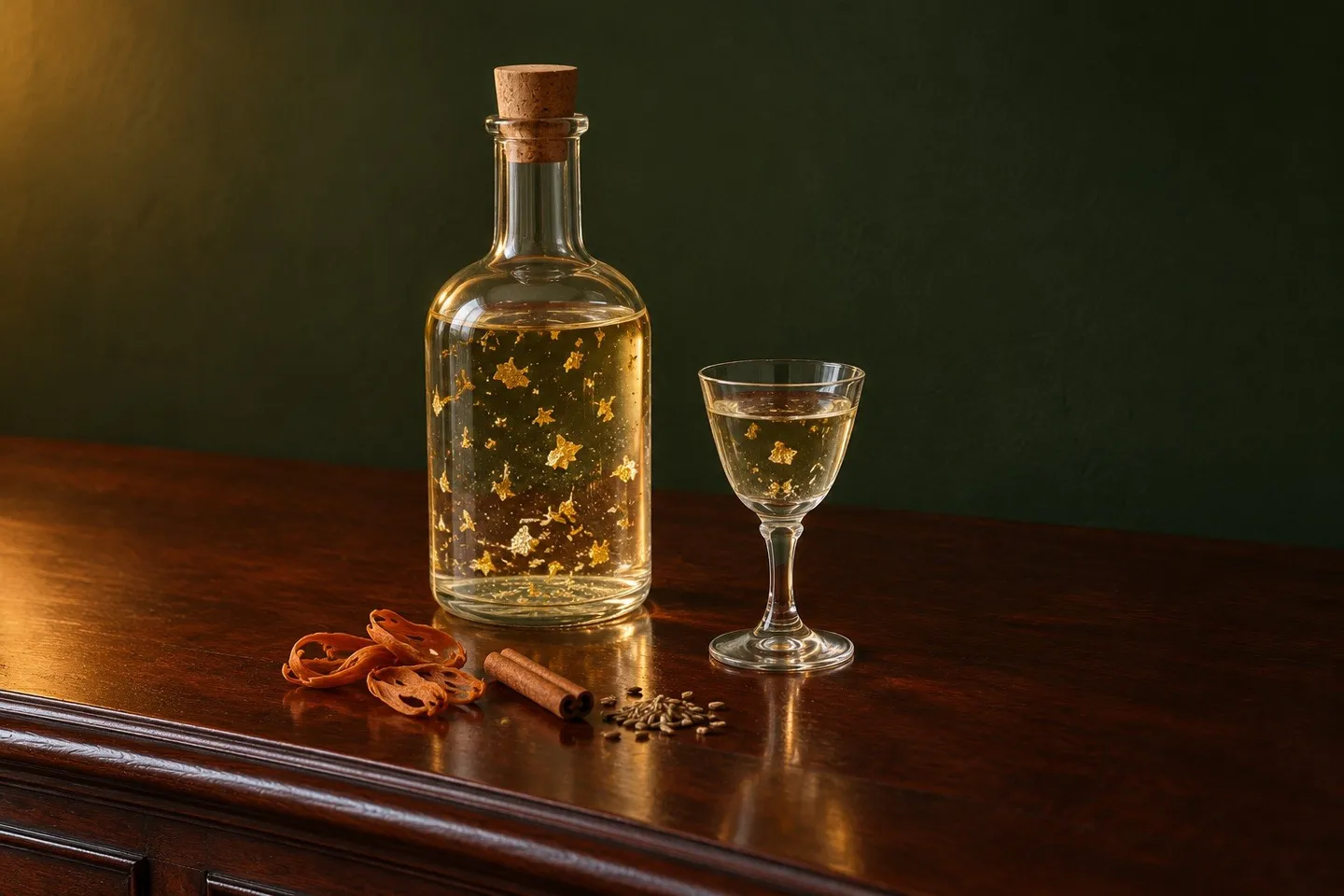
Goldwasser with flakes of gold leaf, beside the mace, cinnamon and aniseed that flavor it.
The story behind the recipe
Goldwasser is a sweet spiced liqueur with flakes of real gold floating in it, and it came from Danzig, the Baltic port that is now Gdańsk in Poland. William Terrington’s Cooling Cups and Dainty Drinks, published in London in 1869, gives a recipe in a single sentence: mace, cinnamon, citron, aniseed and rose steeped for a week in clean spirit, strained, filtered and sweetened with an equal quantity of syrup, then finished with “a few leaves of gold leaf.”
A liqueur named for its gold
Earlier in the same book Terrington explains the drink. Goldwasser, he says, was a spirit made chiefly at Dantzic, flavored with cinnamon, aniseed and other aromatics, and named for the gold leaf that floats in it. In 1869 Danzig was a Prussian city with a long Polish past, which is why we file this page under German, and why it belongs with How Poland Made Vodka. Terrington’s recipe is an English way of making the drink at home, not the Danzig distillers’ own formula, which he does not give.
The gold adds no taste. It is beaten so thin that it breaks into glittering flakes, which drift through the liqueur and settle when the bottle stands. Terrington’s flavorings are the chemist’s oils of his day, counted by the drop; only the mace goes in whole. The rose is the same note as the Warsaw Likier Różany, where it is the whole point.
Read more about this recipe
Making it today
Essential oils sold now are mostly for perfume and aromatherapy, not for food, so we use the whole spices and a little lemon peel instead and let the week of steeping do the work. Citron peel is hard to find, and lemon is the nearest common fruit. The rose comes from culinary rose water, added at the end so you can judge it. Buy gold leaf that is sold as edible; craft gold leaf is often a brass alloy and is not safe to eat. For a sweet Polish glass with no spirit at all, Lucyna Ćwierczakiewiczowa’s Sok Malinowy, a Warsaw raspberry syrup of 1885, goes into cold water or hot tea.
Goldwasser.—Dissolve in 1 pint of clean spirit 1 drachm of mace, 2 drops oil of cinnamon, 3 drops oil of citron, 6 drops of aniseed, 2 drops of oil of roses; in one week strain with pressure; filter; clear; add equal quantity of clear syrup, and a few leaves of gold leaf.

Recipe makes: About 700 ml, one bottle
Ingredients
For About 700 ml, one bottle. Quantities are shown as written.
Quantities as written here, for About 700 ml, one bottle.
- Vodka, 40% alcohol350 ml
- Mace blades, about 41 gor Blades5
- Of cinnamon stick, about 5 cm1
- Thinly pared peel of ½ lemon, yellow part only
- Aniseed1/2 metric tsp (5 ml per tsp)
- White sugar190 g
- Water240 ml
- Culinary rose water, or to taste1/2 metric tsp (5 ml per tsp)
- Sheet edible gold leaf, optional1
Measurement notes
Ingredients as written here
- 350 ml vodka, 40% alcohol
- 1 g mace blades, about 4 or 5 blades
- 1 piece of cinnamon stick, about 5 cm
- Thinly pared peel of ½ lemon, yellow part only
- ½ tsp aniseed
- 190 g white sugar
- 240 ml water
- ½ tsp culinary rose water, or to taste
- 1 sheet edible gold leaf, optional
Equipment
 Glass jar with a lid, about 1 liter
 Fine sieve
 Paper coffee filter and funnel
 Small saucepan
 Clean, dry glass bottles with stoppers
Instructions
Crush the aniseed lightly with the back of a spoon. Put it in the glass jar with the mace blades, the cinnamon stick and the lemon peel, and pour in the vodka.
Close the jar and leave it in a cool, dark place for 7 days, shaking it once a day.
Pour the spiced vodka through the fine sieve into a jug, pressing the spices with a spoon. Throw the spices away.
Run the vodka through the paper coffee filter in the funnel. This takes a while.
Put the white sugar and the water in the small saucepan. Warm it gently, stirring, until the sugar has dissolved, then bring it to the boil, skim off any froth and take it off the heat. Let it cool completely.
Stir the cooled syrup into the filtered vodka. Add the culinary rose water a little at a time, tasting, until the rose is just there behind the spice.
Pour into the clean, dry bottles. If you are using the edible gold leaf, lift it with a dry brush or the tip of a knife, since it sticks to fingers, and drop it into the bottles, where it breaks into flakes. Cork the bottles.
Shake the bottle gently before pouring, so the gold lifts from the bottom.
Nutrition
65calories per serving
- Recipe makes
- About 700 ml, one bottle
- Servings
- 23
Roughly estimated from USDA FoodData Central values for 80-proof vodka and granulated sugar, for one 30 ml glass.
Recipe notes
When adjusting quantities
A single bottle, from a little over half of Terrington’s pint of spirit. Keep the spirit and the syrup roughly equal.
Notes
Quantities mentioned in these notes don’t change when you adjust the batch.
Measures: Terrington’s pint is the British imperial pint of about 570 ml, and his drachm of mace is either about 1.8 g or about 3.9 g, depending on whether he meant the ordinary or the apothecaries’ drachm. He does not say.
Changes from the source: ours is a single bottle, with 350 ml of 40% vodka for his pint of “clean spirit” of unstated strength. Whole cinnamon, lemon peel, aniseed and culinary rose water replace his drops of cinnamon oil, oil of citron, “aniseed” and oil of roses, and our weight of mace is set for this batch rather than converted from his drachm. His “clear syrup,” from the general directions earlier in the book, is a pound of sugar boiled with a pint of water; ours is in about the same proportion, and makes roughly as much syrup as there is spiced vodka, which keeps his “equal quantity.” The gold is optional.
Strength: 350 ml of 40% vodka holds 140 ml of alcohol, in about 700 ml of finished liqueur, so roughly 20 percent. A 30 ml glass holds about 0.6 of a UK unit.
Terrington’s book is not all spirits: our Sparkling Apple Juice takes his champagne cider and makes it without alcohol.
Storage
Keep the bottle corked in a cool, dark place.
Scaling changes the ingredients only; glassware, ice and timings need their own judgment. To adapt this recipe further, try the recipe tool at TuneMyRecipe (opens in a new tab), our sister site.
Sources and attribution
William Terrington, Cooling Cups and Dainty Drinks (London and New York: George Routledge and Sons, 1869), “Goldwasser”, p. 71
Recipe details
- Drink family
- Shrubs, Syrups & Cordials
- Region
- German
- Era
- 19th century
- Source decade
- 1860s
- Difficulty
- Easy
- Occasion
- Christmas