Likier Różany, a Warsaw Rose Liqueur from 1885
Reader ratingsSpirit scented with rose, poured slowly into a hot sugar syrup and tinted red with cochineal: the rose liqueur of Lucyna Ćwierczakiewiczowa’s Warsaw household book of 1885, made today with culinary rose water.
- Recipe makes
- About 900 ml, one large bottle
- Prep
- Total
About 20 minutes, plus cooling the syrup. The book lets the liqueur settle for three days and then rest for at least six months.
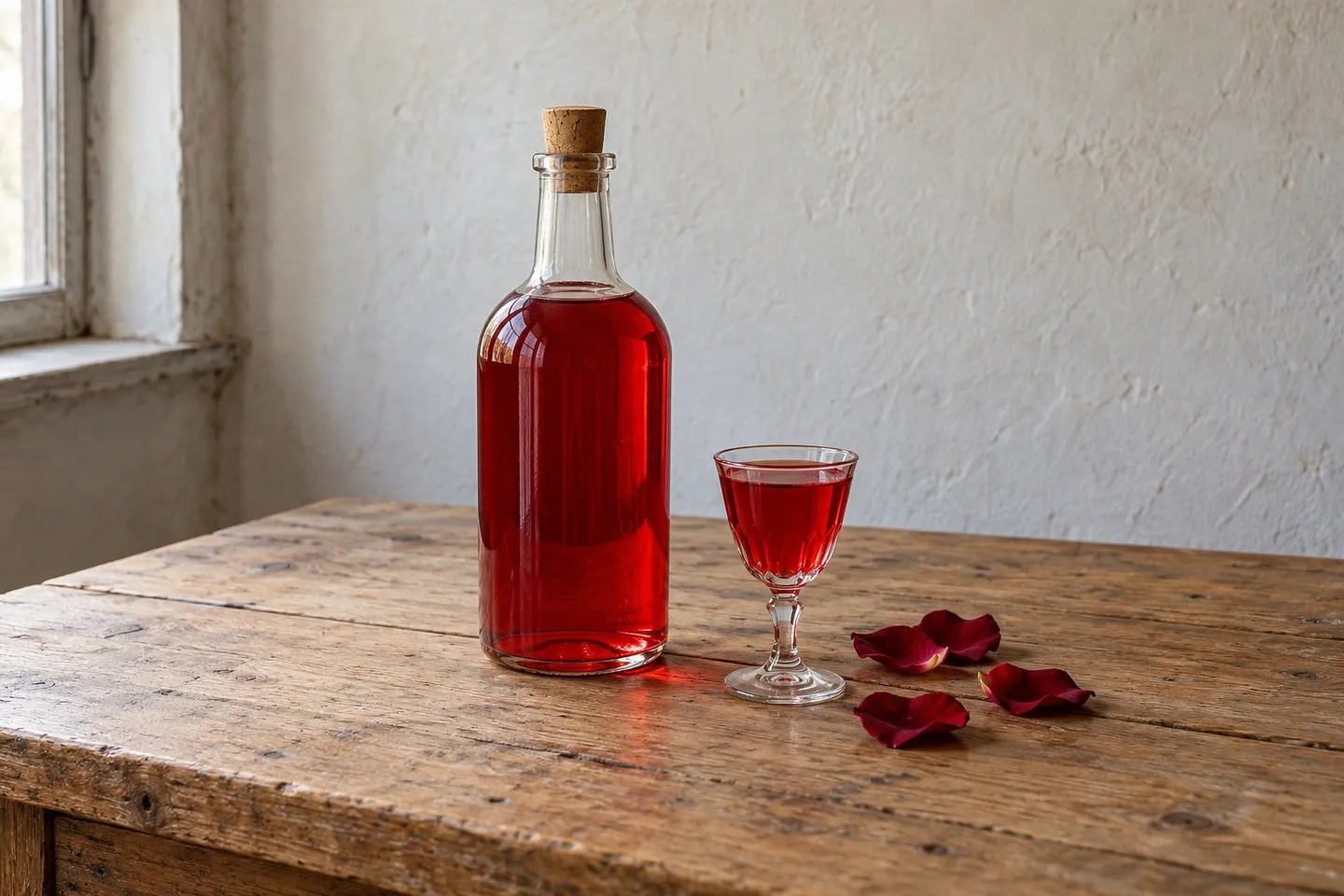
Rose liqueur in a corked bottle and a small stemmed glass, with loose rose petals.
The story behind the recipe
The rose liqueur of an 1885 Warsaw kitchen began with a bought ingredient: three drops of rose oil, “sold in pharmacies,” dropped into half a garniec of the best spirit. Lucyna Ćwierczakiewiczowa then poured the spirit slowly into a hot syrup of six funty of sugar, left it a day, and tinted it red with a little cochineal, checking the color in a small glass. “After three days the liqueur settles and is clear without filtering,” she wrote.
Rose oil and cochineal
Her book of preserves and liqueurs, in its eleventh edition by 1885, was written for housewives who wanted homemade vodkas and liqueurs cheaper than the foreign ones in the shops. Its raspberry liqueur, a page earlier, takes its flavor from fresh fruit; this one takes it from rose oil bought at the chemist’s, measured by the drop. The color came from what she calls alkiernas, “a red liquid made from the little red insects called cochineal, which give a lovely carmine color, used for coloring liqueurs, sugar and the like.” To judge it, she poured some into a small glass, “where in a smaller amount the color can be seen better,” and adjusted to suit. The story of the spirit itself is in How Poland Made Vodka.
Read more about this recipe
Making it today
Rose oil sold today is mostly for perfume and cosmetics, not for food, so we use culinary rose water, which brings the same flower in a form meant for the kitchen. Brands vary a great deal in strength, so add it a little at a time and taste. Her syrup was very heavy, and we use about half her proportion of sugar. Without the cochineal the liqueur is pale; a drop or two of carmine food coloring gives her red, and carmine is still made from cochineal insects, so the colored version is not vegan. The alcohol-free rose syrup from the same book, soured with green gooseberries, is Syrop z Róż.
Rose liqueur. Pour half a garniec of spirit of the best number into a demijohn, put into it three drops of rose oil, sold in pharmacies or pharmaceutical stores, leave the bottle in peace for 24 hours at ordinary room temperature. Make a syrup of 6 funty of the finest sugar, taking a kwaterka of water for each funt of sugar; into it, while still hot, pour the spirit slowly, so that it clears by itself. After 24 hours pour into the demijohn a little alkiernas, a red liquid made from the little red insects called cochineal, which give a lovely carmine color, used for coloring liqueurs, sugar and the like. After pouring it into the demijohn, to see whether it is colored enough, pour some into a small glass, where in a smaller amount the color can be seen better, and adjust accordingly. After three days the liqueur settles and is clear without filtering.

Recipe makes: About 900 ml, one large bottle
Ingredients
For About 900 ml, one large bottle. Quantities are shown as written.
Quantities as written here, for About 900 ml, one large bottle.
- White sugar300 g
- Water190 ml
- Vodka, 40% alcohol500 ml
- Culinary rose water, or to taste2 metric tsp (5 ml per tsp)
Measurement notes
Ingredients as written here
- 300 g white sugar
- 190 ml water
- 500 ml vodka, 40% alcohol
- 2 tsp culinary rose water, or to taste
Equipment
 Small saucepan
 Large jug or bowl
 Small cocktail glass
 Clean, dry glass bottles with stoppers
Instructions
Put the white sugar and the water in the small saucepan. Warm gently, stirring, until the sugar has dissolved, then let it bubble for 1 minute, skimming off any froth. Take it off the heat and let it cool completely.
Pour the cooled syrup into the large jug and pour in the vodka slowly, stirring all the time.
Stir in the culinary rose water, a teaspoon at a time, tasting after each, until the rose is clear but not soapy.
Pour a little into the small cocktail glass to judge the color, and add carmine food coloring a drop at a time if you want the red of the original.
Pour into the clean, dry bottles, cork them and leave them in a cool, dark place for 3 days to settle before pouring.
Nutrition
80calories per serving
- Recipe makes
- About 900 ml, one large bottle
- Servings
- 29
Roughly estimated from USDA FoodData Central values for 80-proof vodka and granulated sugar, for one 30 ml glass.
Recipe notes
When adjusting quantities
A small batch for one large bottle, with about half the book’s proportion of sugar.
Notes
Quantities mentioned in these notes don’t change when you adjust the batch.
Measures: Warsaw cooks of the time used the “new Polish” measures introduced in 1819, in which a garniec is about 4 liters, a kwarta about 1 liter, a kwaterka a quarter of that, about 250 ml, and a funt about 405 g. Period sizes varied, so treat these as rough guides.
Changes from the source: her half garniec of the best spirit was about 2 liters, with 6 funty of sugar, about 2.4 kg, dissolved in 6 kwaterki of water, about 1.5 liters. Ours is a single bottle of 40% vodka with about half her proportion of sugar. Culinary rose water replaces her three drops of pharmacy rose oil; don’t use a rose essential oil that is not sold for food. Her spirit was poured into the syrup while it was still hot; we cool the syrup first so the vodka doesn’t steam off. Her cochineal coloring is optional here. The book prints “the best Nr.” with no number after it, so we can’t say which grade of spirit she meant.
Strength: 500 ml of 40% vodka holds 200 ml of alcohol, in about 900 ml of liqueur once the syrup is in, so about 22 percent. A 30 ml glass holds about two-thirds of a UK unit.
Storage
Keep the bottle corked in a cool, dark place. The book’s general rule is to leave liqueurs untouched for at least six months; it can be poured sooner.
Scaling changes the ingredients only; glassware, ice and timings need their own judgment. To adapt this recipe further, try the recipe tool at TuneMyRecipe (opens in a new tab), our sister site.
Sources and attribution
Lucyna Ćwierczakiewiczowa, Jedyne praktyczne przepisy konfitur, różnych marynat, wędlin, wódek, likierów, win owocowych, miodów oraz ciast, 11th ed. (Warsaw: the author, 1885), No. 24, “Likier różany”, pp. 238–239; our translation
Recipe details
- Drink family
- Shrubs, Syrups & Cordials
- Region
- Polish
- Era
- 19th century
- Source decade
- 1880s
- Difficulty
- Easy
- Occasion
- Christmas