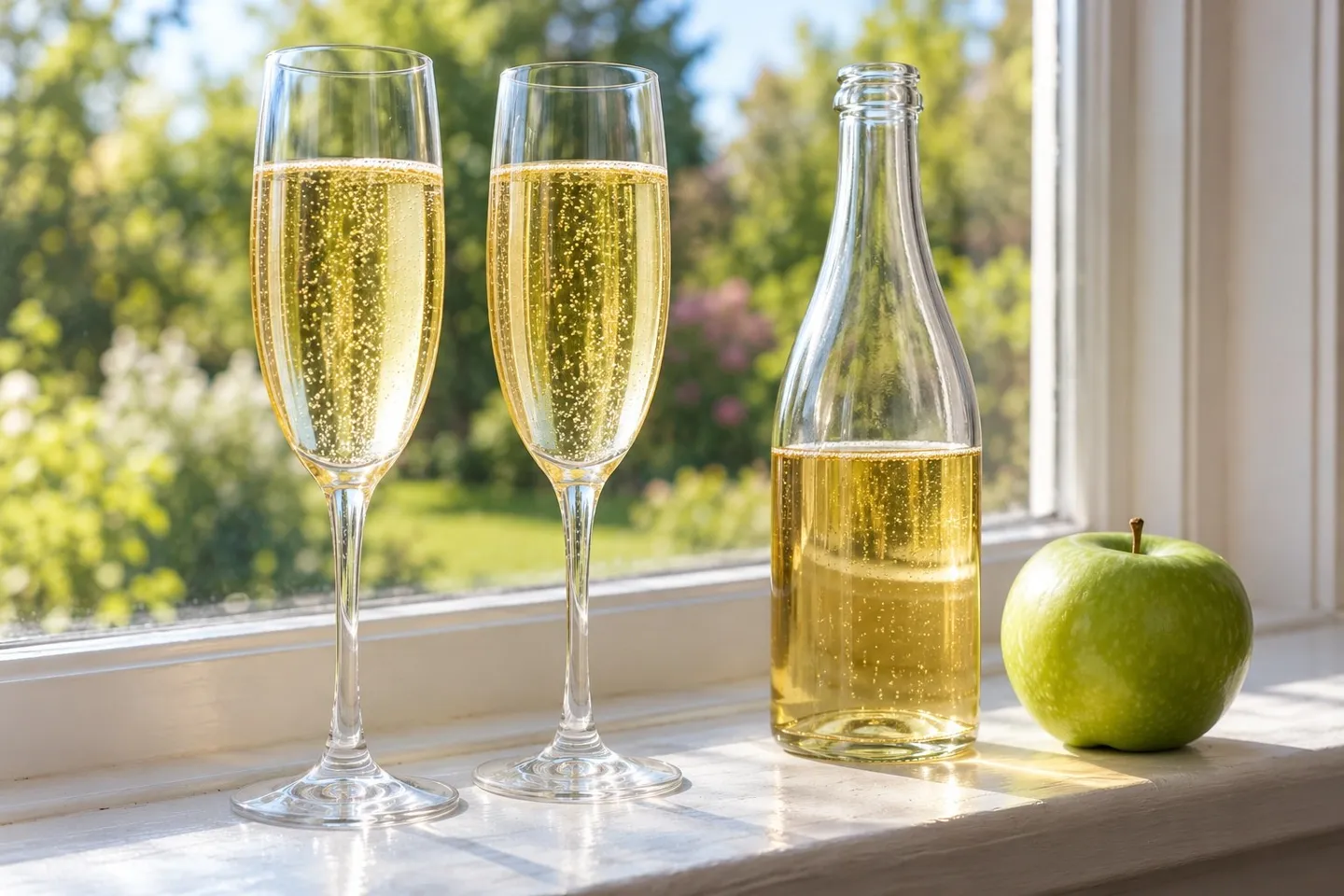
Sparkling Apple Juice, an Alcohol-Free Champagne Cider
Reader ratingsClear apple juice and soda water, cold and poured at the last minute: a modern, alcohol-free stand-in for the bottled champagne cider of the 1860s.
- Recipe makes
- About 1 liter, 6 flutes
- Prep
- Total
Chill the juice, the soda water and the glasses for a few hours beforehand.
Sparkling apple juice in two flutes beside the open bottle and a green apple.
The story behind the recipe
Apple juice and soda water, mixed in a cold jug at the last minute, give this modern adaptation the clear gold and the bubbles of 19th-century champagne cider, without the 5 to 7 percent alcohol the old bottles held. Pasteurized juice takes the place of fermented cider, and the soda water brings the gas.
Ten gallons and a bung
The idea comes from William Terrington’s Cooling Cups and Dainty Drinks (1869), whose Sparkling Champagne Cider took ten gallons of old cider, a little syrup and tartaric acid, then a dose of bicarbonate of potash, and the bung driven in “as tight as possible immediately.” The acid and the bicarbonate made the gas inside the barrel. Here the gas comes ready-made in the soda water, so nothing needs sealing. It was one of several ways champagne cider got its sparkle.
Read more about this recipe
Clear juice, cold glasses
Choose a clear, filtered apple juice rather than a cloudy pressed one. Terrington starts from “good clear old cider,” and even the doctored bottle a US government chemist opened in 1887 was bright and clear. The trade sold that brightness. The chemist described much of the bottled champagne cider of his day as clarified cider, a large share of it made in New Jersey, and thought most of the cheap American champagne was made the same way. A filtered juice from the shop shelf gives the glass the same clear look. The same chemist found that sweet cider fresh from the press averaged 1.76 percent alcohol, and the two champagne ciders he tested three to four times that. Use pasteurized juice: the US Food and Drug Administration warns that untreated juice and fresh-pressed cider can carry harmful bacteria.
The soda water softens the juice’s sweetness as well as lifting it. For a hot alternative on a cold evening there is the mulled sweet cider with nutmeg and cloves, and the alcoholic glass of Terrington’s day is the Cider Cup à la Ensor.
Sparkling Champagne Cider.—Put 10 gallons of good clear old cider into a strong clean beer barrel, pitched inside; add 3 pints clean syrup, and 5 oz. of tartaric acid. In ten minutes take the bung in one hand, and quickly add 7½oz. of bicarbonate of potassa; bung up as tight as possible immediately.

Recipe makes: About 1 liter, 6 flutes
Ingredients
For About 1 liter, 6 flutes. Quantities are shown as written.
Quantities as written here, for About 1 liter, 6 flutes.
- Clear pasteurized apple juice, chilled750 ml
- Soda water, chilled250 ml
Measurement notes
Ingredients as written here
- 750 ml clear pasteurized apple juice, chilled
- 250 ml soda water, chilled
Equipment
 Jug
 6 champagne flutes or coupes, chilled
Instructions
Chill the clear pasteurized apple juice, the soda water and the glasses for at least 2 hours.
Pour the apple juice into a cold jug.
Just before serving, pour in the soda water slowly down the side of the jug and stir once, gently.
Pour into the chilled flutes and serve at once.
Nutrition
60calories per serving
- Recipe makes
- About 1 liter, 6 flutes
- Servings
- 6
Estimated from USDA FoodData Central values for bottled, unsweetened apple juice; soda water adds none.
Recipe notes
When adjusting quantities
Keep three parts juice to one part soda water.
Notes
Quantities mentioned in these notes don’t change when you adjust the batch.
Champagne cider was not alcohol-free: the 1887 USDA analyses found 5.1 and 6.8 percent alcohol in two bottles. This version contains none. Terrington’s other champagne cider on the same page, fortified and scented, is our Champagne Cider with Orange-Flower Water.
The juice brings all the sweetness: about 10 g of sugar per 100 ml in a typical apple juice, so the mixed drink is a little less sweet than most soft drinks.
Storage
Mix it just before serving; the bubbles fade within half an hour. Keep opened apple juice in the fridge.
Scaling changes the ingredients only; glassware, ice and timings need their own judgment. To adapt this recipe further, try the recipe tool at TuneMyRecipe (opens in a new tab), our sister site.
Sources and attribution
Modern adaptation of William Terrington, Cooling Cups and Dainty Drinks (London: Routledge, 1869), p. 111
See the original pages (scan at Internet Archive) (opens in a new tab)
Recipe details
- Drink
- Alcohol-free
- Drink family
- Sodas & Soft Drinks
- Region
- British
- Era
- 19th century
- Source decade
- 1860s
- Base
- Fruit & juice
- Difficulty
- Easy
- Occasion
- Summer partyNew Year’s Eve
- Season
- Summer