Likier Malinowy, a Warsaw Raspberry Liqueur from 1885
Reader ratingsRipe raspberries steeped in spirit for exactly twenty-four hours, twice, then filtered and poured into a thick sugar syrup: the raspberry liqueur of Lucyna Ćwierczakiewiczowa’s Warsaw household book of 1885.
- Recipe makes
- About 700 ml, one bottle
- Prep
- Total
Two steeps of exactly 24 hours, then about 30 minutes to filter and sweeten. The book then leaves the bottles alone for half a year.
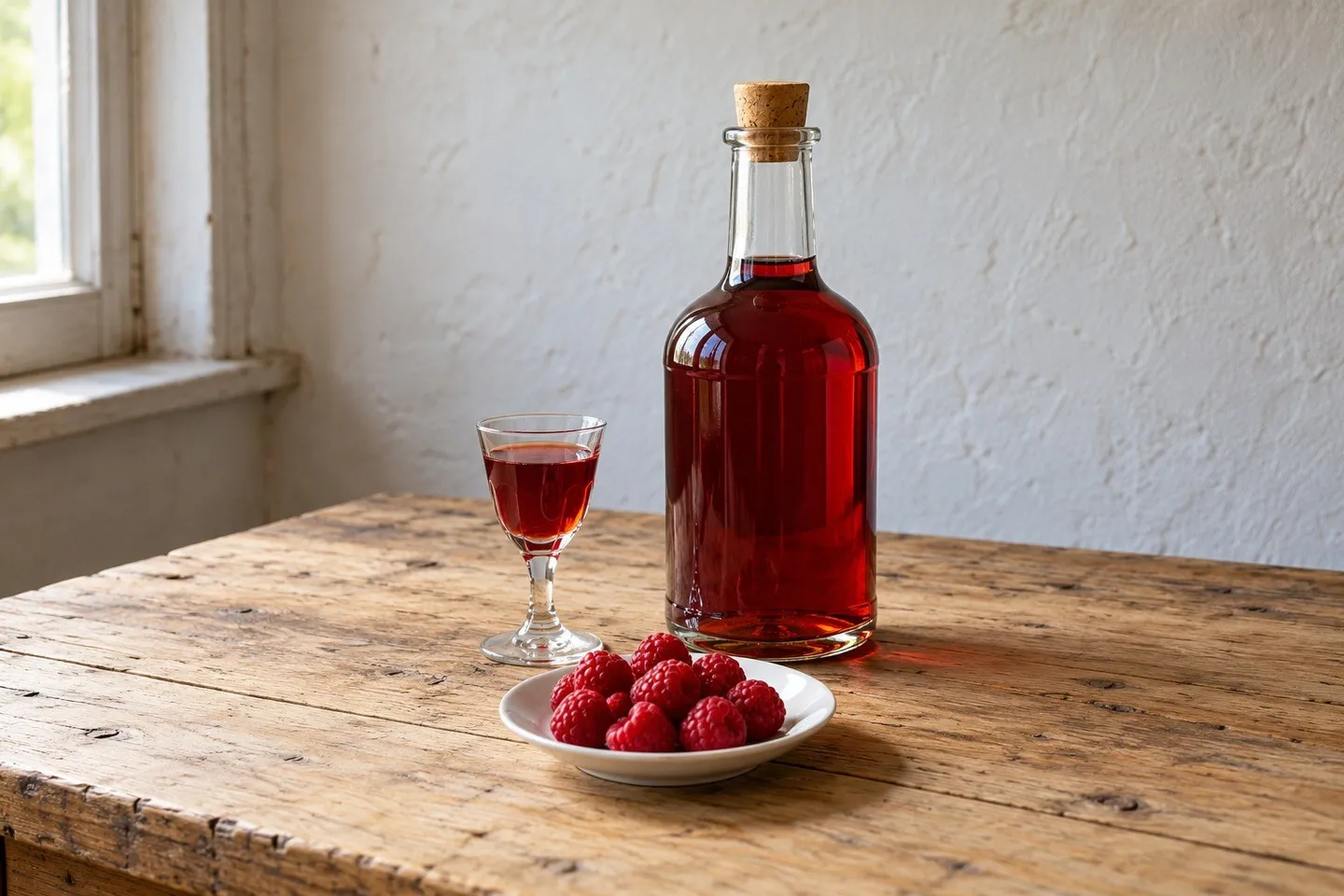
Raspberry liqueur in a corked bottle and a small stemmed glass, with the ripe raspberries it is made from.
The story behind the recipe
This is the raspberry liqueur of a Warsaw household in 1885, and its secret is speed. Lucyna Ćwierczakiewiczowa, one of Warsaw’s best-known cookery writers, steeps ripe raspberries in spirit for twenty-four hours, throws them out, steeps a second lot for another twenty-four, “never longer,” and then pours the filtered spirit into a thick syrup. Her reason: raspberries are full of acid, so the shorter the spirit stands on them, the less acid it takes up, while it still draws out all the scent.
A housewife’s liqueur
The recipe comes from her book of preserves, cured meats, vodkas and liqueurs, which by 1885 was in its eleventh edition. Its liqueur chapter opens by promising that a careful housewife, even in town, can make vodkas and liqueurs at home that cost less than the foreign ones in the shops. She sets three rules: the purest, strongest spirit you can get and refined sugar; fruit and peel left in the spirit no longer than needed; and the finished bottles sealed and left alone for at least six months. Her own spirit is “14 próby,” a strength grade we can’t match to a modern percentage, so we use vodka at 40 percent. How Polish vodka came to be made in the first place is in How Poland Made Vodka.
Read more about this recipe
Making it today
The two short steeps are the whole method, and the second lot of fresh fruit goes into spirit that has already taken up the first. Her syrup is made by wetting the sugar with only as much water as it will take up; we measure that as 60 ml for 200 g. She pours the spirit into the syrup in a bowl and says it should come out “czysty zupełnie,” completely clear; filtering before the syrup goes in is what makes that possible, she explains, because syrup is harder to filter. For the same fruit with no spirit at all, make Sok Malinowy, the raspberry syrup from the same book, which Poles often stir into hot tea.
Raspberry liqueur. Into a one-garniec demijohn put enough completely ripe raspberries to fill three quarters of it, that is, more or less three kwarty; pour over them spirit of 14 próby and leave in the shade at room temperature for 24 hours. After that time pour off the spirit, throw the raspberries away, put in fresh raspberries to half the demijohn and pour over them the same spirit you poured off, leaving it again in the shade for 24 hours, never longer, because raspberries contain much acid; so the shorter the spirit stands on them, the less acid they give off, and the spirit takes up all the aroma. After pouring off the spirit a second time, which can be passed through paper straight away, that is, filtered, because it is harder with the syrup, take 3 funty of the finest sugar, wetting it only with as much water as it takes up by itself, make a thick syrup, pour it into a bowl, pouring the filtered raspberry spirit over it slowly, mix well; it should be completely clear; pour into bottles, cork and leave in peace for half a year.

Recipe makes: About 700 ml, one bottle
Ingredients
For About 700 ml, one bottle. Quantities are shown as written.
Quantities as written here, for About 700 ml, one bottle.
- Ripe raspberries400 g
- Vodka, 40% alcohol500 ml
- White sugar200 g
- Water60 ml
Measurement notes
Ingredients as written here
- 400 g ripe raspberries
- 500 ml vodka, 40% alcohol
- 200 g white sugar
- 60 ml water
Equipment
 Glass jar with a lid, about 1 liter
 Fine sieve
 Paper coffee filter and funnel
 Small saucepan
 Clean, dry glass bottles with stoppers
Instructions
Put half the ripe raspberries in the glass jar and pour the vodka over them. Close the jar and leave it somewhere shady at room temperature for 24 hours.
Pour the vodka off through the fine sieve into a jug, without pressing the fruit. Throw away the raspberries.
Put the rest of the raspberries in the rinsed jar, pour the same vodka back over them, close it and leave it for another 24 hours. No longer.
Pour the vodka off through the sieve again, without pressing, then run it through the paper coffee filter into a clean jug. This takes a while.
Put the white sugar in the small saucepan and pour the water over it. Warm it gently, stirring, until the sugar has dissolved, then let it bubble for 1 minute. Take it off the heat and let it cool completely.
Pour the cooled syrup into a bowl and pour in the raspberry vodka slowly, stirring all the time.
Pour into the clean, dry bottles, cork them and store them in a cool, dark place.
Nutrition
85calories per serving
- Recipe makes
- About 700 ml, one bottle
- Servings
- 23
Roughly estimated from USDA FoodData Central values for 80-proof vodka, raspberries and granulated sugar, for one 30 ml glass.
Recipe notes
When adjusting quantities
A small batch for one bottle. Keep two equal lots of fruit and the two 24-hour steeps.
Notes
Quantities mentioned in these notes don’t change when you adjust the batch.
Measures: Warsaw cooks of the time used the “new Polish” measures introduced in 1819, in which a garniec is about 4 liters, a kwarta about 1 liter and a funt about 405 g. Period sizes varied, so treat these as rough guides.
Changes from the source: her batch filled a 4-liter demijohn with about three liters of raspberries and took 3 funty of sugar, about 1.2 kg; ours is a single bottle, with two equal lots of fruit where hers were three-quarters and then half a demijohn. Her spirit of 14 próby is replaced by 40% vodka, and her room-temperature shade is kept. We cool the syrup before the vodka goes in, which she does not ask for; it keeps the spirit from steaming off. The six months’ rest is hers; the liqueur can be drunk sooner, but it softens as it stands.
Strength: 500 ml of 40% vodka holds 200 ml of alcohol. The fruit keeps back a little and gives up some juice, and the syrup adds about 185 ml, so the finished bottle is roughly 25 to 30 percent alcohol. A 30 ml glass holds a little under one UK unit.
The same 1885 Warsaw book makes its raspberries into a syrup with no alcohol: Sok Malinowy, for cold water or hot tea.
Storage
Keep the bottle corked in a cool, dark place. The book leaves it untouched for half a year before drinking; it can be poured sooner.
Scaling changes the ingredients only; glassware, ice and timings need their own judgment. To adapt this recipe further, try the recipe tool at TuneMyRecipe (opens in a new tab), our sister site.
Sources and attribution
Lucyna Ćwierczakiewiczowa, Jedyne praktyczne przepisy konfitur, różnych marynat, wędlin, wódek, likierów, win owocowych, miodów oraz ciast, 11th ed. (Warsaw: the author, 1885), No. 21, “Likier malinowy”, pp. 236–237; our translation
Recipe details
- Drink family
- Shrubs, Syrups & Cordials
- Region
- Polish
- Era
- 19th century
- Source decade
- 1880s
- Difficulty
- Intermediate
- Occasion
- Christmas