Gunpowder Green Tea, Mrs. Beeton’s Way
Reader ratingsA teaspoon of rolled gunpowder tea for each person and one for the pot, boiling water, five minutes under the lid, then filled up: green tea as Mrs. Beeton made it in 1861.
- Recipe makes
- About 500 ml, 2 cups
- Prep
- Cook
- Total
Includes 2 to 3 minutes to warm the pot and 5 minutes for the tea to draw.
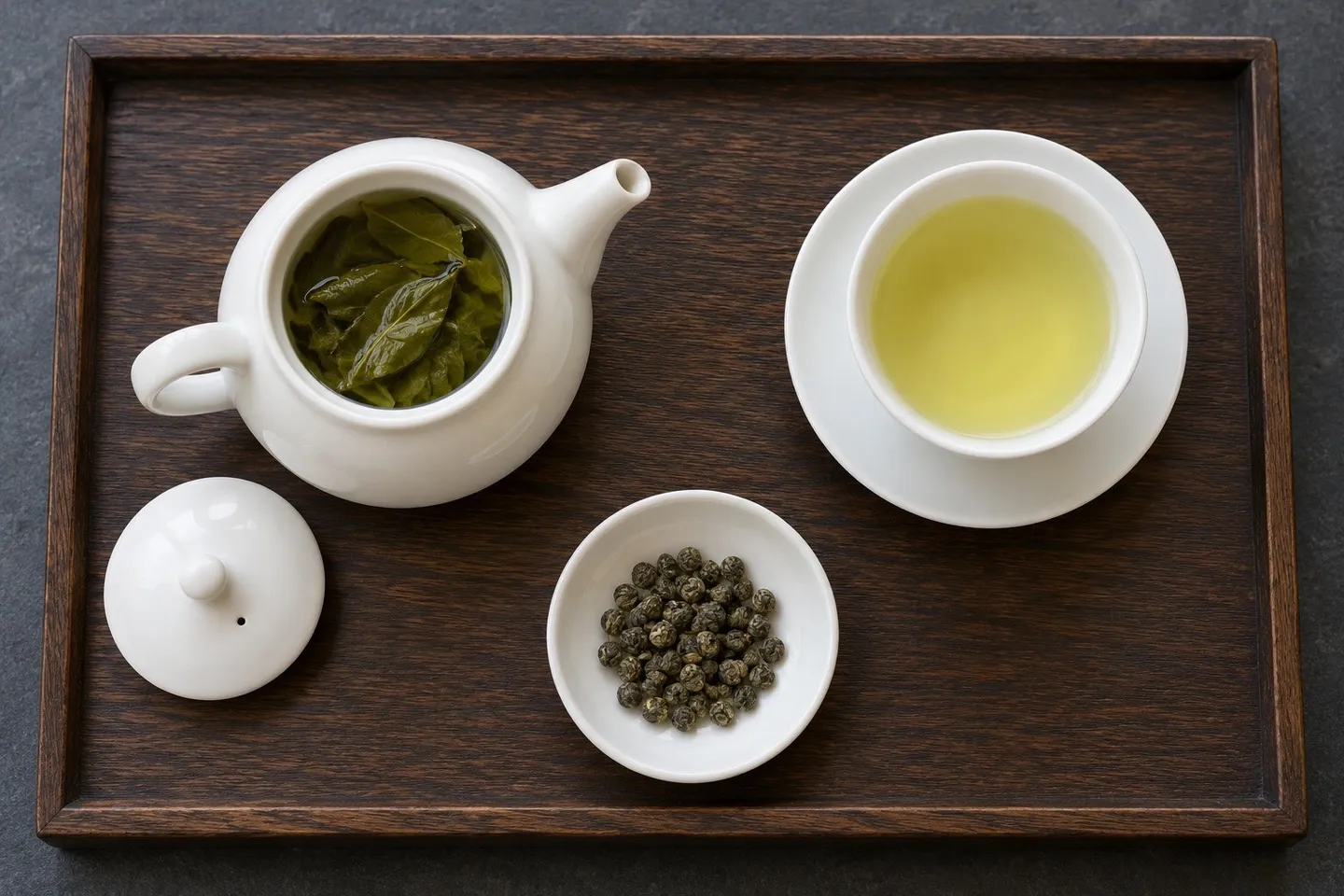
Gunpowder green tea in the cup, the leaves unrolled in the pot and dry pellets in a dish.
The story behind the recipe
Gunpowder is green tea rolled into small, tight gray-green pellets, and this is how Mrs. Beeton told a Victorian household to brew it: a warm pot, “a teaspoonful to each person, and one over,” water that is “actually boiling,” and a long draw with the lid shut before the pot is filled up. In the pot the pellets open out into whole leaves.
The fragrant leaf
The method is No. 1814 in Isabella Beeton’s Book of Household Management (1861). “There is very little art in making good tea,” she begins; “if the water is boiling, and there is no sparing of the fragrant leaf, the beverage will almost invariably be good.” Boiling water mattered to her because “the leaves will not open” without it, and an unopened leaf gives “nothing but tepid water.”
Opening was also the test that real tea passed and fake tea failed. In 1851 a London chemist found “gunpowder” made of tea dust and sand glued into pellets and glazed with color, which no soaking would unroll; the Chinese makers sold it as lie tea.
Read more about this recipe
Green, black or mixed
Mrs. Beeton’s rule is for any tea, and her usual choice was a blend: “four spoonfuls of black to one of green.” She was wary of green tea on its own: “strong green tea is highly pernicious, and should never be partaken of too freely.” That was a Victorian view, shared by William Terrington, who wrote in 1869 that green tea had “more stimulating” properties than black.
We take the short end of her five to ten minutes, because green tea left longer turns bitter. Even so, with water at a full boil, expect it brisk and astringent. For a pot left the full ten minutes, black and strong, there is coffee-tavern tea.
TO MAKE TEA.
1814. There is very little art in making good tea; if the water is boiling, and there is no sparing of the fragrant leaf, the beverage will almost invariably be good. The old-fashioned plan of allowing a teaspoonful to each person, and one over, is still practised. Warm the teapot with boiling water; let it remain for two or three minutes for the vessel to become thoroughly hot, then pour it away. Put in the tea, pour in from ½ to ¾ pint of boiling water, close the lid, and let it stand for the tea to draw from 5 to 10 minutes; then fill up the pot with water. The tea will be quite spoiled unless made with water that is actually boiling, as the leaves will not open, and the flavour not be extracted from them; the beverage will consequently be colourless and tasteless,—in fact, nothing but tepid water. Where there is a very large party to make tea for, it is a good plan to have two teapots instead of putting a large quantity of tea into one pot; the tea, besides, will go farther. When the infusion has been once completed, the addition of fresh tea adds very little to the strength; so, when more is required, have the pot emptied of the old leaves, scalded, and fresh tea made in the usual manner. Economists say that a few grains of carbonate of soda, added before the boiling water is poured on the tea, assist to draw out the goodness: if the water is very hard, perhaps it is a good plan, as the soda softens it; but care must be taken to use this ingredient sparingly, as it is liable to give the tea a soapy taste if added in too large a quantity. For mixed tea, the usual proportion is four spoonfuls of black to one of green; more of the latter when the flavour is very much liked; but strong green tea is highly pernicious, and should never be partaken of too freely.
Time.—2 minutes to warm the teapot, 5 to 10 minutes to draw the strength from the tea.
Sufficient.—Allow 1 teaspoonful to each person, and one over.

Recipe makes: About 500 ml, 2 cups
Ingredients
For About 500 ml, 2 cups. Quantities are shown as written.
Quantities as written here, for About 500 ml, 2 cups.
- Gunpowder green tea, 3 level teaspoons8 g
- Boiling water, plus more to warm the pot525 ml
Measurement notes
Ingredients as written here
- 8 g gunpowder green tea, 3 level teaspoons
- 525 ml boiling water, plus more to warm the pot
Equipment
 Kettle
 Small teapot with a lid, about 600 ml
 Tea strainer
 2 teacups
Instructions
Fill the teapot with boiling water from the kettle, put the lid on and leave it for 2 to 3 minutes to heat through. Pour the water away.
Put the gunpowder green tea in the warm pot.
Bring the kettle back to a full boil and pour in a little more than half of the boiling water. Close the lid at once.
Leave the tea to draw for 5 minutes.
Fill up the pot with the rest of the boiling water, then pour the tea through a strainer into the cups.
Nutrition
2calories per serving
- Recipe makes
- About 500 ml, 2 cups
- Servings
- 2
Estimated from USDA FoodData Central values for brewed green tea, without milk or sugar.
Recipe notes
When adjusting quantities
Mrs. Beeton’s rule is a teaspoon of tea for each person and one over. For a large party she used two pots, not one big one.
Notes
Quantities mentioned in these notes don’t change when you adjust the batch.
Rolled gunpowder pellets are dense, so a level teaspoon weighs about 2.5 to 3 g; weigh it the first time. Mrs. Beeton’s first pour, half to three-quarters of an imperial pint, is 285 to 425 ml; we use about 300 ml and fill up with the rest.
For her mixed tea, use four spoons of black tea to one of gunpowder for every five spoons the pot needs, and the same method.
Tea has caffeine. The European Food Safety Authority puts single doses of up to 200 mg and daily intakes of up to 400 mg as raising no safety concern for healthy adults, and 200 mg a day in pregnancy; a cup or two of green tea at this strength is well within that.
Scaling changes the ingredients only; glassware, ice and timings need their own judgment. To adapt this recipe further, try the recipe tool at TuneMyRecipe (opens in a new tab), our sister site.
Sources and attribution
Isabella Beeton, The Book of Household Management (London: S. O. Beeton, 1861), no. 1814, pp. 879–880
Recipe details
- Drink
- Alcohol-free
- Drink family
- Hot Drinks
- Region
- British
- Era
- 19th century
- Source decade
- 1860s
- Difficulty
- Easy
- Occasion
- Dry January