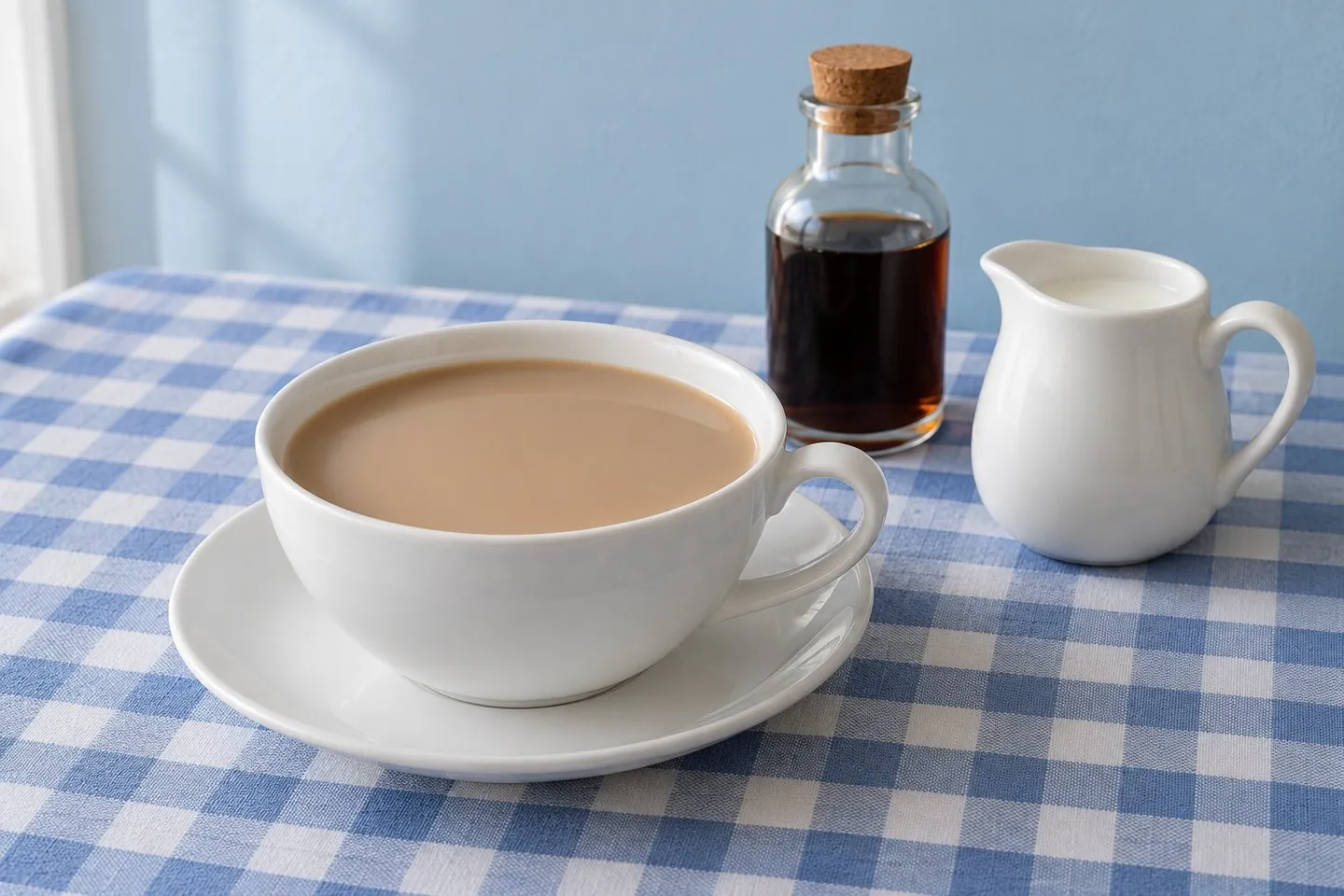
Mrs. Beeton’s Café au Lait with Essence of Coffee
Reader ratingsFresh-ground coffee and a small spoonful of chicory, dripped, warmed and dripped again into a strong essence, then stirred into hot milk: Mrs. Beeton’s café au lait of 1861.
- Recipe makes
- About 175 ml essence, 6 breakfast cups
- Prep
- Cook
- Total
The essence keeps covered in the fridge for up to 3 days, so after the first batch each cup takes only as long as heating the milk.
Café au lait in a breakfast cup, with the bottle of coffee essence and a jug of hot milk.
The story behind the recipe
A strong coffee concentrate, made once and kept in a bottle with a pinch of chicory in it, is the heart of Mrs. Beeton’s café au lait. She pours boiling water slowly through ground coffee and chicory, warms the result to simmering point and filters it a second time. Two tablespoons of the essence then turn a breakfast cup of hot milk into café au lait.
A coffee for early risers
The recipe is No. 1808 in Isabella Beeton’s Book of Household Management (1861), and she says who it is for: “those persons who have to rise extremely early; and having only the milk to make boiling, is very easily and quickly prepared.” Her café au lait, No. 1812, follows a few pages later and points back to it: the essence “answers admirably for café au lait,” and the drink is “infinitely superior to the weak watery coffee so often served at English tables.”
Her chicory is a seasoning, not a filler. To a quarter pound of coffee she allows “1 small teaspoonful of powdered chicory,” about 2 percent of the weight, at a time when London analysts were finding grocers’ “coffee” that was half chicory or more.
Read more about this recipe
Half a bottle, and the fridge
We make half of Mrs. Beeton’s essence, enough for six breakfast cups. She says the corked bottle “will remain good for several days”; we keep it in the fridge and use it within three. Roasted ground chicory is sold as a coffee alternative. Leave it out and the essence is simply strong coffee, and a little lighter in color.
Mrs. Beeton gives no sugar for this drink. Her breakfast cup is not measured; we take it as 250 ml of milk. For coffee as a French writer made it in 1685, try Dufour’s coffee, boiled with a little sugar.
TO MAKE ESSENCE OF COFFEE.
1808. INGREDIENTS.—To every ¼ lb. of ground coffee allow 1 small teaspoonful of powdered chicory, 3 small teacupfuls, or 1 pint, of water.
Mode.—Let the coffee be freshly ground, and, if possible, freshly roasted; put it into a percolater, or filter, with the chicory, and pour slowly over it the above proportion of boiling water. When it has all filtered through, warm the coffee sufficiently to bring it to the simmering-point, but do not allow it to boil; then filter it a second time, put it into a clean and dry bottle, cork it well, and it will remain good for several days. Two tablespoonfuls of this essence are quite sufficient for a breakfast-cupful of hot milk. This essence will be found particularly useful to those persons who have to rise extremely early; and having only the milk to make boiling, is very easily and quickly prepared. When the essence is bottled, pour another 3 teacupfuls of boiling water slowly on the grounds, which, when filtered through, will be a very weak coffee. The next time there is essence to be prepared, make this weak coffee boiling, and pour it on the ground coffee instead of plain water: by this means a better coffee will be obtained. Never throw away the grounds without having made use of them in this manner; and always cork the bottle well that contains this preparation, until the day that it is wanted for making the fresh essence.
Time.—To be filtered once, then brought to the boiling-point, and filtered again.
Average cost, with coffee at 1s. 8d. per lb., 6d.
Sufficient.—Allow 2 tablespoonfuls for a breakfast-cupful of hot milk.
CAFE AU LAIT.
1812. This is merely very strong coffee added to a large proportion of good hot milk; about 6 tablespoonfuls of strong coffee being quite sufficient for a breakfast-cupful of milk. Of the essence No. 1808, which answers admirably for café au lait, so much would not be required. This preparation is infinitely superior to the weak watery coffee so often served at English tables. A little cream mixed with the milk, if the latter cannot be depended on for richness, improves the taste of the coffee, as also the richness of the beverage.
Sufficient.—6 tablespoonfuls of strong coffee, or 2 tablespoonfuls of the essence, to a breakfast-cupful of milk.

Recipe makes: About 175 ml essence, 6 breakfast cups
Ingredients
For About 175 ml essence, 6 breakfast cups. Quantities are shown as written.
Quantities as written here, for About 175 ml essence, 6 breakfast cups.
- Freshly ground coffee, medium roast56 g
- Roasted ground chicory, a small half teaspoon1 g
- Boiling water285 ml
- Whole milk1.5 l
Measurement notes
Ingredients as written here
- 56 g freshly ground coffee, medium roast
- 1 g roasted ground chicory, a small half teaspoon
- 285 ml boiling water
- 1.5 l whole milk
Equipment
 Coffee grinder, unless the coffee is bought ground
 Kettle
 Coffee dripper and paper filters
 Small saucepan
 Clean glass bottle or jar with a lid
- Saucepan or milk pan for the milk
Instructions
Set a paper filter in the coffee dripper over a heatproof jug, and rinse it with hot water. Pour the rinsing water away.
Put the freshly ground coffee and the roasted ground chicory in the filter and stir them together with a spoon.
Pour the boiling water over them slowly, a little at a time, letting each pour sink in before the next, until all of it has gone through.
Tip the coffee into a small saucepan and warm it over a low heat until small bubbles show at the edge, about 90 °C. Do not let it boil.
Filter it a second time through a fresh paper filter in the dripper into a clean bottle or jar. Let it cool, close it, and keep it in the fridge.
Heat the whole milk in a pan until it steams and just begins to rise, then take it off the heat.
Warm the breakfast cups, divide the essence evenly among them and fill them up with the hot milk. Stir and serve.
Nutrition
160calories per serving
- Recipe makes
- About 175 ml essence, 6 breakfast cups
- Servings
- 6
Estimated from USDA FoodData Central values for whole milk and brewed coffee, for one breakfast cup without sugar.
Recipe notes
When adjusting quantities
Keep Mrs. Beeton’s proportions: a small half teaspoon (about 1 g) of chicory to every 56 g of coffee, and 285 ml of water to the same. Allow 250 ml of milk for each cup.
Notes
Quantities mentioned in these notes don’t change when you adjust the batch.
Mrs. Beeton’s quantities halved are 2 oz of coffee, a small half teaspoon of chicory and half an imperial pint of water. Half a batch gives about 175 ml of essence, since the grounds hold back some of the water: two tablespoons for each of six cups. To make one cup at a time from the bottle, use two tablespoons of essence (30 ml) to 250 ml of hot milk, and more or less to taste.
To check the blend the Victorian way, as William Terrington described it in 1869, drop a pinch of the plain ground coffee on a glass of cold water and a pinch of the chicory on another. The coffee floats and barely colors the water; the chicory sinks at once and leaves a reddish-brown trail as it falls.
Mrs. Beeton wasted nothing: she poured another three teacupfuls of boiling water over the spent grounds, kept that weak coffee, and brought it to the boil to use in place of plain water for the next batch of essence.
The essence contains coffee’s caffeine; the chicory adds none. A cup at this strength has a little less coffee in it than an ordinary mug of filter coffee.
Scaling changes the ingredients only; glassware, ice and timings need their own judgment. To adapt this recipe further, try the recipe tool at TuneMyRecipe (opens in a new tab), our sister site.
Sources and attribution
Isabella Beeton, The Book of Household Management (London: S. O. Beeton, 1861), nos. 1808 and 1812, pp. 875–878
Recipe details
- Drink
- Alcohol-free
- Drink family
- Hot Drinks
- Region
- British
- Era
- 19th century
- Source decade
- 1860s
- Difficulty
- Easy
- Occasion
- Dry January
- Season
- Winter