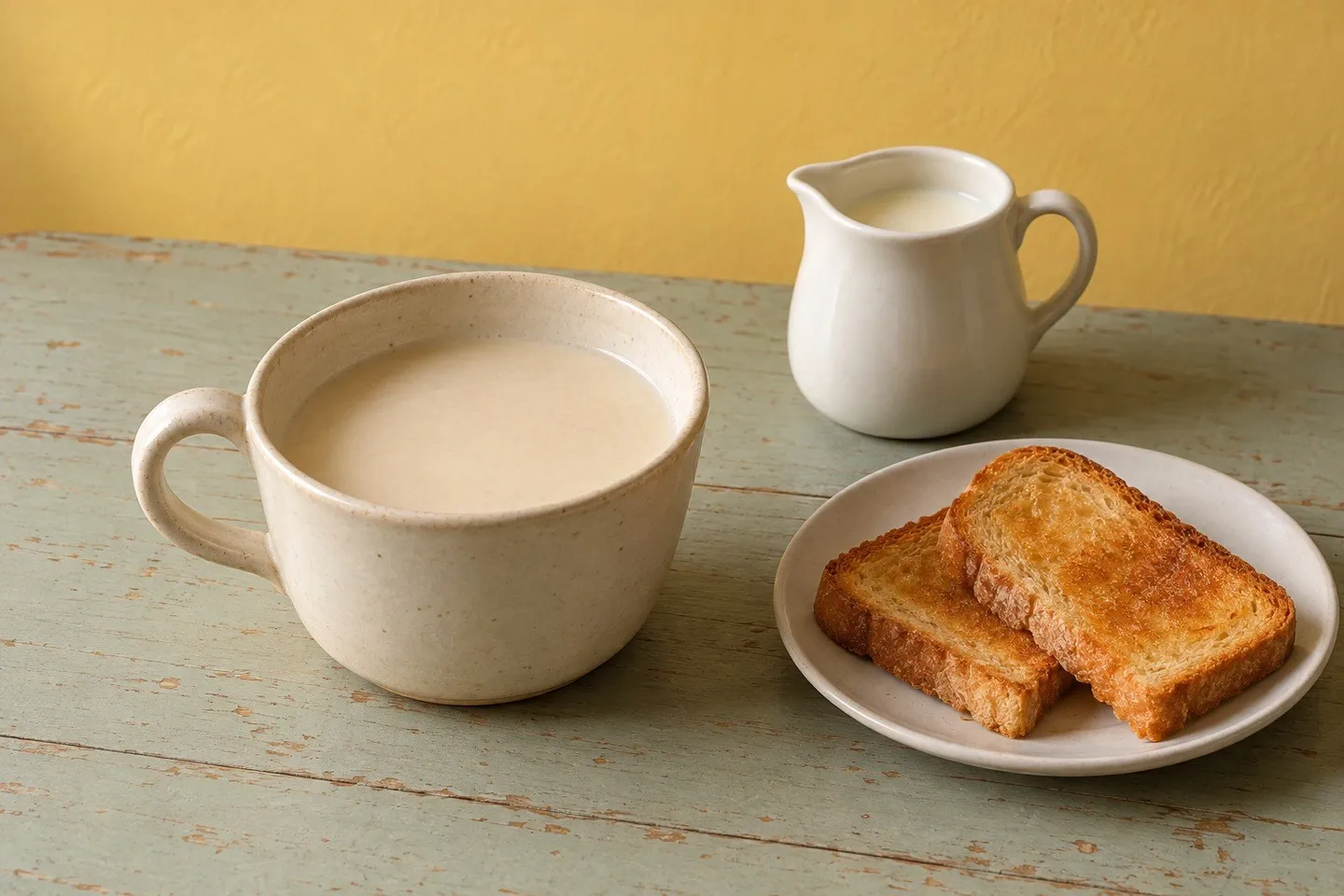
Milk Porridge, a Strained Oat Gruel with Milk
Reader ratingsOats boiled long into a fine gruel, strained, and let down with cold or warm milk, with toast on the side: Maria Rundell’s milk porridge from the sickroom chapter of her 1806 cookbook.
- Recipe makes
- About 550 ml, 2 cups or small handled bowls (our estimate)
- Prep
- Cook
- Total
Allows about 40 minutes for Rundell’s long boiling of the oats, then a few minutes to strain and warm with the milk. Times are our estimates.
Milk porridge in a plain earthenware breakfast cup, with toast and a small jug of milk.
The story behind the recipe
Milk porridge, in Maria Rundell’s kitchen, was barely porridge at all. She boils oats long into “a fine gruel,” strains the grain away and lets down the smooth liquid with milk, cold or warm, then sends it up with toast. It sits in her chapter of cookery for the sick, and what reaches the bowl is something between a soup and a hot drink.
From the sickroom shelf
Rundell’s A New System of Domestic Cookery came out in London in 1806, signed only “By a Lady,” and was reprinted in Philadelphia the next year. Her sickroom pages run from orgeat and lemonade to gruels and caudles, each a few lines long. Milk porridge takes three. Right below it she gives a French milk porridge, oatmeal steeped in water overnight, strained and boiled with milk, and notes that it “is much ordered, with toast, for the breakfast of weak persons, abroad.” The plain English version is the quicker of the two.
She never explains “half grits.” Elsewhere in the book her black puddings use “bruised grits,” and the French milk porridge printed right below it is made of oatmeal, so “half grits” may mean oats only partly broken. We read it that way and use steel-cut oats, which are oat groats chopped into a few pieces. The method is close to the Water Gruel of a fifteenth-century cookery poem, some three and a half centuries older, which strains groats boiled in water and sweetens them with honey. Rundell skips the honey and finishes with milk.
Read more about this recipe
Making it today
The amounts are ours, since Rundell gives none. Forty grams of oats to half a liter of water, simmered for about forty minutes, should leave a fine gruel that coats a spoon thinly; strained and let down with milk, it should pour like thin cream and taste of oats and milk, with no sweetness beyond the milk’s own. Rundell lets you choose: cold milk stirred in cools it at once, and milk warmed with it gives a hot bowl. The toast is hers. A pinch of salt or sugar is up to you; she mentions neither.
Rundell wrote it for invalids; here it is simply a warm bowl for a cold morning, and no cure for anything. A Viking poet ended his own fast with milk some eight centuries earlier, in Why Did Egil’s Daughter Give Him Milk?
Milk Porridge.
Make a fine gruel of half grits, long boiled—strain off—either add cold milk, or warm with milk as may be approved. Serve with toast.

Recipe makes: About 550 ml, 2 cups or small handled bowls (our estimate)
Ingredients
For About 550 ml, 2 cups or small handled bowls (our estimate). Quantities are shown as written.
Quantities as written here, for About 550 ml, 2 cups or small handled bowls (our estimate).
- Water500 ml
- Steel-cut oats40 g
- Whole milk200 ml
- Toast, to serve2 slices
Measurement notes
Ingredients as written here
- 500 ml water
- 40 g steel-cut oats
- 200 ml whole milk
- 2 slices toast, to serve
Equipment
 Saucepan with a lid
 Fine sieve
- Small saucepan
 Cups
Instructions
Bring the water to the boil in a saucepan and stir in the steel-cut oats.
Lower the heat, cover with the lid slightly ajar and simmer gently for about 40 minutes, stirring now and then and adding a splash of water if it starts to catch.
Pour the gruel through a fine sieve into a small saucepan, pressing lightly on the oats with the back of a spoon so only the smooth liquid goes through.
For a hot bowl, stir in the whole milk and warm it gently over low heat, stirring, until it steams; don’t let it boil. For a cooler one, stir the cold milk into the hot gruel off the heat.
Pour into cups or small handled bowls and serve at once, with the toast on the side.
Nutrition
90calories per serving
- Recipe makes
- About 550 ml, 2 cups or small handled bowls (our estimate)
- Servings
- 2
Roughly estimated from USDA FoodData Central values for oats and whole milk, per cup without the toast, assuming about a third of the oats’ calories pass through the sieve.
Recipe notes
When adjusting quantities
Keep 40 g of oats to every 500 ml of water, and add milk to the strained gruel to taste.
Notes
Quantities mentioned in these notes don’t change when you adjust the batch.
Rundell gives no amounts, times or yield; ours are estimates. The strained gruel should come to about 350 ml, and the milk brings it to about 550 ml, depending on how much the oats soak up.
Whole oat groats work too but take longer; simmer until the grains split. Rolled oats cook faster but give a thicker, slightly gluey liquid.
The strained oats are good stirred into a breakfast porridge.
Keep any leftover in the fridge, covered, and drink it within a day; it thickens as it cools, so loosen it with a little milk when you warm it again.
Scaling changes the ingredients only; glassware, ice and timings need their own judgment. To adapt this recipe further, try the recipe tool at TuneMyRecipe (opens in a new tab), our sister site.
Sources and attribution
[Maria Eliza Rundell], A New System of Domestic Cookery (London: J. Murray and J. Harding, 1806), p. 255
See the original pages (scan at Internet Archive) (opens in a new tab)
Recipe details
- Drink
- Alcohol-free
- Drink family
- Hot Drinks
- Region
- British
- Era
- 19th century
- Difficulty
- Easy
- Season
- Winter