Why Did Egil’s Daughter Give Him Milk?
In Egil’s Saga, Thorgerd tricks her grieving father into drinking milk, breaking his fast so he lives to make a poem for his drowned son. What the saga says.
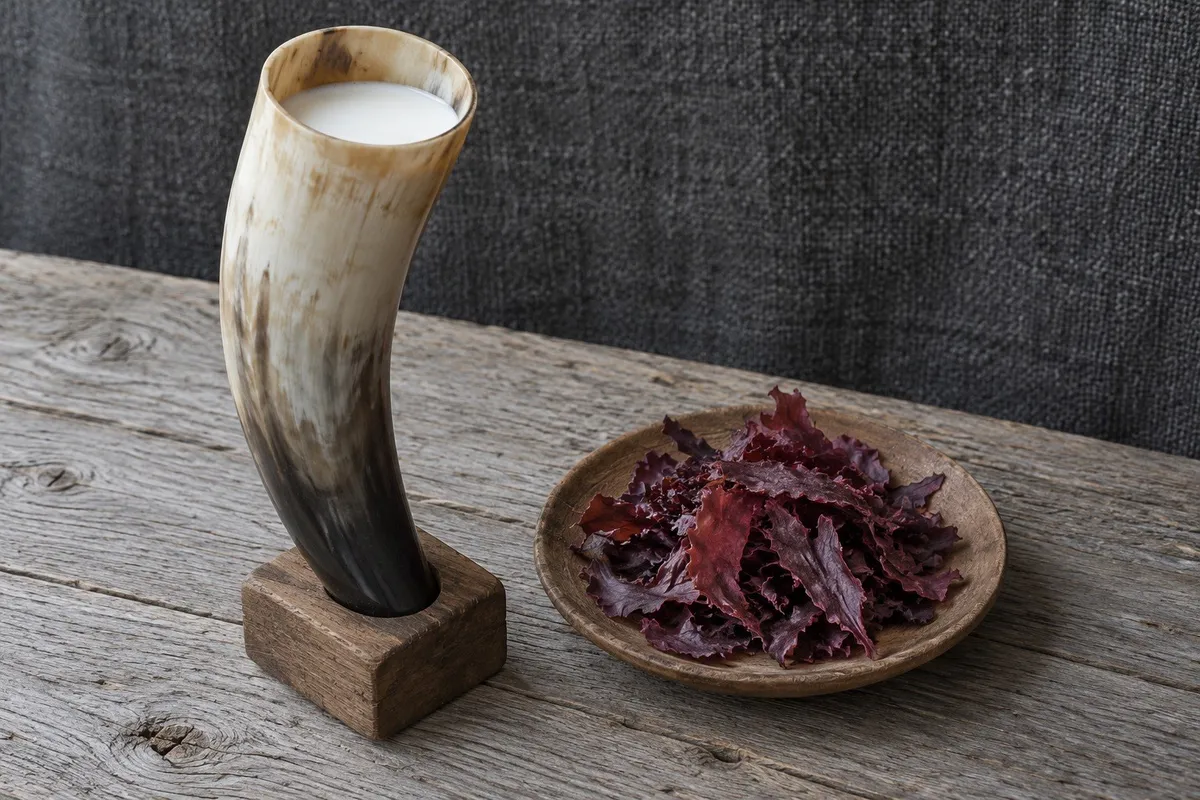
Thorgerd gave her father milk so that he would break his fast before he knew it. In Egil’s Saga, the poet Egil Skallagrimsson shuts himself away to starve after his son drowns, and Thorgerd joins him, saying she will die too. She gets him to eat something salty, he grows thirsty, and he drains the horn she hands him. Then she tells him what was in it: “Now are we deceived; this is milk.” Their plan to die is spoiled, so she proposes another: live long enough for him to make a memorial poem for his son. He does, and the poem is Sonatorrek, “Sons’ Loss.”
The scene belongs to a saga written down in Iceland in the thirteenth century about a man who lived in the tenth. It shows what the saga’s teller, writing some three centuries after the fact, thought a clever daughter could do with an ordinary drink.
A son lost at sea
W. C. Green’s English translation of 1893 tells it in chapter 81. Egil’s son Bodvar went out with the household men to fetch timber by boat, and on the way back a gale ran against the ebb tide: “The end was that the boat sank under them, and all were lost.” Egil found the body, carried it to his father Skallagrim’s burial mound and had it laid there. Then he rode home to Borg and “went at once to the locked bed-closet in which he was wont to sleep. He lay down, and shut himself in, none daring to crave speech of him.”
The next day he still would not open the door, and “he had no meat or drink.” On the third morning his wife Asgerd sent a rider west for their daughter Thorgerd, who came through the night. When Asgerd asked if she had eaten, Thorgerd answered aloud, so that her father could hear: “No supper have I had, and none will I have till I sup with Freyja. I can do no better than does my father.” At the door she called, “Father, open the door! I will that we both travel the same road.” He undid the lock.
Paul Du Chaillu retold the episode in The Viking Age (1889) under sorrow, mourning and burial, as an example of how the North grieved.
Seaweed and a horn
Shut in together, father and daughter lay on separate beds. Egil heard her chewing and asked what it was. “I am chewing samphire,” she said, “because I think it will do me harm. Otherwise I think I may live too long.”
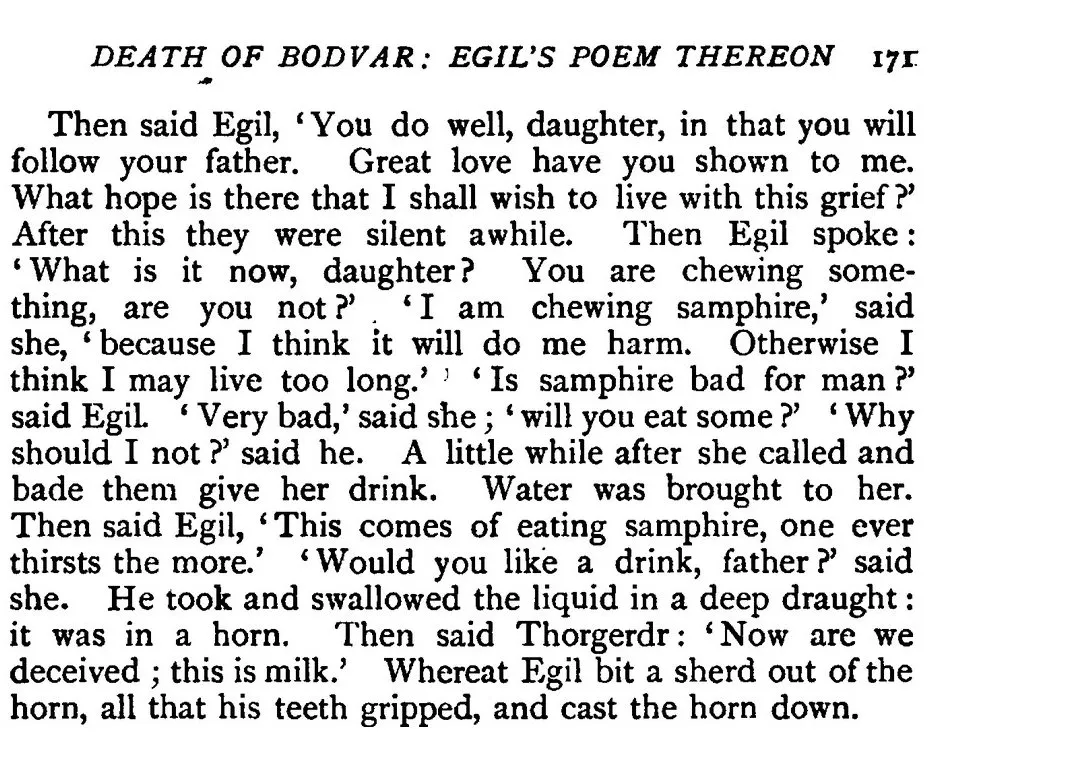 The Story of Egil Skallagrimsson, trans. W. C. Green (London: Elliot Stock, 1893), p. 171.
Green’s “samphire” will mislead a modern cook, who thinks of the green coastal plant. The Old Norse word is sǫl, seaweed, and Du Chaillu printed it as “samphire (sea-weed).” The saga names no species and says nothing of how it was dried or prepared. Thorgerd’s claim that it will do her harm is part of her act, too, so the scene gives no warrant for calling it poison. What matters to the story is the thirst. Egil says so himself: “This comes of eating samphire, one ever thirsts the more.”
She asks for drink, it is brought, he drinks deep, and only after he has swallowed does she say what it was. Naming the milk comes after it is already inside him. Egil does not take it gracefully: he “bit a sherd out of the horn, all that his teeth gripped, and cast the horn down.”
Now are we deceived
In the Old Norse she says vit, a dual pronoun meaning “we two,” and calls the drink mjólk. By that vit she counts herself among the deceived along with her father, as if their shared plan had simply run into bad luck, and that lets her next move sound like a joint change of course. That is our reading of the sentence, and no proof that any real daughter spoke it.
Her next move follows at once: “What counsel shall we take now? This our purpose is defeated. Now I would fain, father, that we should lengthen our lives, so that you may compose a funeral poem on Bodvar, and I will grave it on a wooden roller; after that we can die, if we like.” Du Chaillu has her carve it “on a stick of wood.” Egil doubts he can compose at all, then says, “However, I will try this.”
Green’s chapter ends with what the poem did: “Egil began to cheer up as the composing of the poem went on; and when the poem was complete, he brought it before Asgerdr and Thorgerdr and his family. He rose from his bed, and took his place in the high-seat.” He held the funeral feast, and when Thorgerd went home he “enriched her with good gifts.” The milk ended the fast; the saga gives the poem the credit for bringing him back.
Water or milk
Read closely, Green’s English has a small snag: Thorgerd calls for drink, “Water was brought to her,” and a moment later the horn holds milk. The manuscripts have the same snag. The chief manuscript of the saga is Möðruvallabók, a fourteenth-century Icelandic book of sagas; two other versions survive, one in a damaged fourteenth-century manuscript and one only in seventeenth-century copies.
In Bjarni Einarsson’s critical edition of 2003, Thorgerd asks for water to drink, a reading the editor takes from the other two versions and marks in angle brackets. Möðruvallabók puts the water in the next clause instead, saying she was given water, and the damaged fourteenth-century manuscript has the water in both places. Einarsson treats the water in that second clause as a plain copying slip and leaves it out, so in his text she is simply given a drink. Green’s sentence follows the reading the modern editor rejects.
None of this unsettles the scene. What the copyists disagreed over is where the water is named, in her request or in what she was given. The poem has a history of its own: Möðruvallabók keeps only its first stanza, and the whole of Sonatorrek comes from the seventeenth-century copies. A translation that runs smoothly from the horn to the poem joins material from different manuscripts.
What kind of milk
The saga says mjólk, milk. It names no animal and says nothing of fat, quantity or souring, and the horn is dýrshorni, an animal’s horn. A reader might expect ale in a saga horn; here the whole surprise is that it held milk.
Sour dairy foods turn up elsewhere in the same saga. Earlier in Egil’s story a stingy host sets out “large bowls of curds” for thirsty guests, and later on a shield given to Egil is spoiled by falling into a tub of sour whey; What Did the Vikings Drink? gathers those scenes. Thorgerd’s milk is not described that way. The safest reading is the plainest: milk was ordinary enough to hand a thirsty man without arousing his suspicion, and that is what made it useful to her.
Milk in later kitchens
Milk drinks written down as recipes come much later. Maria Rundell’s A New System of Domestic Cookery, printed in London in 1806, has two short milk drinks in her chapter of cookery for the sick.
Milk Porridge is a fine oat gruel strained and let down with milk, served with toast, a warm, plain cup from the sickroom. Lemon Whey turns boiling milk with lemon juice, pours the clear whey off the curd and thins it with hot water and a little sugar. Among her sweet dishes she also has curds and cream, an English cousin of the bowls of curds in Egil’s saga, and the whey from a cheese, she writes, “is a very wholesome drink”: that one is Whey, the Drink Left Over from Cheese.
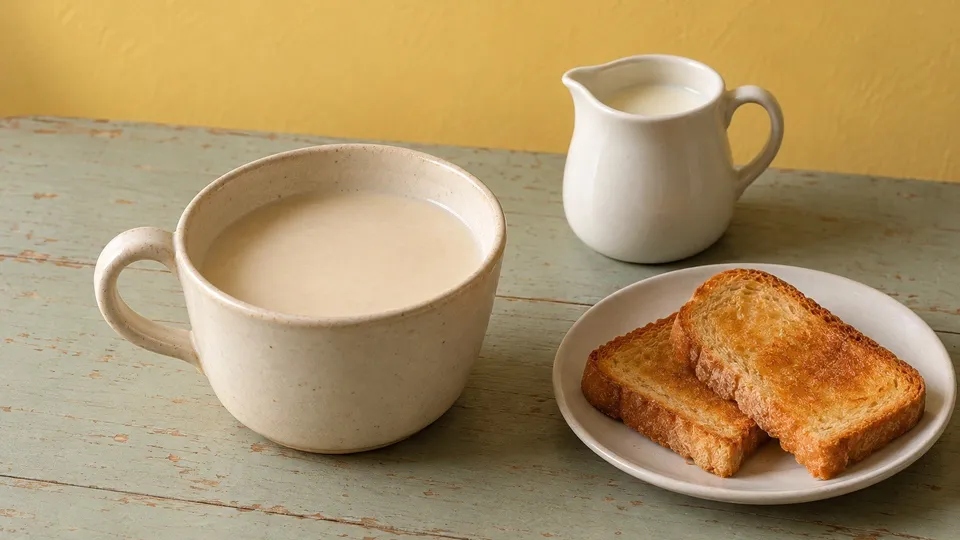 Always alcohol-freeMilk Porridge, a Strained Oat Gruel with Milk
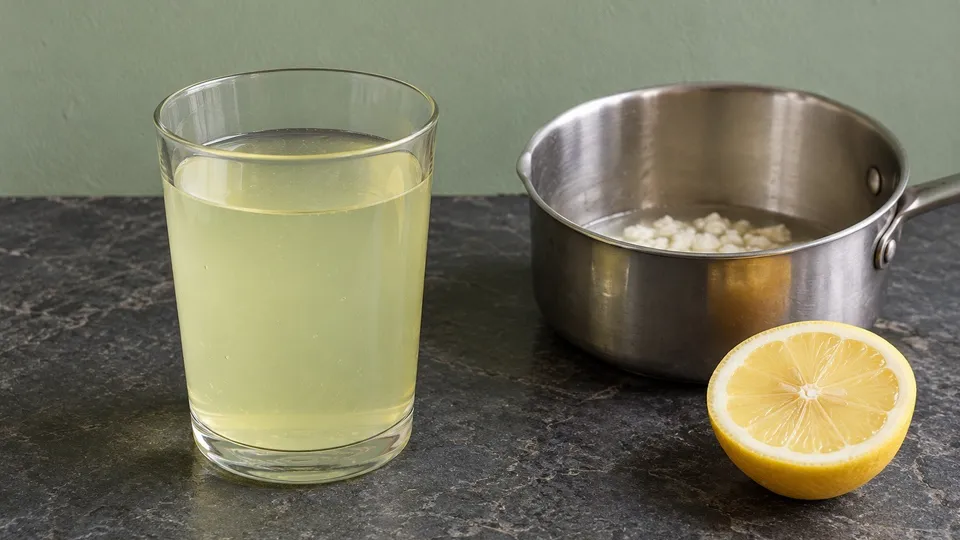 Always alcohol-freeLemon Whey, Hot Milk Turned with Lemon Juice
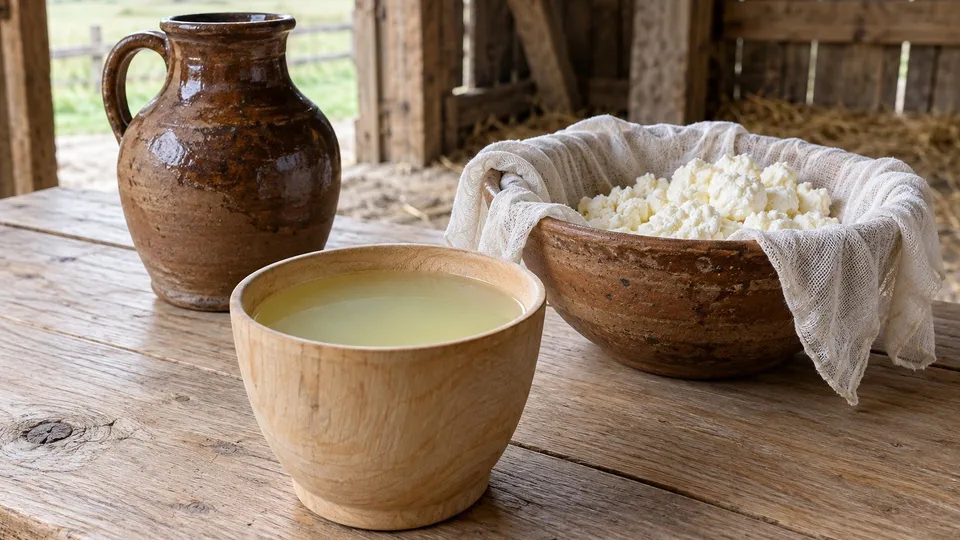 Always alcohol-freeWhey, the Drink Left Over from Cheese
Lemon Whey takes about ten minutes from cold milk to cup, most of it waiting for the curd to settle, so it can be on the table before the kettle has cooled.
Sources
- The Story of Egil Skallagrimsson, trans. W. C. Green (London: Elliot Stock, 1893), ch. 81, pp. 169–174; other episodes pp. 74–76 (curds) and 180 (sour whey).
- Paul B. Du Chaillu, The Viking Age, 2 vols. (New York: Scribner, 1889), vol. 2, pp. 414–416.
- Egils saga, ed. Bjarni Einarsson (London: Viking Society for Northern Research, 2003, reprinted 2013), foreword pp. ix–x; text and notes pp. 145–146.
- Maria Eliza Rundell, A New System of Domestic Cookery (London: J. Murray and J. Harding, 1806), pp. 160–161, 255, 257.