Lemon Whey, Hot Milk Turned with Lemon Juice
Reader ratingsBoiling milk turned with lemon juice, the clear whey poured off the curd and thinned with hot water and a little sugar: the alcohol-free sickroom whey from Maria Rundell’s 1806 cookbook.
- Recipe makes
- About 450 ml, 2 cups (our estimate)
- Prep
- Cook
- Total
Allows a few minutes for the curd to settle before the whey is poured off. Times are our estimates.
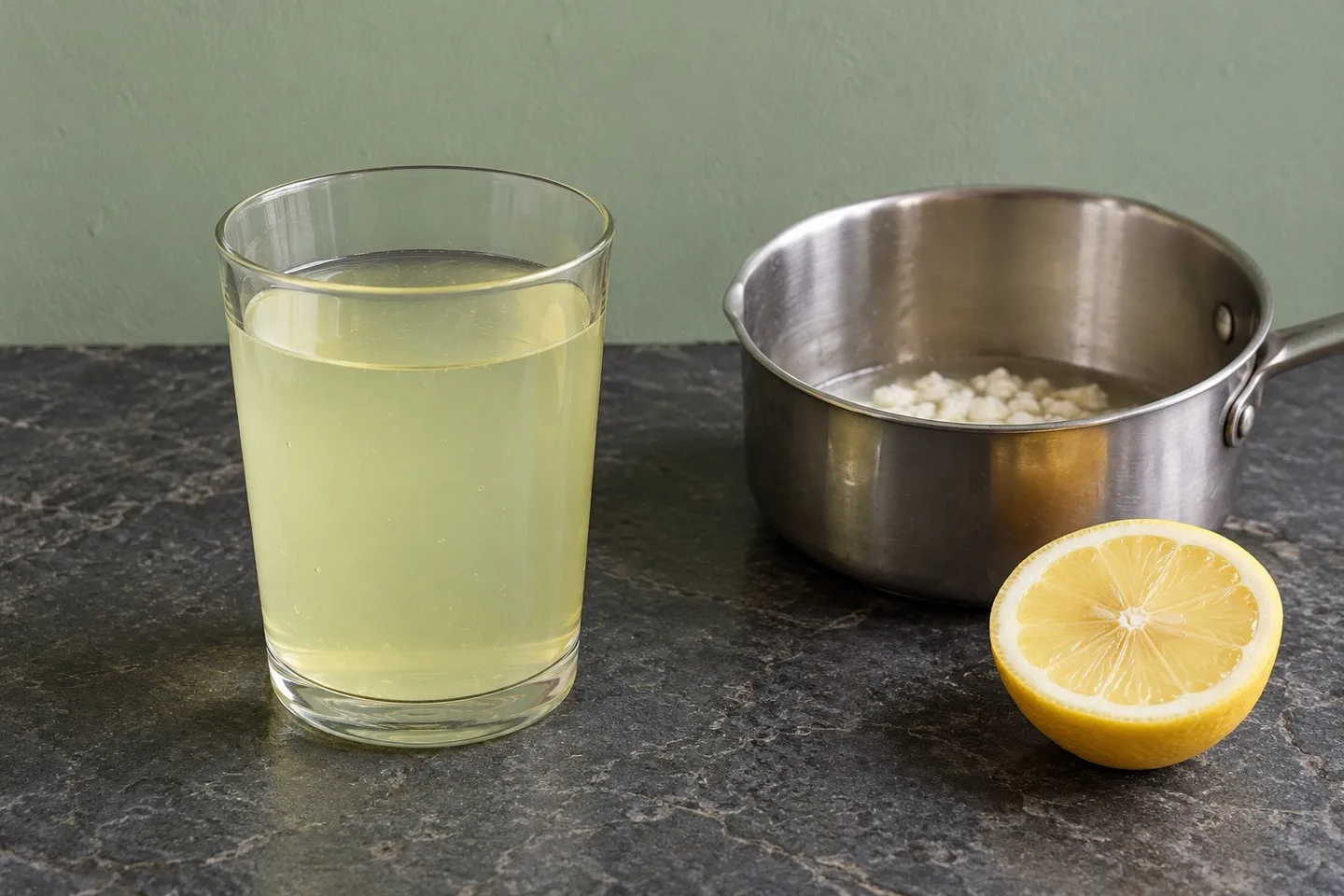
Hot lemon whey in a plain glass tumbler, beside the saucepan with the curd left behind and a halved lemon.
The story behind the recipe
Lemon whey is what is left when boiling milk meets lemon juice: the milk splits into a soft white curd and a thin, pale liquid, and the liquid is the drink. Maria Rundell pours it off the curd, thins it with as much boiling water again and drops in “a bit or two of sugar.” The result should be a hot, light, sour-sweet cup, closer to a weak lemon tea than to anything milky.
Wheys for the sickroom
Rundell’s A New System of Domestic Cookery (London, 1806) keeps her wheys in the chapter of cookery for the sick. She starts with the plainest: the whey left from making cheese “is a very wholesome drink, especially when the cows are in fresh herbage.” Then she shows how to make whey on purpose, in a saucepan. Her main recipe turns the milk with raisin wine, a homemade wine of the period. The vinegar and lemon wheys follow in a single sentence, “as above,” with the acid in place of the wine, so both are free of alcohol; we make the lemon one.
Her instructions are about clearness. The milk is turned with just enough acid that “it looks clear,” the pan is set aside “till the curd subsides,” and the cook is told “do not stir it.” Poured off gently, she promises, the whey comes away “perfectly cleared of milky particles, and as weak as you chuse to make it.” Her milk-clarified lemonade works the same trick from the other side, curdling milk into lemon to clear a cold drink. Here the milk comes first and the drink is served hot.
Read more about this recipe
Making it today
Rundell gives the milk as half a pint and the water as half a pint, which we round to 250 ml each, and leaves the lemon to the cook: add it until the milk turns. A tablespoon should be plenty for this much hot milk, and you may not need it all. We use whole milk, which splits cleanly. Straining through a fine sieve is our addition, for anyone who pours less steadily than Rundell’s cook. The sugar is hers and can be adjusted.
The curd left in the pan is a small spoonful of fresh cheese; eat it the same day. For milk used as a trick rather than a comfort, read Why Did Egil’s Daughter Give Him Milk?
White Wine Whey.
Put half a pint of new milk on the fire; the moment it boils up, pour in as much sound raisin wine as will completely turn it, and it looks clear—let it boil up, then set the saucepan aside till the curd subsides, and do not stir it. Pour the whey off, and add to it half a pint of boiling water, and a bit of white sugar. Thus you will have a whey perfectly cleared of milky particles, and as weak as you chuse to make it.
Vinegar and Lemon Wheys.
Pour into boiling milk as above, and when clear, dilute with boiling water, and put a bit or two of sugar.

Recipe makes: About 450 ml, 2 cups (our estimate)
Ingredients
For About 450 ml, 2 cups (our estimate). Quantities are shown as written.
Quantities as written here, for About 450 ml, 2 cups (our estimate).
- Whole milk250 ml
- Lemon juice, from about half a lemon1 metric tbsp (15 ml per tbsp)
- Boiling water250 ml
- Sugar2 metric tsp (5 ml per tsp)
Measurement notes
Ingredients as written here
- 250 ml whole milk
- 1 tbsp lemon juice, from about half a lemon
- 250 ml boiling water
- 2 tsp sugar
Equipment
 Small saucepan
 Citrus juicer
 Kettle
 Fine sieve
 Cups
Instructions
Squeeze the lemon juice and set it beside the stove. Put the kettle on for the boiling water.
Bring the whole milk to the boil in a small saucepan over medium heat, watching it closely.
The moment it rises, pour in the lemon juice a little at a time, swirling the pan gently rather than stirring, just until the milk splits into white curd and the liquid around it looks clear and pale. You may not need all the juice.
Let it bubble up once more, then take the pan off the heat and leave it untouched for 3 to 5 minutes, until the curd has sunk.
Pour the whey gently off the curd through a fine sieve into the cups, leaving the curd behind.
Add the boiling water and the sugar, stir until it dissolves, and drink it hot.
Nutrition
45calories per serving
- Recipe makes
- About 450 ml, 2 cups (our estimate)
- Servings
- 2
Roughly estimated from USDA FoodData Central values for acid whey, lemon juice and granulated sugar, per cup, counting only the whey poured off the curd.
Recipe notes
When adjusting quantities
Keep the boiling water equal in volume to the milk, and add lemon juice only until the milk turns.
Notes
Quantities mentioned in these notes don’t change when you adjust the batch.
The amounts of lemon juice and the yield are our estimates. Bottled lemon juice works, but fresh is brighter.
Rundell’s vinegar whey is made the same way with vinegar in place of lemon juice; a mild cider or white wine vinegar is the gentlest choice.
Her white wine whey, made with raisin wine, contains alcohol and isn’t made here.
Drink it while hot. Any leftover whey goes in the fridge and should be used the same day.
Scaling changes the ingredients only; glassware, ice and timings need their own judgment. To adapt this recipe further, try the recipe tool at TuneMyRecipe (opens in a new tab), our sister site.
Sources and attribution
[Maria Eliza Rundell], A New System of Domestic Cookery (London: J. Murray and J. Harding, 1806), p. 257
See the original pages (scan at Internet Archive) (opens in a new tab)
Recipe details
- Drink
- Alcohol-free
- Drink family
- Hot Drinks
- Region
- British
- Era
- 19th century
- Difficulty
- Easy
- Season
- Winter