George Washington’s Small Beer from His 1757 Notebook
Reader ratingsBran and hops boiled three hours, strained onto molasses and worked a week: the small beer in the notebook George Washington kept as a Virginia colonel in 1757.
- Recipe makes
- About 3.6 liters, 11 bottles of 330 ml
- Prep
- Cook
- Total
Brew day is about 4½ hours, most of it the three-hour boil, plus about 2 hours to cool. It works for a week, as Washington directs, then 1 to 2 days in the bottle before it goes in the fridge.
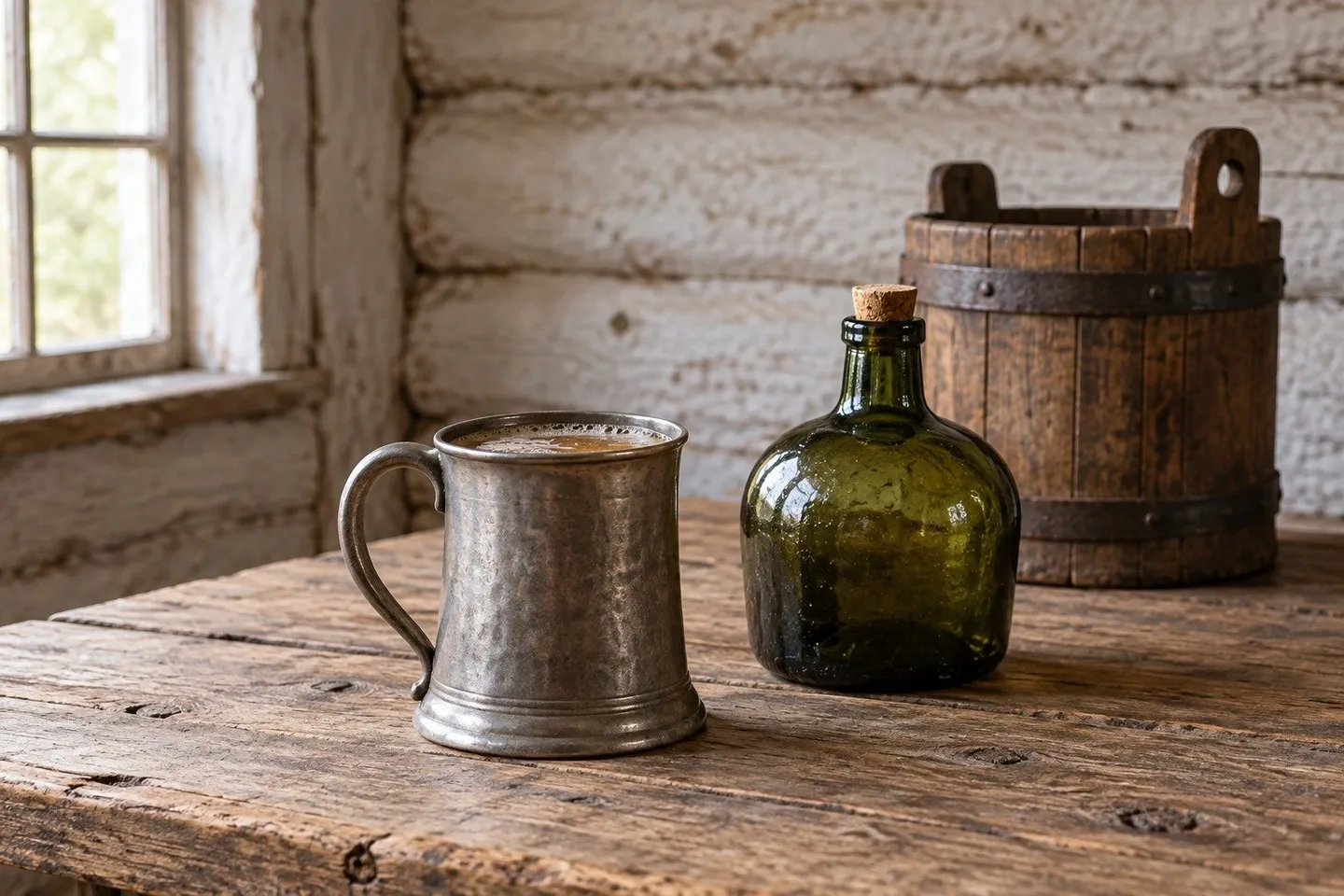
Small beer in a pewter mug, with a dark green glass bottle and a wooden pail.
The story behind the recipe
“To make Small Beer,” the recipe begins, and it is just that: an everyday beer, weak and cheap, made from bran, hops and molasses. It is written in a small pocket notebook that George Washington used in 1757, when he was a Virginia colonel raising two regiments in the war with the French. The notebook is now in the New York Public Library, whose Victor Hugo Paltsits printed it in 1920.
A notebook from the war
The recipe carries no date of its own, and nothing on the page says who brewed it or for whom; the 1757 date comes from the army memoranda around it. The heading “Washington’s Recipe for Making Beer” is Paltsits’s; Washington’s own words are the recipe in the Original below. Small beer was the household beer of the time, brewed weak to be drunk all day, and molasses, the cheap sugar of the colonies, stands in here for malt. Thirty years later a Philadelphia dinner given for Washington ran through 54 bottles of Madeira and 60 of claret; this is the beer at the other end of the scale, as What Did the Founding Fathers Drink? tells.
Read more about this recipe
Our version
Washington’s batch is thirty gallons; ours is one, keeping his proportion of three gallons of molasses to thirty of beer. He gives no weight for the bran, only “a large Siffer full,” and leaves the hops “to your Taste,” so 60 grams of wheat bran and 7 grams of whole hops are our choices, on the light side. Light molasses keeps it closest to the West Indian cane molasses he would have bought; blackstrap is harsher. He put his yeast in when the wort was “little more than Blood warm”; modern ale yeast does better a little cooler. He says nothing of how it tasted. It comes out at about 4 percent alcohol, rising slowly in the bottle. The nearest drink on this site is another molasses beer, spruce beer from an 1804 New York handbill, and for a molasses drink with no yeast and no alcohol there is spruce soda.
To make Small Beer —
Take a large Siffer full of Bran Hops to your Taste. — Boil these 3 hours then strain out 30 Gallns into a Cooler put in 3 Gallns Molasses while the Beer is Scalding hot or rather draw the Melasses into the Cooler & St[r]ain the Beer on it while boiling Hot. let this stand till it is little more than Blood warm then put in a quart of Yea[s]t if the Weather is very Cold cover it over with a Blank[et] & let it Work in the Cooler 24 hours then put it into the Cask — leave the Bung open till it is almost don[e] Working — Bottle it that day Week it was Brewed.

Recipe makes: About 3.6 liters, 11 bottles of 330 ml
Ingredients
For About 3.6 liters, 11 bottles of 330 ml. Quantities are shown as written.
Quantities as written here, for About 3.6 liters, 11 bottles of 330 ml.
- Water, plus more boiled water to top up5.5 l
- Wheat bran60 g
- Whole hops7 g
- Light molasses380 ml
- Dried ale yeast2 g
Measurement notes
Ingredients as written here
- 5.5 l water, plus more boiled water to top up
- 60 g wheat bran
- 7 g whole hops
- 380 ml light molasses
- 2 g dried ale yeast
Equipment
 Large stockpot, at least 8 liters
 Large heatproof bowl or second pot, at least 5 liters
 Fine sieve lined with muslin
 Thermometer
 Glass jug, 4.5 liters, with a bung and airlock
 Funnel
 Brewing sanitizer
 Plastic soda bottles, enough for 3.6 liters
Instructions
Put the water, wheat bran and whole hops in the stockpot and bring to a boil. Turn the heat down so it boils gently, half-covered, for 3 hours. Top it up with a little boiled water now and then so it never boils down by more than about a quarter.
Pour the light molasses into the heatproof bowl. Set the lined sieve over it and strain the boiling-hot liquid onto the molasses, as Washington directs. Stir until the molasses dissolves.
Top up with boiled water until there is ten times as much liquid as molasses, Washington’s proportion. Cover the bowl and leave it to cool to 20 to 24 °C, about 2 hours in a sink of cold water.
Clean and sanitize the jug, bung, airlock, funnel and a spoon, following the sanitizer maker’s directions.
Sprinkle the dried ale yeast over the cooled wort and stir it in with the sanitized spoon. Cover the bowl with a clean lid or plate and leave it to work for 24 hours at 18 to 22 °C.
Pour it through the funnel into the jug, leaving a hand’s width of space at the top, and fit the airlock. Leave it for 6 days more, until the bubbling has slowed.
On the seventh day, sanitize the bottles and pour the beer into them, leaving the sediment in the jug. Fill each only to the shoulder and screw the caps on tight.
Keep the bottles at room temperature and squeeze one each day. When it feels firm, after 1 to 2 days, move them all to the fridge. Open each bottle slowly over the sink.
Nutrition
100calories per serving
- Recipe makes
- About 3.6 liters, 11 bottles of 330 ml
- Servings
- 11
Estimated for one 330 ml bottle from USDA FoodData Central values for molasses, assuming about three-quarters of its sugar ferments to alcohol at 7 kcal per gram, with the rest left as sugar; bran and hops add almost nothing to the strained beer.
Recipe notes
When adjusting quantities
Washington’s own batch is thirty gallons, about thirty times this one. Keep his one part molasses to ten of strained beer by volume when you scale; the bran and hops amounts are ours.
Notes
Quantities mentioned in these notes don’t change when you adjust the batch.
Washington’s gallons are taken as the wine gallon used for liquids in colonial Virginia, the same as today’s US gallon of 3.8 liters, so our batch is a thirtieth of his. His “quart of Yea[s]t” was live yeast from an earlier brewing; a little dried ale yeast does the same work.
Strength is an estimate. Molasses is roughly half fermentable sugar, so at Washington’s proportion the beer could reach about 5 percent once fully worked; bottled at a week, as he directs, it is still working and sits nearer 4. It is not alcohol-free, and not for children or anyone avoiding alcohol.
Washington bottled it while it was still working. Never bottle it in glass, never fill the bottles to the top and never leave full bottles somewhere warm: the yeast keeps making gas. If a bottle is rock-hard, chill it well and open it slowly.
Storage
Keep the bottles in the fridge once they are firm and drink them within 2 weeks. The beer contains live yeast and goes on making gas while it is warm.
Scaling changes the ingredients only; glassware, ice and timings need their own judgment. To adapt this recipe further, try the recipe tool at TuneMyRecipe (opens in a new tab), our sister site.
Sources and attribution
George Washington, notebook of 1757, “To make Small Beer”, as printed in Victor Hugo Paltsits, ed., Washington’s Note Book (New York: New York Public Library, 1920), p. 6
See the original pages (scan at Internet Archive) (opens in a new tab)
Recipe details
- Drink family
- Wine, Beer & Mead
- Region
- American
- Era
- 18th century
- Base
- Beer & ale
- Difficulty
- Intermediate
- Season
- Summer