What Did Medieval Children Drink?
Milk from a mother or a nurse first, then beer, milk and water, depending on age and household. What the medieval and Tudor sources say, and what they don’t.
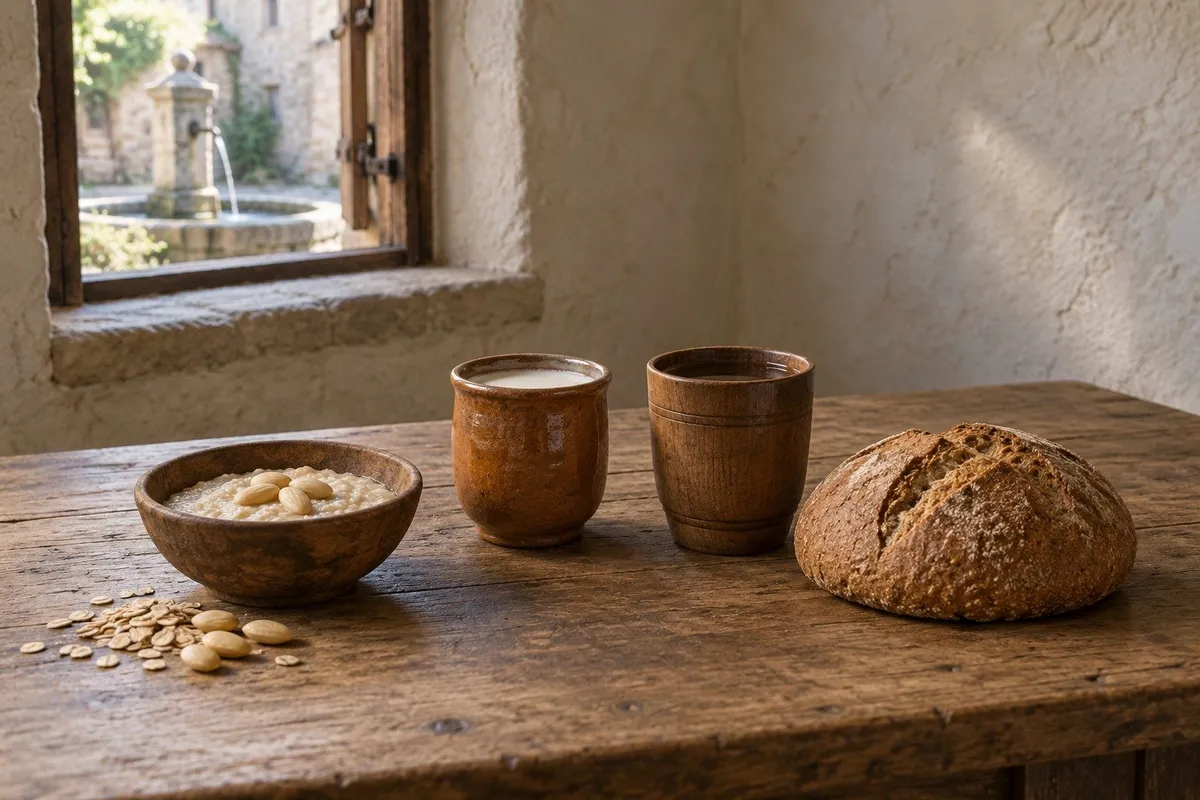
Babies drank milk from their mother or a nurse. Sources for older children mention beer, where a family brewed or bought it, and milk and water as well; whey and almond drinks belong to the wider kitchen and medicine. No medieval source gives a single children’s drink, a fixed age for weaning or the strength of a child’s ale. The records that do survive come from different kinds of books, and each answers a different question.
They cover England and northern Europe from about 1200 to 1550. Whether medieval people drank water at all is the subject of Did Medieval People Really Drink Beer Instead of Water?; this page follows the children.
Before the cup
The medieval discussion starts with the breast. Bartholomaeus Anglicus, whose thirteenth-century encyclopedia John Trevisa translated into English in the late fourteenth century, has the mother provide the child’s milk and judges her own milk the more fitting food. He also describes the nurse who takes the mother’s place: she gives suck, comforts and cleans the child, and prepares food for one who can’t yet chew. That is a learned ideal of care, not a survey of English mothers.
His age divisions are easy to misread. In the English of the 1495 printing, toothless infancy lasts seven months, and the teething childhood that follows lasts to seven years. Neither is a weaning date. An isotope study of children buried at St Nicholas Kirk in Aberdeen, published in 2018, suggests that in the twelfth to fifteenth centuries nursing could continue to two years or beyond, alongside other food; that is a model of one population, not a rule.
A quart for the nursery
The most concrete record is a Tudor one. The household book of Henry Algernon Percy, Earl of Northumberland, begun in 1512 for his houses at Wressle and Leckonfield in Yorkshire, sets out who got what at each meal. Under “BRAIKFAST for the Nurcy for my Lady Margaret and Maister Ingeram Percy” it lists: “ITEM a Manchet a Quarte of Bere a Dysch of Butter a Pece of Saltfisch a Dysch of Sproitts or iij White Herryng …” A manchet was a loaf of fine bread.
That is one quart of beer for a nursery breakfast, named for two children. It is not a quart for each child. The entry doesn’t say how old they were, who else in the nursery shared it, or how strong the beer was; it doesn’t even call it small beer. The same orders let the earl’s children breakfast every day in Lent, when most of the household had breakfast only on certain days, which shows them planned for as a group of their own. We know the book from Thomas Percy’s edition of 1770, reprinted in 1905, not from the Tudor manuscript.
Milk, boiled with a little sugar
The Tudor physician Andrew Boorde, in his Dyetary of Helth of 1542, recommends animal milk for children directly. Cow’s and ewe’s milk, he writes, is “very good for melancoly men, & for olde men and chyldren, specyally yf it be soddyn, addynge to it a lytell sugre.” Soddyn means boiled. It is medical advice in the language of the humors, and it gives no quantity, but it is advice about children by name.
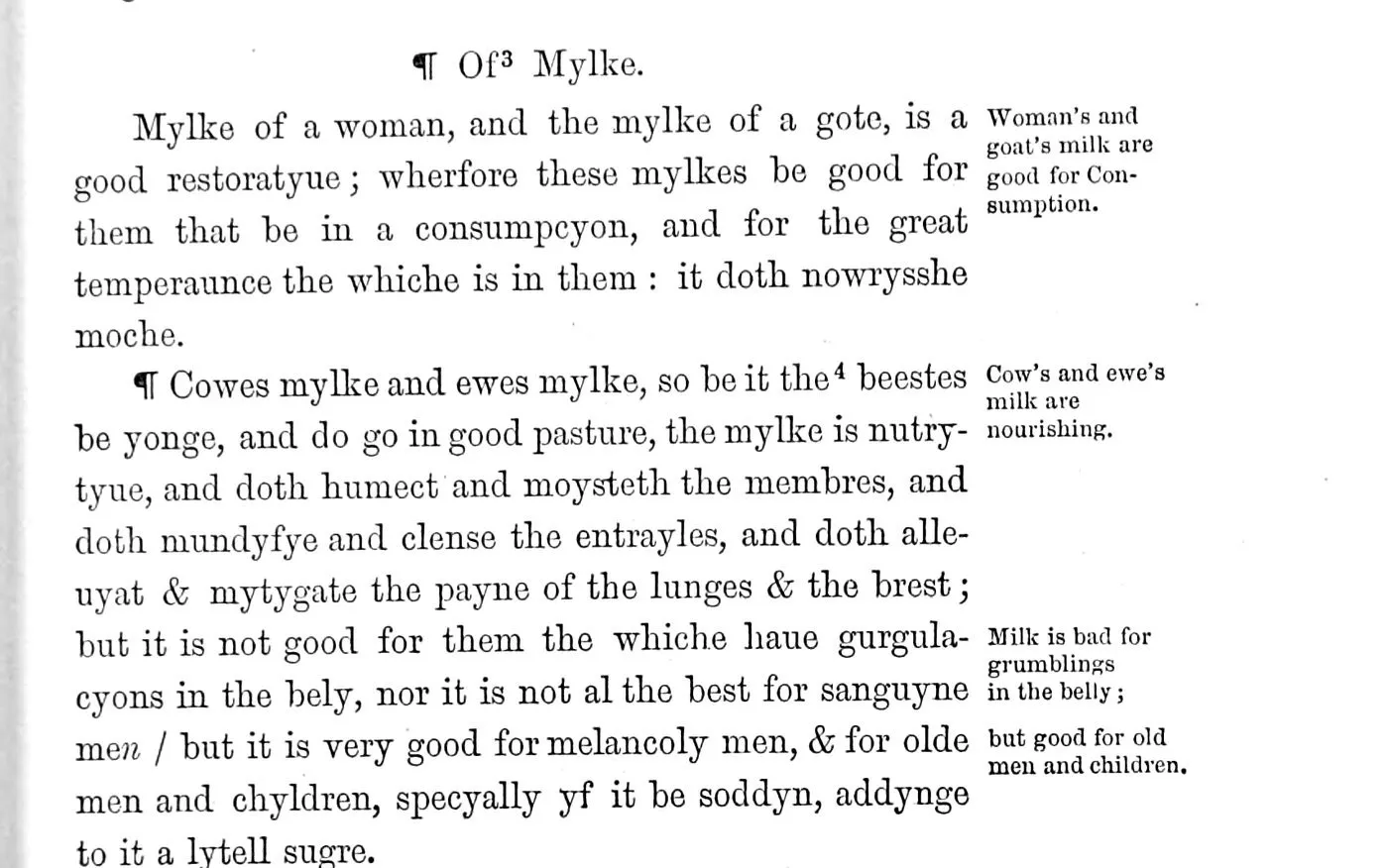 Andrew Boorde on milk, in his Dyetary of Helth of 1542, from F. J. Furnivall’s 1870 edition, p. 267. Royal College of Physicians of Edinburgh / Wellcome Collection, public domain.
For a cup in his spirit, bring whole milk just to a boil and stir in a little sugar. Nothing here is a substitute for breast milk or formula for a baby.
Young water drinkers
Boorde is also the man most often quoted as proof that water was feared. He did think plain water a poor drink for an Englishman: “water is colde, slowe, and slacke of dygestyon,” he wrote, and he warned against water fouled with froth, duckweed and mud. Yet in the same book he reports that in the high countries of the continent “the vsuall drynke … for youth, is fountayn water; for in euery towne is a fountayne or a shalowe wel, to the which all people that be yonge, and seruauntes, hath a confluence and a recourse to drynke.”
That is one traveler’s report of foreign custom, not a count of English children’s cups. But a rule that nobody drank water can’t survive his own young water drinkers.
Whey and almonds
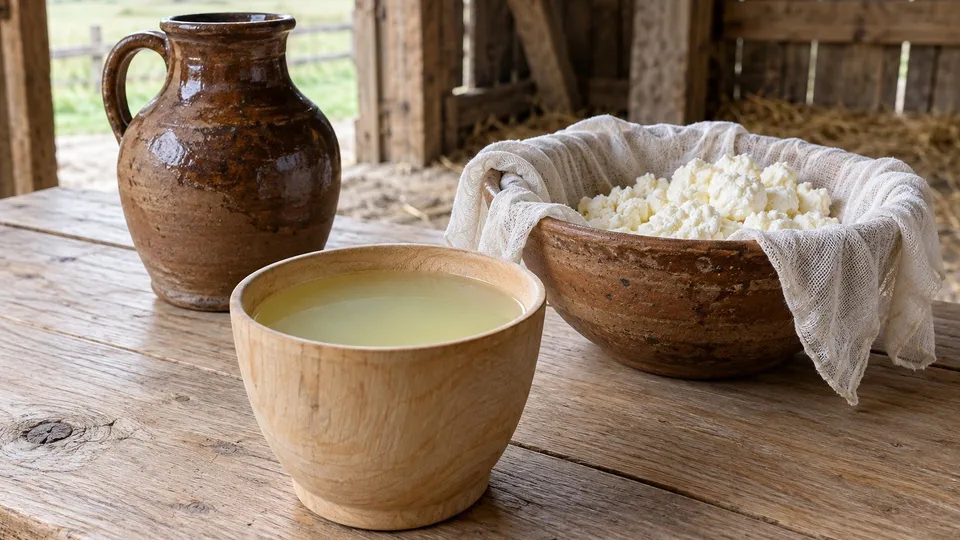
Boorde calls whey, “yf it be wel ordered, specyally that whay the which doth come of butter,” a temperate drink that “doth nourysshe,” without saying who drank it. Whey, the Drink Left Over from Cheese makes the cheese kind.
 Always alcohol-freeWhey, the Drink Left Over from Cheese
Almond preparations turn up in two different settings. The royal cookbook The Forme of Cury, of about 1390, has a gruel of almonds:
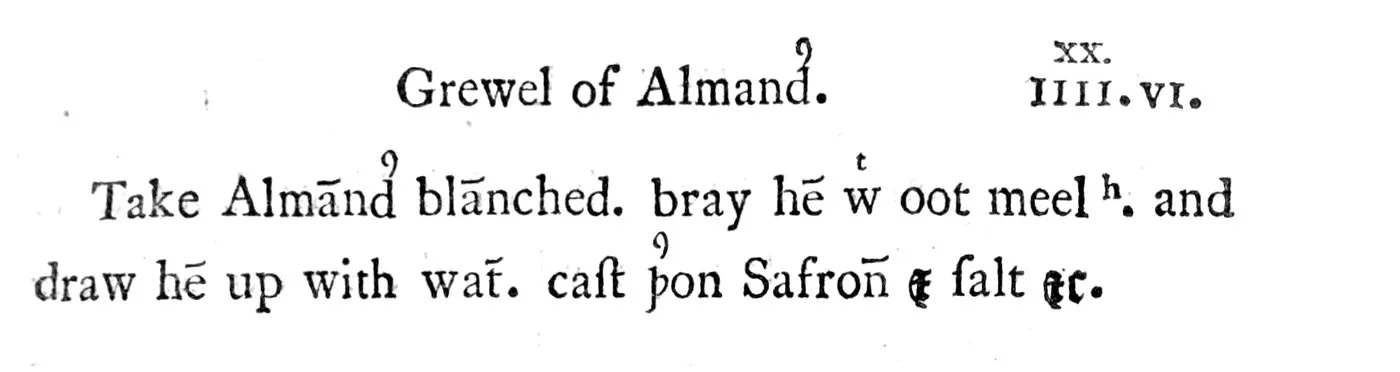 “Grewel of Almand,” The Forme of Cury (London: J. Nichols, 1780), p. 45. Wellcome Collection, public domain.
Blanched almonds pounded with oatmeal, drawn up with water, with saffron and salt. Nothing says it was made for children. Thomas Phaer’s Booke of Children, written in the 1540s and read here in a printing of 1596, does prescribe an almond drink for a sick child, with fennel juice or water and a little sugar. A cookbook gruel and a medicine are different things, and neither makes almond milk a medieval infant formula. For the plain fast-day kind, see Almond Milk, the Medieval Fast-Day Milk; for a thin gruel the period gave the sick, Water Gruel, a Medieval Oat Drink for the Sick.
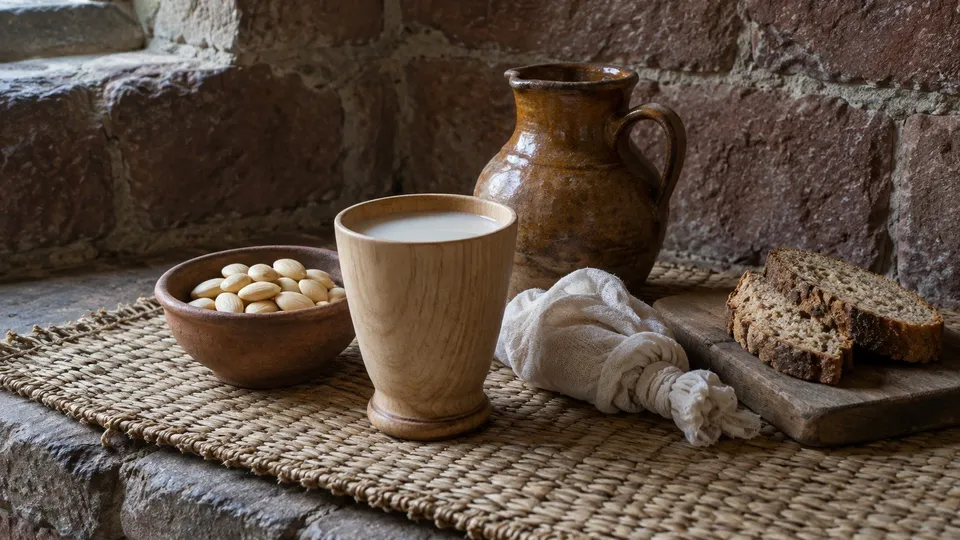 Always alcohol-freeAlmond Milk, the Medieval Fast-Day Milk
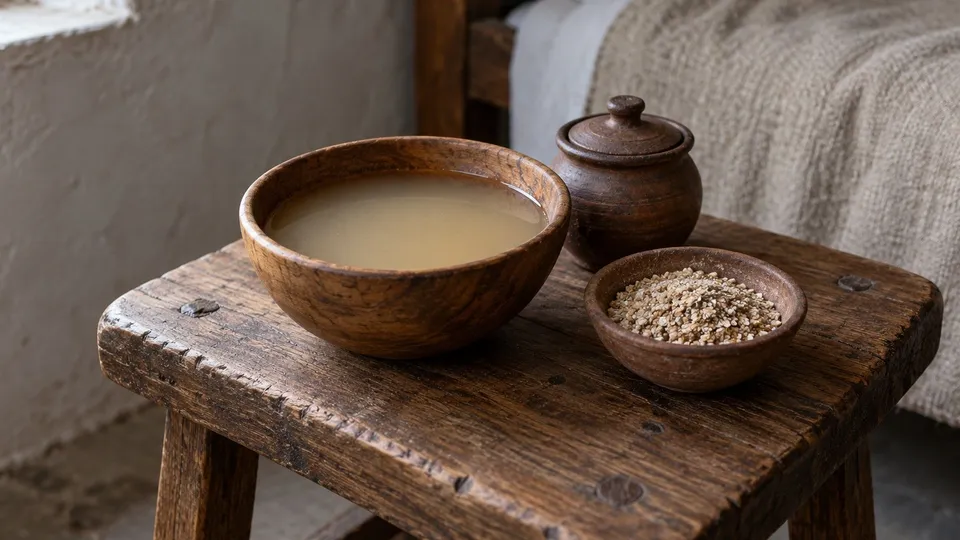 Always alcohol-freeWater Gruel, a Medieval Oat Drink for the Sick
Medieval children, question by question
Did medieval babies drink beer instead of milk?
No source we have seen says so. The medieval nursing passages put human milk at the center, from a mother or a nurse. The Percy household gave beer to a nursery, but it doesn’t say how old the children were or how much each drank.
At what age were medieval children weaned?
There was no single age. Bartholomaeus’s seven months and seven years are stages of growth, not weaning dates. Phaer’s “about the seventh month” is when teeth appear, and he allows for variation. The Aberdeen study suggests nursing could continue to two years or beyond, alongside other food, in one medieval community.
How strong was children’s ale?
Nobody wrote it down. The Percy order doesn’t call its nursery beer small or give its strength, and a percentage would be a guess.
Did children drink water?
Some did. Boorde reported young people drinking from town fountains abroad, and in London, as Did Medieval People Really Drink Beer Instead of Water? tells, the conduit’s water was meant for the poor to drink. Beer may well have come first for children in English households that could brew, but the sources don’t let it stand alone.
What did medieval children drink without alcohol?
Milk and water, and for some whey; almond preparations appear in the cookbooks and in medicine. All of the recipes linked on this page are alcohol-free. The one to start with is the almond milk: it needs only blanched almonds, water and a cloth to squeeze them through, and it is the white milk a medieval cook poured whenever the Church ruled out the cow’s.
For what was on the plate, our sister site The Forgotten Menu has what a medieval household ate in 1265 (opens in a new tab).
Sources
- Bartholomaeus Anglicus, De proprietatibus rerum, trans. John Trevisa ([Westminster: Wynkyn de Worde, about 1495]), Book VI, chapters I–IX. Huntington Library 82741.
- The Regulations and Establishment of the Household of Henry Algernon Percy, the Fifth Earl of Northumberland (London: A. Brown & Sons, 1905; reprint of Thomas Percy’s edition of 1770), pp. 73, 75.
- Andrew Boorde, A Compendyous Regyment or a Dyetary of Helth (1542), ed. F. J. Furnivall (London: N. Trübner for the Early English Text Society, 1870), pp. 252–257, 267.
- The Forme of Cury, ed. Samuel Pegge (London: J. Nichols, 1780), p. 45.
- Thomas Phaer, The Regiment of Life … with the Booke of Children (London: Edward Allde, 1596), copy 1, canvases 139–142, 158, 162–163. Wellcome Collection.
- J. Britton and others, isotope study of subadults from St Nicholas Kirk, Aberdeen, International Journal of Osteoarchaeology 28 (2018), pp. 510–522 (abstract).