A Short History of Hot Chocolate
Hot chocolate reached England in the 1650s already sweet, made with water or milk and egg yolks. By 1886 it was a cheap powdered cocoa at under a cent a cup.
Hot chocolate came to England in the 1650s as a drink already sweetened with sugar, made either with hot water or with boiling milk, sometimes thickened with egg yolks. For two centuries it was a cake of ground cacao and sugar, grated and frothed into a cup, and it cost a good deal. What changed by the 1880s was the product more than the recipe: a powdered cocoa with much of its fat pressed out, stirred into milk and water for less than a cent a cup.
Sweet from the start
The earliest English book on chocolate we know of was a translation. In 1652 Captain James Wadsworth put Antonio Colmenero de Ledesma’s Spanish treatise of 1631 into English as Chocolate: or, An Indian Drinke, and its bookseller, John Dakins, sold the chocolate itself alongside it. How the Spanish made the water version, and the quicker cup for “men of businesse,” is told in How Were Coffee, Tea and Chocolate Made in 1685?, and we make it as Colmenero’s spiced chocolate.
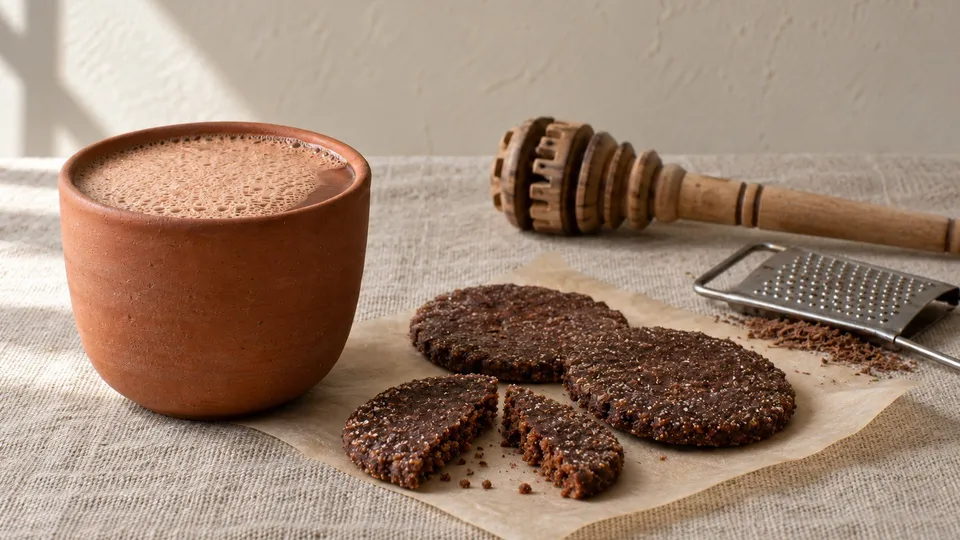 Always alcohol-freeColmenero’s Spiced Chocolate, Frothed with Hot Water
The cup was sweet from the first. Even the plainest Spanish way ends “and so drinke it with Sugar.” The earliest English recipes we have found already put sugar in.
Milk, eggs and a molenillo
The 1652 book also printed a milk recipe, in a short section added at the back. “If you please to take it in milke, to a quart, three ounces of Chocolate will be sufficient.” The chocolate is scraped fine into boiling milk and worked with “the Spanish Instrument called Molenillo,” a wooden stick “with a round knob made very round, and cut ragged, that as you turne it in your hands, the milke may froth and dissolve the Chocolate the better.” Then come “the yelke of two eggs well beaten with some of the hot milke,” and “Sugar, as much as you like for your taste.”
It was meant as a meal. “Thus drinke a good draught: or if you please you may slice a little Manchet into a dish, and so eate it for a breakfast.” And it would last: “If you drinke a good draught of this in a morning, you may travell all the day without any other thing, this is so Substantiall and Cordiall.” The same page allows water and sugar for “some weake stomacks,” and almond milk for others.
By 1685 a London translation of a French book could say that “we in England usually boyl the Chocolate with the water, and some to make it more dainty, though less wholesome, use therein Eggs and Milk.” Milk was an English choice from the start, not a late refinement.
A morning draught in chocolate
Samuel Pepys drank it for the usual reason. The morning after the coronation of Charles II in April 1661, he wrote:
 Samuel Pepys’s diary for April 24, 1661, in The Diary of Samuel Pepys, ed. Henry B. Wheatley, vol. 2 (London, 1904), p. 24.
A “morning draft” was usually ale or beer. Pepys’s friend Creed bought his in chocolate instead, “to settle my stomach.”
Six shillings a pound
It was sold ready to drink by then. A London newsbook of June 1657 announced that “in Bishopsgate street, in Queen’s Head alley, at a Frenchman’s house, is an excellent West India drink, called chocolate, to be sold, where you may have it ready at any time; and also unmade, at reasonable rates,” as Walter Baker & Co. quoted it in 1886. Two years later the Mercurius Politicus named a Frenchman in the same alley as “the first man who did sell it in England.”
Reasonable rates were not low ones. Henry Stubbe’s The Indian Nectar, a book on chocolate from the reign of Charles II, said the best could be bought from one Mortimer, “an honest though poor man, living in East Smithfield,” for 6s. 8d. a pound, with commoner sorts at about half that. A pound of the best was roughly £50 today, by UK consumer prices (Bank of England).
By the early 1700s chocolate was a fashionable drink, and Alexander Pope put it in The Rape of the Lock: a negligent sprite, fixed like Ixion, “In fumes of burning chocolate shall glow, / And tremble at the sea that froths below.” The froth was still the point.
Cheaper by the pound
In 1765 a chocolate mill was built on the Neponset River at Dorchester, Massachusetts, the first in British North America, according to the company that grew out of it. Its founder, an Irish immigrant named John Hannan in the company’s spelling, “had learned the business of chocolate-making in England”; after his death in 1780, Dr. James Baker took the business over.
In England the cup moved toward milk and the sickroom. Maria Rundell’s New System of Domestic Cookery (1806) melts a cake of chocolate into a pint of water to keep as a stock, then puts “a spoonful or two into milk, boil it with sugar, and mill it well. This, if not made thick, is a very good breakfast or supper.” We make it as Rundell’s chocolate.
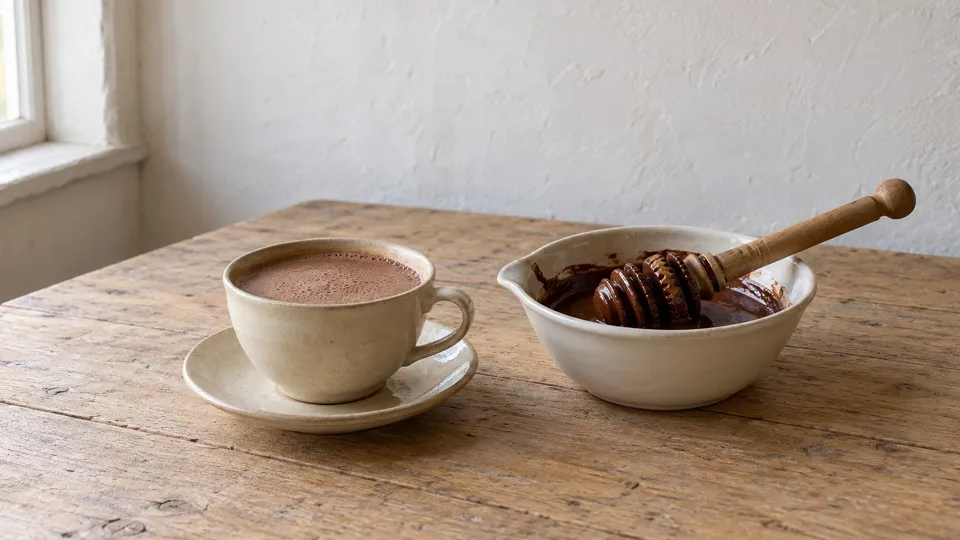 Always alcohol-freeRundell’s Chocolate, a Breakfast or Supper Cup from 1806
Tax kept it dear. In 1832 Britain cut the duty on cocoa from its own colonies from 6d. to 2d. a pound. “The result,” Baker’s history says, “was that the consumption which, during the three years ending in 1831, averaged only 440,578 pounds a year, shortly increased to an average of 2,072,335 pounds,” nearly five times as much.
Less than one cent a cup
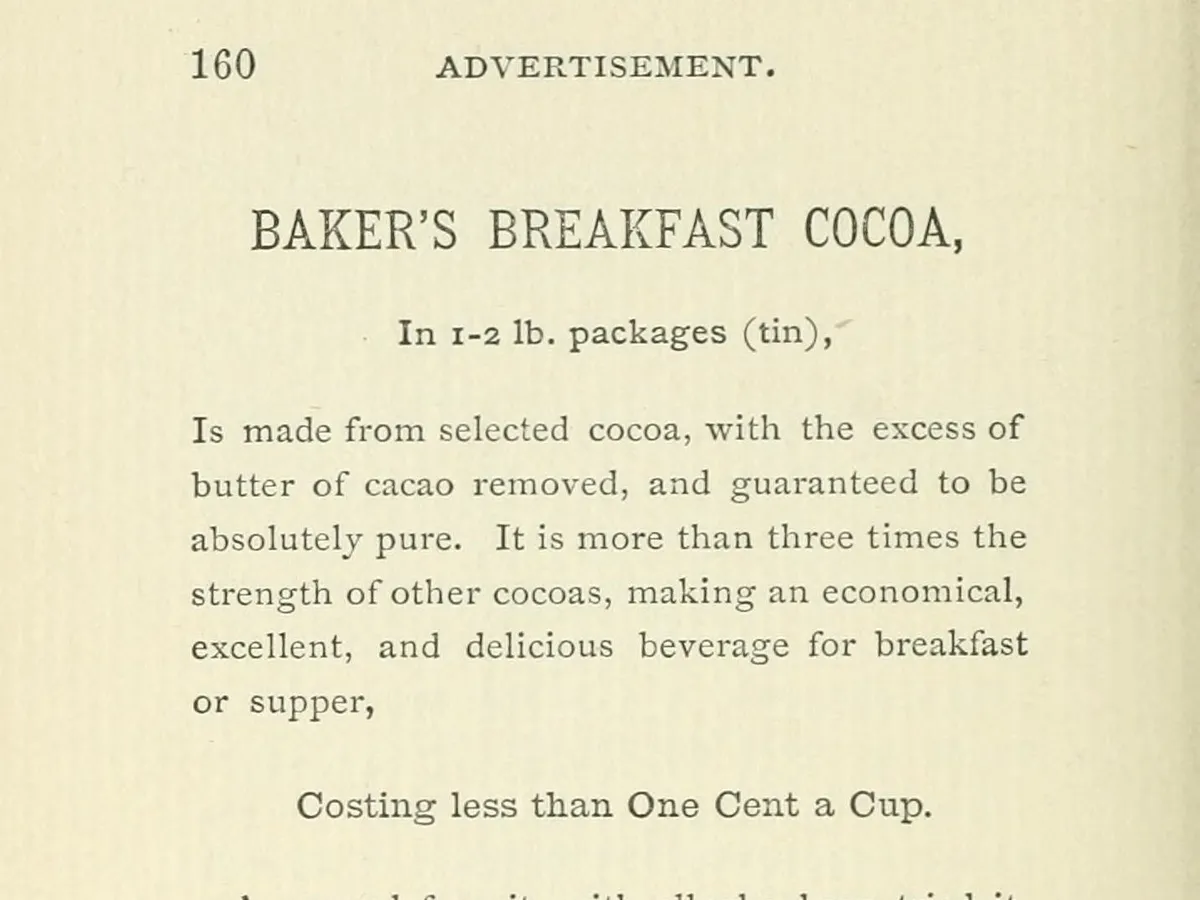
The other change was in the cacao itself. In 1828, by modern accounts, the Dutch maker Coenraad van Houten patented a press that squeezed much of the fat, the cocoa butter, out of ground cacao, leaving a powder that mixed easily with liquid. By 1886 Walter Baker & Co. of Dorchester was selling “Breakfast Cocoa” in half-pound tins, “made from selected cocoa, with the excess of butter of cacao removed,” at a cost of “less than One Cent a Cup.” A cent then is about 36 cents today, by US consumer prices.
The method on the tin was short: a teaspoonful of powder mixed with a spoonful of boiling water, “then add equal parts of boiling water and boiled milk, and sugar to the taste.” That thinner, cheaper, everyday cup is Breakfast Cocoa the 1886 Way, and the grocer who borrowed Baker’s name is in The Grocer Called Baker.
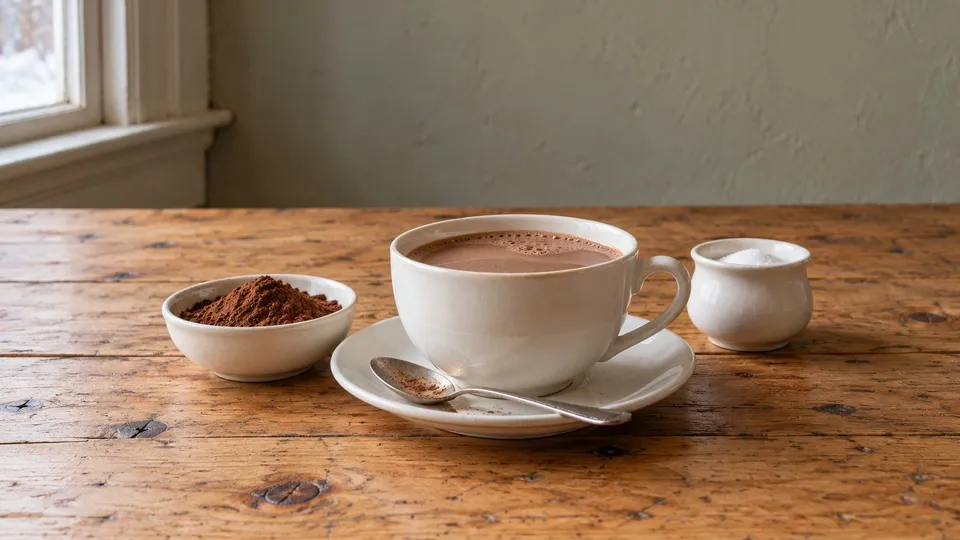 Always alcohol-freeBreakfast Cocoa the 1886 Way, Half Milk and Half Water
For the richest cup in this history, go back to the beginning. The 1652 breakfast chocolate, with milk, egg yolks and sugar frothed together, is Chocolate in Milk with Egg Yolks, a 1652 Breakfast Cup: one good draught, as the book says, to “travell all the day.”
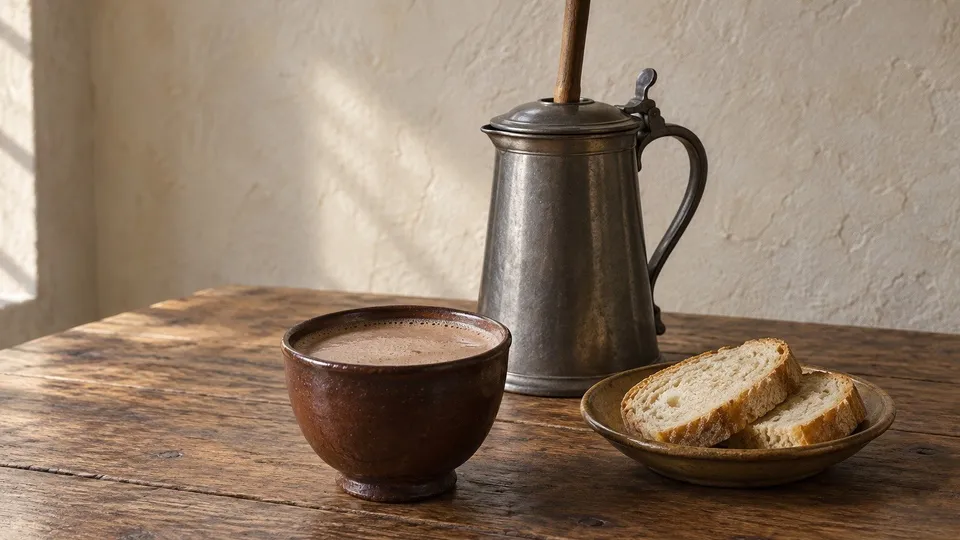 Always alcohol-freeChocolate in Milk with Egg Yolks, a 1652 Breakfast Cup
Sources
- Antonio Colmenero de Ledesma, Chocolate: or, An Indian Drinke, trans. James Wadsworth (London: J. G. for John Dakins, 1652), title page, p. 33, and the appendix on chocolate in milk or water.
- Philippe Sylvestre Dufour, The Manner of Making of Coffee, Tea, and Chocolate, trans. John Chamberlayne (London: William Crook, 1685), p. 107.
- Samuel Pepys, The Diary of Samuel Pepys, ed. Henry B. Wheatley, vol. 2 (London: George Bell & Sons, 1904), p. 24.
- Maria Eliza Rundell, A New System of Domestic Cookery (London: John Murray, 1806), pp. 258–259.
- Walter Baker & Co., Cocoa and Chocolate: A Short History of Their Production and Use (Dorchester, Mass., 1886), pp. 39–42, 99, 160.