Breakfast Cocoa the 1886 Way, Half Milk and Half Water
Reader ratingsCocoa powder worked to a paste with a spoonful of boiling water, then made up with equal parts of boiling water and boiled milk: the breakfast cocoa of a Massachusetts chocolate maker’s 1886 booklet, at the center of an 1898 lawsuit.
- Recipe makes
- 1 breakfast cup
- Prep
- Cook
- Total
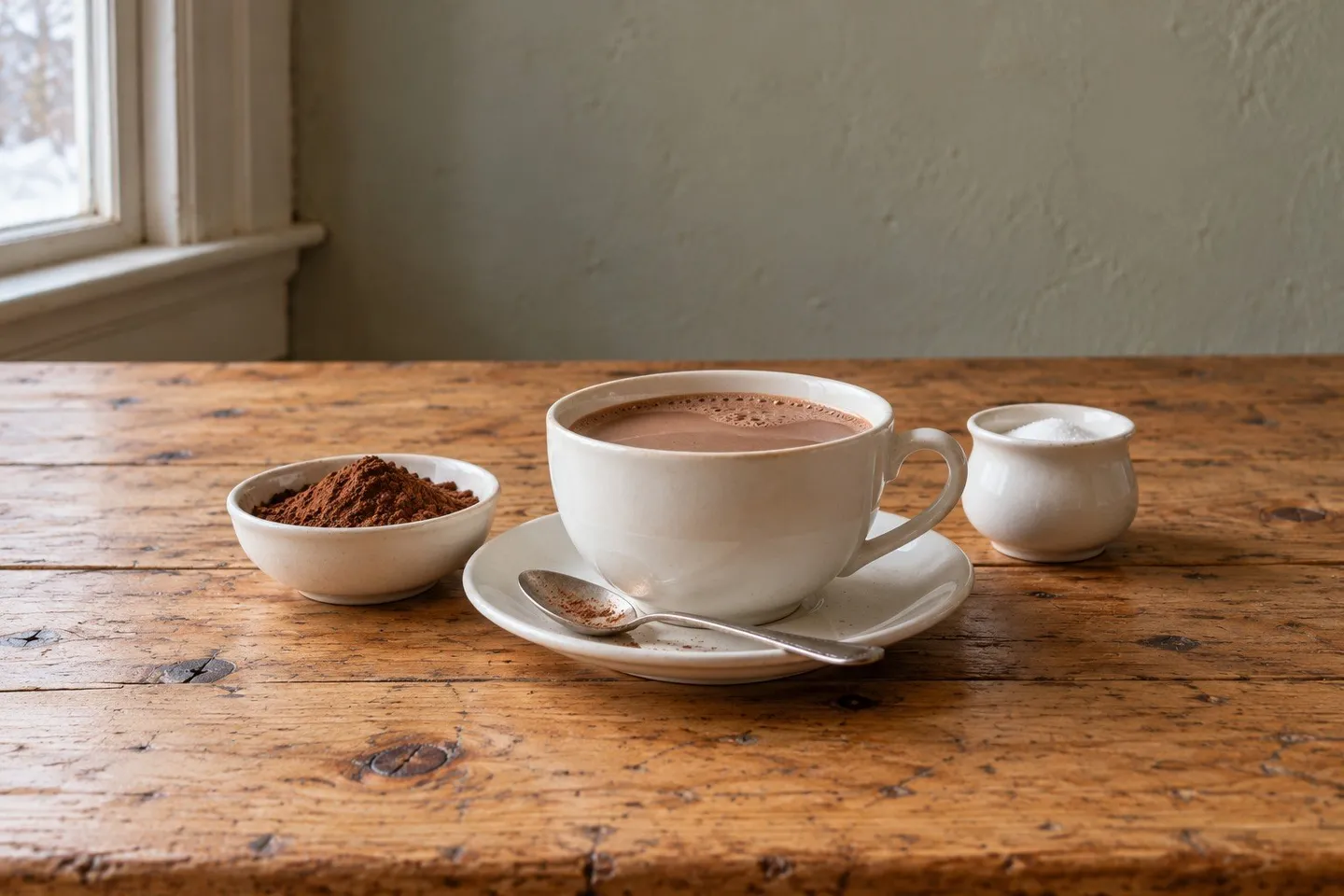
A breakfast cup of cocoa, with cocoa powder and sugar.
The story behind the recipe
Breakfast cocoa, in 1886, was a teaspoon of powder stirred to a paste with a spoonful of boiling water, then made up with equal parts of boiling water and boiled milk and sweetened to taste. That is how Walter Baker & Company of Dorchester, Massachusetts, told its customers to make the powdered cocoa it sold as “Breakfast Cocoa,” in a booklet on the history and uses of cocoa and chocolate. “Boiling two or three minutes will improve it,” the booklet adds.
The name in the cup
Twelve years later the same two words were in a New York courtroom. A wholesale grocer whose name really was Baker, William P. Baker, had been buying ready-ground cocoa by the barrel from a Newark firm, repacking it in half-pound cans and selling it as “W. P. Baker’s Breakfast Cocoa.” In May 1898 the federal circuit court ruled that he could trade under his own full name but could not put “Breakfast Cocoa” beside the name Baker. The judge was careful about the word itself: the Dorchester company “has no exclusive right to the word ‘Breakfast’ disconnected from its name.” How the case came about, and the chocolate cakes that were part of it, is in The Grocer Called Baker.
Read more about this recipe
Making it today
The paste is the point: cocoa powder won’t mix into hot liquid without lumps, and a spoonful of boiling water first lets it dissolve smoothly. The booklet’s single teaspoon makes a very light cup by today’s standards, so we use two. For the richer drink from the page before, made with solid chocolate and its own weight of sugar, see An 1886 Chocolate Cup.
Baker’s Breakfast Cocoa. Into a breakfast-cup put a teaspoonful of the powder, add a tablespoonful of boiling water and mix thoroughly; then add equal parts of boiling water and boiled milk, and sugar to the taste. Boiling two or three minutes will improve it.

Recipe makes: 1 breakfast cup
Ingredients
For 1 breakfast cup. Quantities are shown as written.
Quantities as written here, for 1 breakfast cup.
- Unsweetened cocoa powder2 tsp
- Boiling water, for the paste1 tbsp
- Boiling water1/2 cup
- Whole milk1/2 cup
- Sugar, or to taste2 tsp
Measurement notes
Ingredients as written here
- 2 tsp unsweetened cocoa powder
- 1 tbsp boiling water, for the paste
- 1/2 cup boiling water
- 1/2 cup whole milk
- 2 tsp sugar, or to taste
Equipment
 Kettle
 Small saucepan
 Whisk
 Mug
Instructions
Heat the whole milk in the small saucepan until it just boils, then take it off the heat.
Put the unsweetened cocoa powder in the mug, add the boiling water, for the paste, and stir until smooth, with no dry lumps.
Pour in the boiling water and the hot milk, stirring, and sweeten with the sugar.
For the book’s improvement, pour it all back into the saucepan and let it bubble gently for 2 minutes, whisking, then pour it back into the mug.
Nutrition
120calories per serving
- Recipe makes
- 1 breakfast cup
Roughly estimated from USDA FoodData Central values for unsweetened cocoa powder, whole milk and granulated sugar, for one cup.
Recipe notes
When adjusting quantities
One breakfast cup. Keep the water and milk equal.
Notes
Quantities mentioned in these notes don’t change when you adjust the batch.
Changes from the source: the booklet uses one teaspoon of cocoa; we use two, because a single teaspoon gives a very thin cup. It doesn’t say how big a breakfast cup was; we make about a cup. The booklet was written to sell the company’s own cocoa; any unsweetened cocoa powder works.
Scaling changes the ingredients only; glassware, ice and timings need their own judgment. To adapt this recipe further, try the recipe tool at TuneMyRecipe (opens in a new tab), our sister site.
Sources and attribution
Walter Baker & Company, Cocoa and Chocolate: A Short History of Their Production and Use (Dorchester, Mass.: Walter Baker & Company, 1886), “Breakfast Cocoa”, p. 99
Recipe details
- Drink
- Alcohol-free
- Drink family
- Hot Drinks
- Region
- American
- Era
- 19th century
- Source decade
- 1880s
- Difficulty
- Easy
- Season
- Winter