Chocolate in Milk with Egg Yolks, a 1652 Breakfast Cup
Reader ratingsGrated chocolate frothed into boiling milk with two egg yolks and sugar: the 1652 breakfast cup from the earliest English chocolate book we know of.
- Recipe makes
- About 1 liter, 4 cups
- Prep
- Cook
- Total
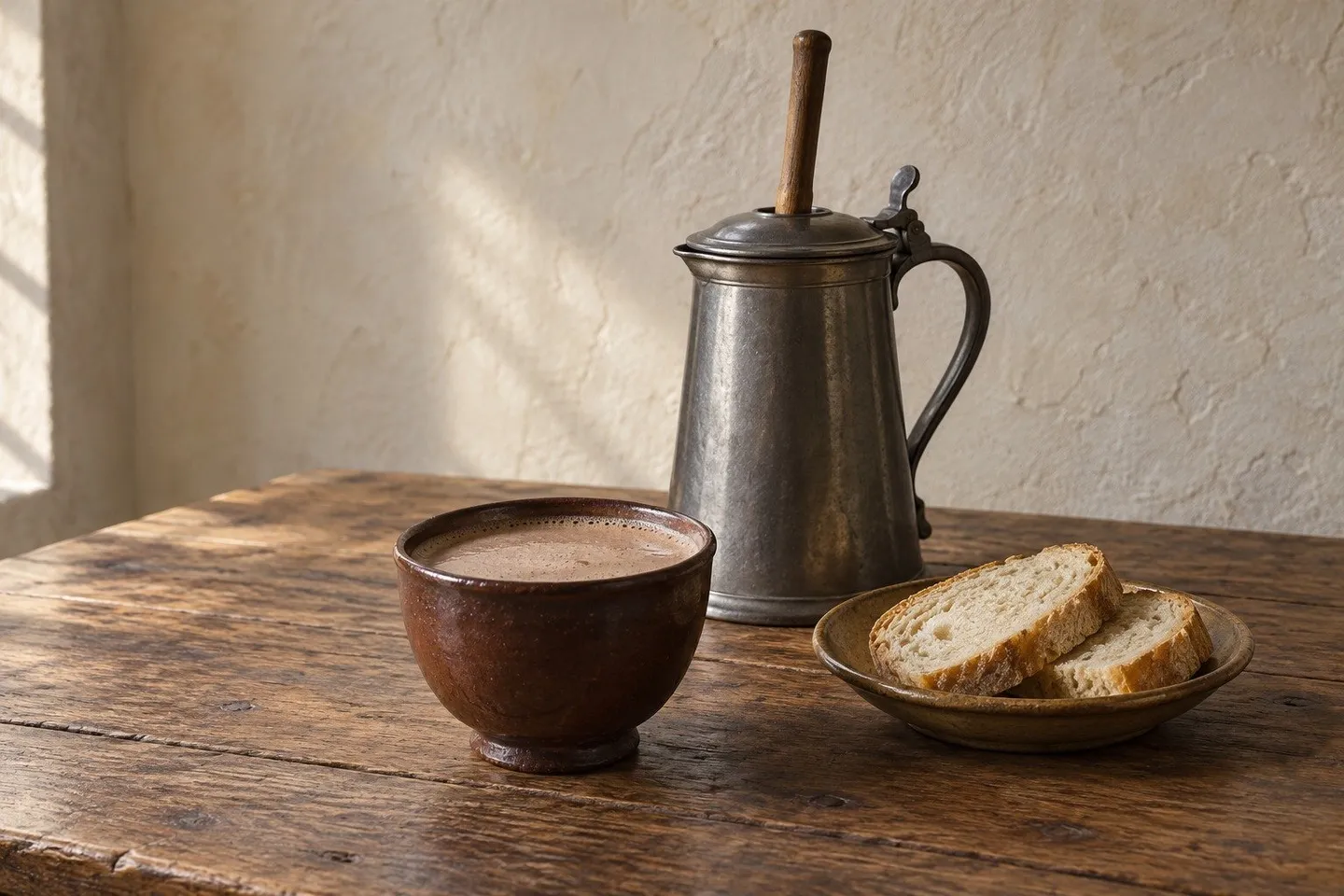
Chocolate in milk with egg yolks in a deep earthenware cup, with a chocolate pot and mill and a dish of white bread.
The story behind the recipe
“If you please to take it in milke, to a quart, three ounces of Chocolate will be sufficient.” That is how the earliest English book on chocolate we know of, Captain James Wadsworth’s 1652 translation of a Spanish treatise, begins its milk recipe. Chocolate is scraped into boiling milk, frothed with a wooden mill, thickened with two beaten egg yolks and sweetened to taste.
A breakfast in a cup
The recipe sits in a short section added at the back of the English book, and it is plain about what the cup is for. Drink “a good draught,” or slice a little manchet, fine white bread, into a dish with it, “and so eate it for a breakfast.” Drunk in the morning, it promises, “you may travell all the day without any other thing, this is so Substantiall and Cordiall.” That claim is the book’s, not ours. How it fits among the water chocolate of the same book and the cheap cocoa of the 1880s is in A Short History of Hot Chocolate.
Read more about this recipe
Our version
A period quart of milk is close to a liter, and we keep the book’s three ounces of chocolate, about 85 grams. The chocolate of 1652 came as a cake already ground with sugar and spice, so a dark chocolate of about 55% cocoa stands in for it, with an optional pinch of cinnamon. The book brings the milk back “untill it be ready to boyle” before the yolks go in; we heat the yolks only to 71°C, the USDA’s safe point for eggs and well short of a boil, so they thicken the milk without curdling. The book says nothing about taste beyond “Cordiall.” For the water version the same book suggests for “some weake stomacks,” make Colmenero’s spiced chocolate.
How to make use of the Chocolate, to be taken as a drinke, exceeding cordiall for the comfort of the healthfull, and also for those in weaknesse and Consumptions, to be dissolved in Milke or Water.
If you please to take it in milke, to a quart, three ounces of Chocolate will be sufficient: Scrape your Chocolate very fine, put it into your milke when it boiles, work it very well with the Spanish Instrument called Molenillo between your hands: which Instrument must be of wood, with a round knob made very round, and cut ragged, that as you turne it in your hands, the milke may froth and dissolve the Chocolate the better: then set the milke on the fire againe, untill it be ready to boyle: having the yelke of two eggs well beaten with some of the hot milke; then put your eggs into the milke, and Chocolate and Sugar, as much as you like for your taste, and worke all togeather with the Molenillo, and thus drinke a good draught: or if you please you may slice a little Manchet into a dish, and so eate it for a breakfast: you may if you please make your Chocolate with Water and Sugar, working it after the same order with your Molenillo, which for some weake stomacks may chance to be better liked. And many there be that beat Almonds, and strayne them into the water it is boyled, and wrought with the Chocolate and Sugar: others like to put the yelkes of eggs as before in the milke, and ever sweeten it with Sugar to your taste: If you drinke a good draught of this in a morning, you may travell all the day without any other thing, this is so Substantiall and Cordiall.

Recipe makes: About 1 liter, 4 cups
Ingredients
For About 1 liter, 4 cups. Quantities are shown as written.
Quantities as written here, for About 1 liter, 4 cups.
- Whole milk950 ml
- Dark chocolate, about 55% cocoa solids85 g
- Large egg yolks2
- Sugar, or to taste1 metric tbsp (15 ml per tbsp)
- Ground cinnamon (optional)1 pinch
Measurement notes
Ingredients as written here
- 950 ml whole milk
- 85 g dark chocolate, about 55% cocoa solids
- 2 large egg yolks
- 1 tbsp sugar, or to taste
- 1 pinch ground cinnamon (optional)
Equipment
 Saucepan
 Fine grater
 Wooden chocolate whisk (molinillo) or a small whisk
 Small bowl
 Ladle
 Instant-read thermometer
Instructions
Grate the dark chocolate finely.
Bring the whole milk just to a boil in the saucepan, then take it off the heat. Add the chocolate and whisk hard, or spin the molinillo between your palms, until the chocolate melts and the milk froths.
Beat the egg yolks in the small bowl, then whisk in a ladle of the hot chocolate milk, a little at a time.
Set the pan back over low heat and pour in the yolk mixture, whisking all the time. Stir in the sugar and the ground cinnamon, if using.
Keep whisking over low heat until the chocolate reaches 71 to 75°C on the thermometer and thickens very slightly, about 3 to 5 minutes. Do not let it boil.
Whisk once more to raise a froth and pour into warmed cups. Serve at once, with slices of white bread if you like.
Nutrition
310calories per serving
- Recipe makes
- About 1 liter, 4 cups
- Servings
- 4
Estimated from USDA FoodData Central values for whole milk, dark chocolate of about 55% cocoa, raw egg yolk and sugar, for one 250 ml cup.
Recipe notes
Notes
Quantities mentioned in these notes don’t change when you adjust the batch.
The 1652 quart is taken as about 950 ml, close to the English wine quart. Three ounces is about 85 grams.
If you only have unsweetened chocolate, use about 45 g of it with about 50 g of sugar in place of the dark chocolate and the tablespoon of sugar.
Use the freshest eggs you can, or pasteurized yolks for anyone very young, old or pregnant. Make it just before drinking, and don’t reheat it once the yolks are in.
Scaling changes the ingredients only; glassware, ice and timings need their own judgment. To adapt this recipe further, try the recipe tool at TuneMyRecipe (opens in a new tab), our sister site.
Sources and attribution
Antonio Colmenero de Ledesma, Chocolate: or, An Indian Drinke, trans. James Wadsworth (London: J. G. for John Dakins, 1652), appendix, “How to make use of the Chocolate, to be taken as a drinke”
Recipe details
- Drink
- Alcohol-free
- Drink family
- Hot Drinks
- Region
- British
- Era
- 17th century
- Difficulty
- Easy
- Season
- Winter