White Tea, Sweet Milk and Hot Water for Children from 1873
Reader ratingsHalf a cup of hot water with two teaspoons of sugar and as much milk: the warm “white tea” Catharine Beecher gave children in 1873.
- Recipe makes
- 1 cup
- Prep
- Total
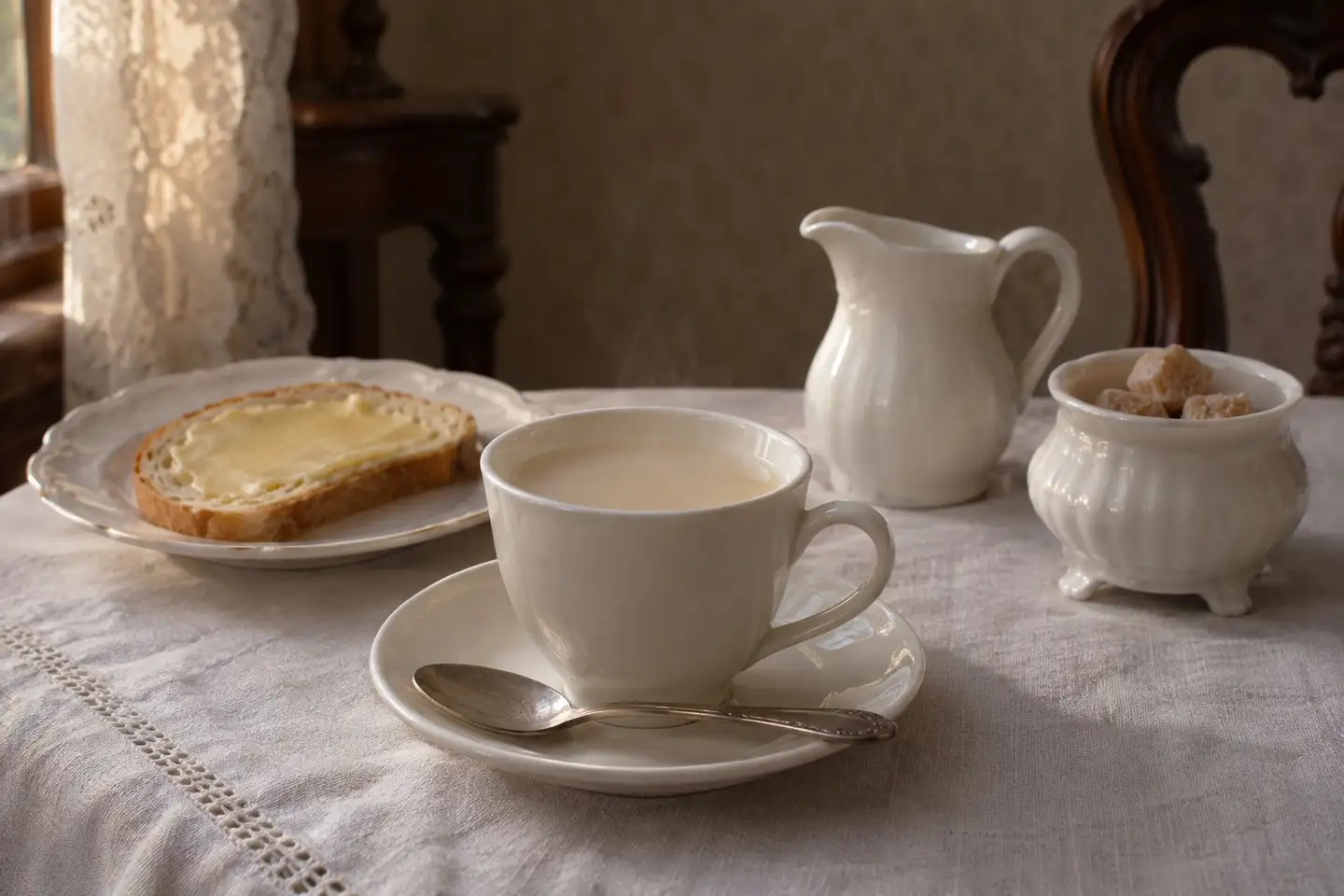
White tea of hot water, milk and sugar in a china cup, with buttered bread, a milk jug and a sugar bowl.
The story behind the recipe
White tea has no tea in it: it is hot water, sugar and milk in equal parts of water and milk, poured for a child at the tea table. Catharine Beecher printed it in 1873 under the heading “White Tea, and Boys’ Coffee, for Children,” with a one-line theory of taste: “Children never love tea and coffee till they are trained to it.”
Why Beecher left the tea out
The recipe is in her Handy Cook-Book, the second part of The New Housekeeper’s Manual she published with her sister Harriet Beecher Stowe, in a chapter of “Drinks and Articles for the Sick and Young Children.” Its worry was strength. “Coffee is usually drank so strong as to injure children and grown persons of delicate constitution,” the page before says, and then: “All alcoholic drinks are dangerous.” The answer was a cup that looked like the grown-ups’ and had none of the grown-ups’ drinks in it. Twenty years later the same cup turns up under another name, “cambric tea,” in Elisabeth Scovil’s The Care of Children of 1894, and the whole run of children’s drinks from Victorian negus to the Shirley Temple is in What Did Children Drink in the 1800s?
The “boys’ coffee” in the heading was a bowl rather than a cup: toast or dry bread crumbled with “plenty of sugar,” and half milk and half boiling water poured over it, to be eaten with a spoon.
Read more about this recipe
Beecher’s half and half
The amounts are Beecher’s own, read as US cups: half a cup of hot water, two teaspoons of sugar and half a cup of milk. Their “good milk” would have been fresh from a local dairy; use pasteurized whole milk. Pouring cold milk into water just off the boil leaves the cup warm, not hot, but check it before you hand it to a child.
For a cold drink in the same spirit, Scovil’s cool water with “a small quantity of home-made fruit syrup” is the summer version, and our Mrs. Beeton’s lemonade is a sweeter one for a party.
White Tea, and Boys’ Coffee, for Children.—Children never love tea and coffee till they are trained to it. They always like these drinks. Put two tea-spoonfuls of sugar to half a cup of hot water, and add as much good milk. Or crumb toast or dry bread into a bowl with plenty of sugar, and add half milk to half boiling water.

Original: 1 cup
Ingredients
My drinksFor 1 cup. Quantities are shown as written.
Quantities as written here, for 1 cup.
- Hot water, just off the boil1/2 cup
- Sugar2 tsp
- Whole milk1/2 cup
Measurement notes
Ingredients as written here
- 1/2 cup hot water, just off the boil
- 2 tsp sugar
- 1/2 cup whole milk
Equipment
 Kettle
 Teacup
 Teaspoon
Instructions
Pour the hot water into a teacup.
Stir in the sugar until it has dissolved.
Add the whole milk, stir, and check that it is warm, not hot, before serving.
Nutrition
105calories per serving
Estimated from USDA FoodData Central values for whole milk and granulated sugar.
Recipe notes
When adjusting quantities
Keep equal parts hot water and milk, with 2 teaspoons of sugar to each cup.
Notes
Quantities mentioned in these notes don’t change when you adjust the batch.
The recipe is Beecher’s own; the choice of pasteurized whole milk and the check on heat are ours. For the boys’ coffee, crumble a slice of toast into a bowl with a heaped teaspoon of sugar (our amount) and pour over equal parts milk and boiling water.
A few drops of vanilla are a later idea: Scovil suggested them in 1894 for a child who disliked plain milk, “calling it ‘ice cream milk.’”
Scaling changes the ingredients only; glassware, ice and timings need their own judgment. To adapt this recipe further, try the recipe tool at TuneMyRecipe (opens in a new tab), our sister site.
Sources and attribution
“White Tea, and Boys’ Coffee, for Children” in Catharine E. Beecher, The Handy Cook-Book, part II of Catharine E. Beecher and Harriet Beecher Stowe, The New Housekeeper’s Manual (New York: J. B. Ford, 1873), p. 521
Recipe details
- Drink
- Alcohol-free
- Drink family
- Hot Drinks
- Region
- American
- Era
- 19th century
- Source decade
- 1870s
- Base
- Milk & whey
- Difficulty
- Easy
- Season
- Winter