The Navy’s Evening Pint of Tea from 1824
Reader ratingsA quarter-ounce of tea made up to a pint and sweetened from the sugar ration: the evening pint every Royal Navy sailor was promised from 1824, when the Admiralty cut the grog.
- Recipe makes
- One pint, about 500 ml
- Prep
- Cook
- Total
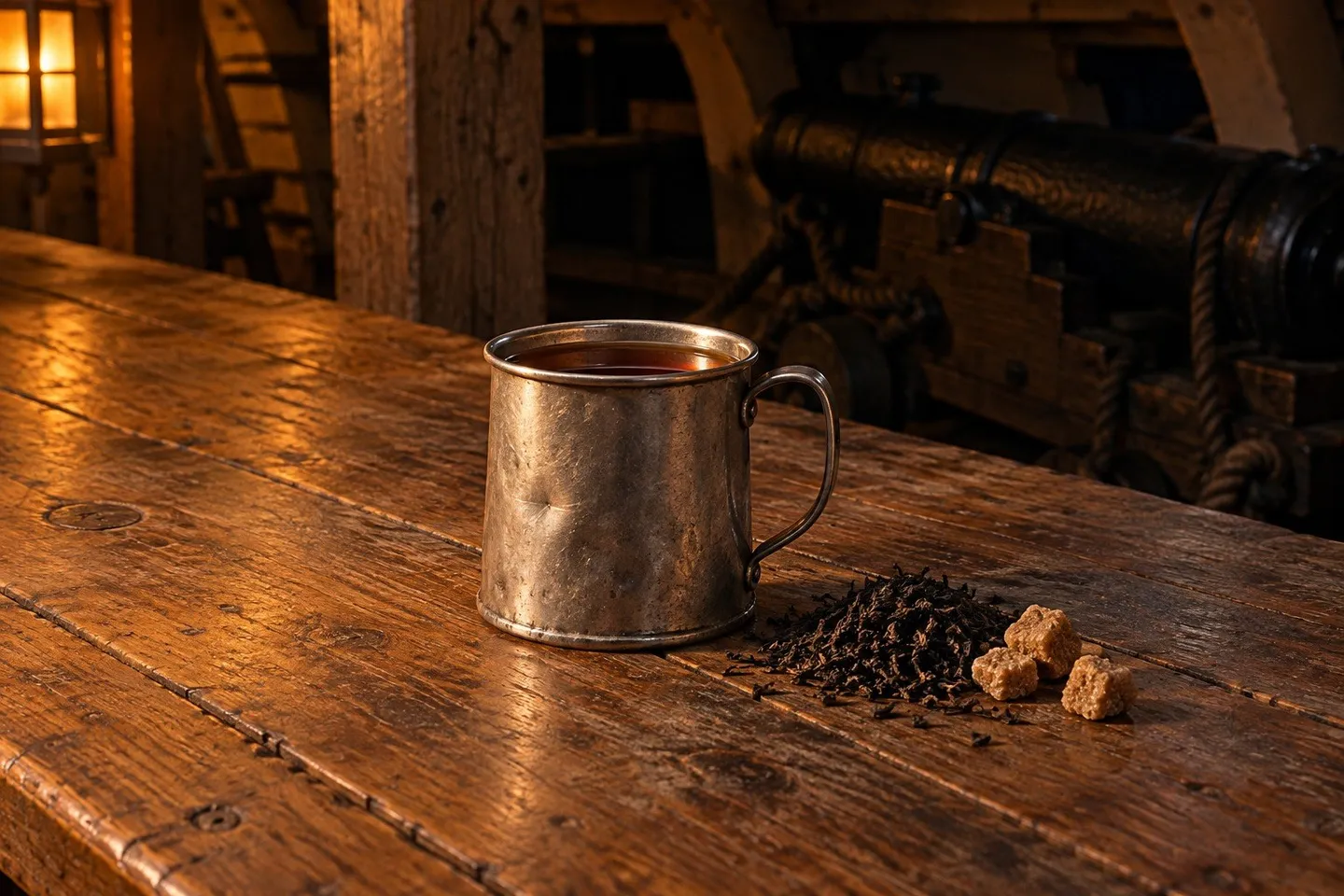
Tea in a tin mug on a warship’s mess table, with loose black tea and sugar.
The story behind the recipe
From the summer of 1824 every man and boy in the Royal Navy was promised a pint of tea or coffee every evening. The Admiralty’s new rations, sent out on July 1 over the signature of its secretary, John Wilson Croker, added “a quantity of Tea or Coffee, sufficient to make a Pint of liquid,” to be “issued every Evening.” The circular doesn’t say how much tea made that pint; the daily list of provisions gives tea as a quarter of an ounce, and we use that. The sugar to sweeten it came from the same ration, which also had to cover the ship’s cocoa.
Tea for half the spirits
The tea came with a cut. In the same circular, the spirits issued in place of beer or wine were “diminished One Half,” and the evening pint was described as “part compensation” for the loss, with two shillings a month added to the men’s pay, about £9.50 today by UK consumer prices (Bank of England), to make up the rest. Seven months later, in the House of Commons, one member wondered whether the men would think the tea “little better than clover dust.” The First Naval Lord, Sir George Cockburn, answered that the men had welcomed the change, and that the tea had nothing to do with their grog at all. The whole affair is in Half the Grog and a Pint of Tea.
Read more about this recipe
Making it today
The circular gives neither the evening tea’s weight nor a method, so this page is our reconstruction. The daily list’s quarter of an ounce, about 7 g, is a generous amount for a pint and makes a strong, dark brew. The circular doesn’t say black or green, or how much of the sugar went into the tea; we use black tea and two teaspoons. There is no milk in the ration. For the stronger, sweeter tea of the Victorian temperance movement, made with ten minutes in the pot, try Coffee-Tavern Tea.
Sugar ............ One and Half Ounce, Tea ............ Quarter of an Ounce.
... and that a quantity of Tea or Coffee, sufficient to make a Pint of liquid, will be issued every Evening.

Recipe makes: One pint, about 500 ml
Ingredients
For One pint, about 500 ml. Quantities are shown as written.
Quantities as written here, for One pint, about 500 ml.
- Loose black tea7 g
- Boiling water500 ml
- White sugar, or to taste2 metric tsp (5 ml per tsp)
Measurement notes
Ingredients as written here
- 7 g loose black tea
- 500 ml boiling water
- 2 tsp white sugar, or to taste
Equipment
 Kettle
 Teapot or heatproof jug
 Tea strainer
 Mug
Instructions
Warm the teapot or jug with a little hot water from the boiling water, then pour it away.
Put the loose black tea in the pot and pour on the rest of the boiling water.
Leave it to brew for 5 minutes, then pour it through a tea strainer into the mug.
Stir in the white sugar and drink it hot.
Nutrition
30calories per serving
- Recipe makes
- One pint, about 500 ml
Roughly estimated from USDA FoodData Central values for brewed black tea and granulated sugar, for one pint with 2 teaspoons of sugar.
Recipe notes
When adjusting quantities
One sailor’s pint. The circular gives no weight for the evening tea; we use the quarter-ounce of the daily list. The sugar is our choice.
Notes
Quantities mentioned in these notes don’t change when you adjust the batch.
Measures: a quarter of an ounce is about 7 g. Britain’s imperial pint of about 570 ml became law only in 1826, and the circular doesn’t say which pint it meant, so we use 500 ml.
Changes from the source: the circular gives only the tea and the volume. The brewing time, the black tea and the amount of sugar are ours. The daily sugar ration of an ounce and a half, about 42 g, also had to sweeten the cocoa, so we use only a little of it here.
Scaling changes the ingredients only; glassware, ice and timings need their own judgment. To adapt this recipe further, try the recipe tool at TuneMyRecipe (opens in a new tab), our sister site.
Sources and attribution
Admiralty circular of July 1, 1824, signed J. W. Croker, “Victualling Regulations”, in The Navy List, corrected to September 25, 1826 (London: John Murray, 1826), pp. 144–145
Recipe details
- Drink
- Alcohol-free
- Drink family
- Hot Drinks
- Region
- British
- Era
- 19th century
- Difficulty
- Easy
- Season
- Winter