Bread Kvass, the 24-Hour Rye Kvass from 1887
Reader ratingsDried rye bread steeped in boiling water, sweetened with dark treacle, started with a little yeast and bottled with two raisins: Elena Molokhovets’s 1887 kvass, at a tenth of her batch.
- Recipe makes
- About 1.2 liters, 6 glasses
- Prep
- Total
About two and a half days: 2 to 3 hours for the bread to steep and cool, 12 hours working in a warm room, then 2 days bottled in the fridge, as Molokhovets directs. Hands-on time is about half an hour.
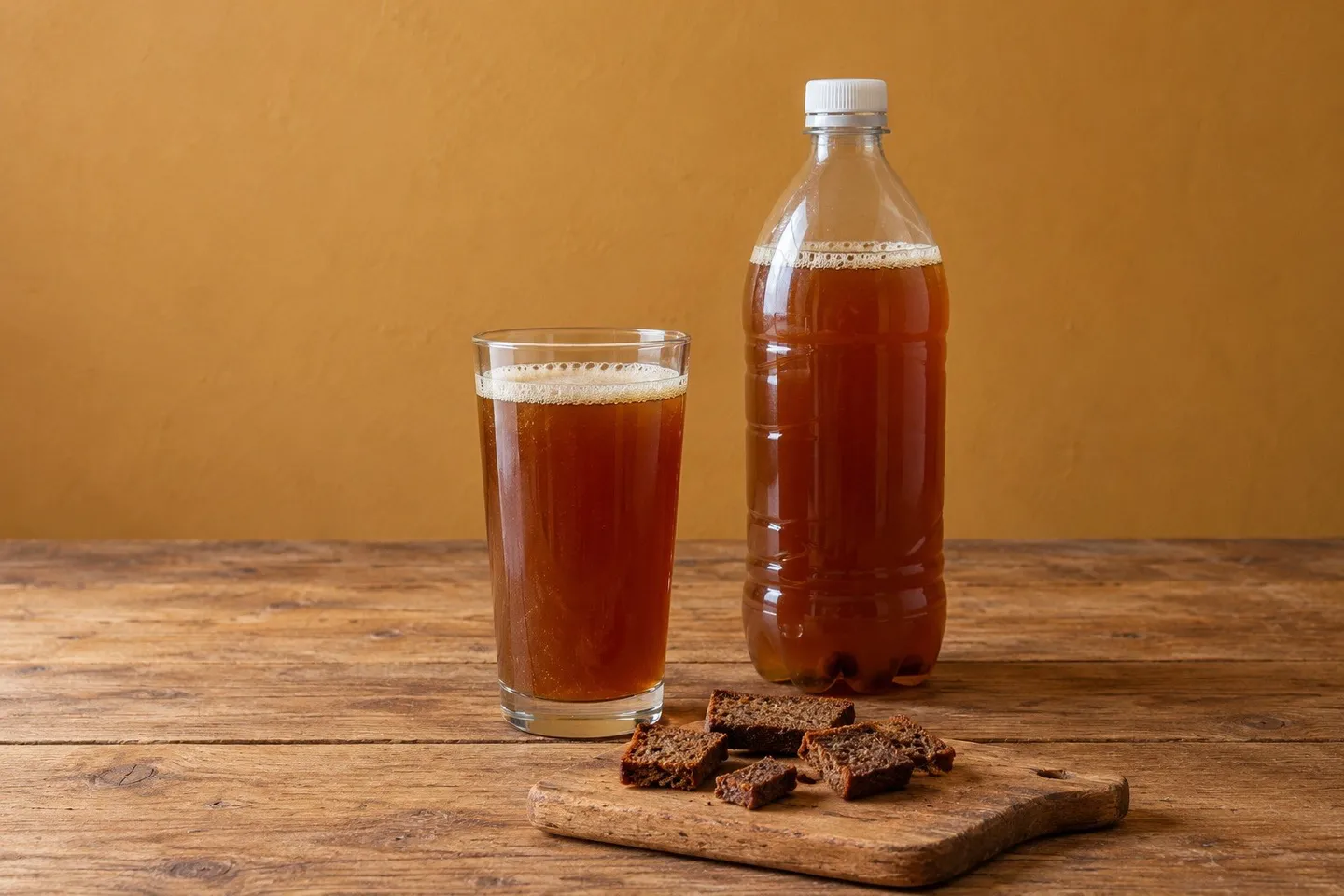
Bread kvass in a plain glass, with a bottle of kvass and pieces of dried rye bread.
The story behind the recipe
Kvass is a home-brewed Russian drink of rye, and this is the quick bread version. Elena Molokhovets’s household book, A Gift to Young Housewives, was in its thirteenth edition by 1887, and there her “24-hour kvass from pieces of rye bread” takes stale bread, boiling water, dark treacle, a little yeast and two raisins in every bottle. It can be drunk, she says, “after two days.”
A kitchen brew
Molokhovets puts her kvass in a chapter with beer and mead, and gives it several recipes: kvass from rye meal and malt, kvass with mint, with sugar and lemon, with rowan berries. This one is the plainest. The bread is cut small and dried hard, scalded with water and left under a thick cloth until the liquid is “as warm as milk fresh from the cow.” It is strained without squeezing, sweetened, started with yeast and a spoonful of flour, left twelve hours in a warm room, then bottled with raisins, corked well and put in the cellar.
That makes it a cousin of the home-brewed ginger and hop beers that English and American households also bottled, and which, as What Were Victorian Non-Alcoholic Beers? shows, held a little alcohol whatever they were called.
Read more about this recipe
Making it today
Our batch is a tenth of hers, about a liter and a half of water. We use plastic soda bottles rather than corked glass, since the yeast goes on making gas, and the fridge stands in for her cellar. Dry the bread in a low oven until it is hard right through; she asks only for bread “well dried,” so toasting it darker is up to you.
This kvass is low in alcohol, not free of it. For a version with no yeast at all, made with lemon and mint, there is Alcohol-Free Bread Kvass with Lemon and Mint. Another bottled small beer, from New York, is Spruce Beer from an 1804 New York Handbill.
24-hour kvass from pieces of rye bread.
Take 3 pounds of stale, well-baked rye bread, cut in small pieces and well dried; put it in a clean small tub, pour over it 24 bottles of boiling water, cover at once with a thick cloth, and let it stand until it is as warm as milk fresh from the cow. Then strain it through a clean napkin, but do not squeeze. To this quantity put 2 pounds of good dark treacle, stir well so that none stays on the bottom, then pour in 2 tablespoons of yeast mixed with 1 spoonful of wheat flour. Stand it for 12 hours in a warm room; in the morning strain it and pour it into bottles, putting 2 raisins in each; cork well and put in the cellar. It can be drunk after two days.

Recipe makes: About 1.2 liters, 6 glasses
Ingredients
For About 1.2 liters, 6 glasses. Quantities are shown as written.
Quantities as written here, for About 1.2 liters, 6 glasses.
- Stale dark rye bread125 g
- Boiling water1.5 l
- Black treacle80 g
- Dried yeast1/4 metric tsp (5 ml per tsp)
- All-purpose flour1/4 metric tsp (5 ml per tsp)
- Raisins6
Measurement notes
Ingredients as written here
- 125 g stale dark rye bread
- 1.5 l boiling water
- 80 g black treacle
- 1/4 tsp dried yeast
- 1/4 tsp all-purpose flour
- 6 raisins
Equipment
 Large heatproof bowl
 Sieve lined with muslin or a clean cotton cloth
 Funnel
 Plastic soda bottles
Instructions
Cut the stale dark rye bread into small pieces and dry them in the oven at about 120 °C for 30 to 45 minutes, until hard right through.
Put the dried bread in the bowl, pour on the boiling water, cover at once with a plate and a thick cloth, and leave it until it is just warm to the touch, about 35 °C. This takes 2 to 3 hours.
Strain the liquid through a napkin or muslin laid in the sieve. Let it drip; do not squeeze the bread.
Stir in the black treacle until none is left on the bottom of the bowl.
Mix the dried yeast and all-purpose flour with a spoonful of the warm liquid, then stir it in. Cover and leave in a warm room, about 22 to 25 °C, for 12 hours.
Strain again and pour the kvass through the funnel into the plastic bottles, filling each only to the shoulder. Put the raisins in, two to a bottle, and screw the caps on tight.
Put the bottles in the fridge for 2 days before drinking. Open them slowly over the sink.
Nutrition
45calories per serving
- Recipe makes
- About 1.2 liters, 6 glasses
- Servings
- 6
Roughly estimated from USDA FoodData Central values for molasses, for one 200 ml glass.
Recipe notes
When adjusting quantities
This is a tenth of Molokhovets’s batch, which was three Russian pounds of bread to 24 bottles of water. Keep two raisins to each bottle.
Notes
Quantities mentioned in these notes don’t change when you adjust the batch.
Changes from the source: a tenth of Molokhovets’s quantities. Her Russian pound (funt) is about 410 g and her bottle about 0.61 liter, so her 3 pounds of bread, 24 bottles of water and 2 pounds of treacle are about 1.2 kg, 14.8 liters and 820 g. A tenth of her two tablespoons of yeast is about half a teaspoon of liquid yeast, so a quarter teaspoon of dried yeast is our stand-in. Black treacle (or dark molasses) stands in for her dark treacle, patoka. Drying the bread in the oven, the temperatures, plastic bottles and the fridge in place of a cellar are ours.
The dried bread holds back some of the water, so the yield is about 1.2 liters.
Strength is an estimate; we have not measured it. Black treacle is roughly two-thirds sugar, so if every bit fermented the kvass could reach nearly 3 percent alcohol. Twelve hours’ work and two cold days ferment only part of it, so expect much less, but it is not alcohol-free and not for children or anyone avoiding alcohol.
Never bottle it in glass with a tight cap, never fill the bottles to the top and never leave full bottles somewhere warm. If a bottle is rock-hard, chill it well and open it slowly.
Storage
Keep the bottles in the fridge and drink the kvass soon after the two days Molokhovets gives it. It contains live yeast and keeps making gas; squeeze a bottle now and then and loosen the cap if it is rock-hard.
Scaling changes the ingredients only; glassware, ice and timings need their own judgment. To adapt this recipe further, try the recipe tool at TuneMyRecipe (opens in a new tab), our sister site.
Sources and attribution
Elena Molokhovets, Podarok molodym khozyaikam (A Gift to Young Housewives), 13th ed. (St Petersburg: Gelpern, 1887), No. 2189, “Kvass sutochnyi iz kuskov rzhanogo khleba”, p. 93; our translation
Recipe details
- Drink
- DrinkLow-alcohol
- Drink family
- Wine, Beer & Mead
- Region
- Russian
- Era
- 19th century
- Source decade
- 1880s
- Base
- Barley & grain
- Difficulty
- Intermediate
- Season
- Summer