Sparkling Champagne Cider, Terrington’s Sweetened Hard Cider
Reader ratingsSparkling hard cider sweetened with a little syrup, poured into a tall glass and drunk at once: a safe modern take on Terrington’s 1869 barrel of cider gassed with tartaric acid and bicarbonate.
- Recipe makes
- 1 tall glass, about 260 ml
- Prep
- Total
Chill the cider and the syrup for a few hours first. Make the simple syrup ahead: equal weights of sugar and water, warmed until clear, then cooled.
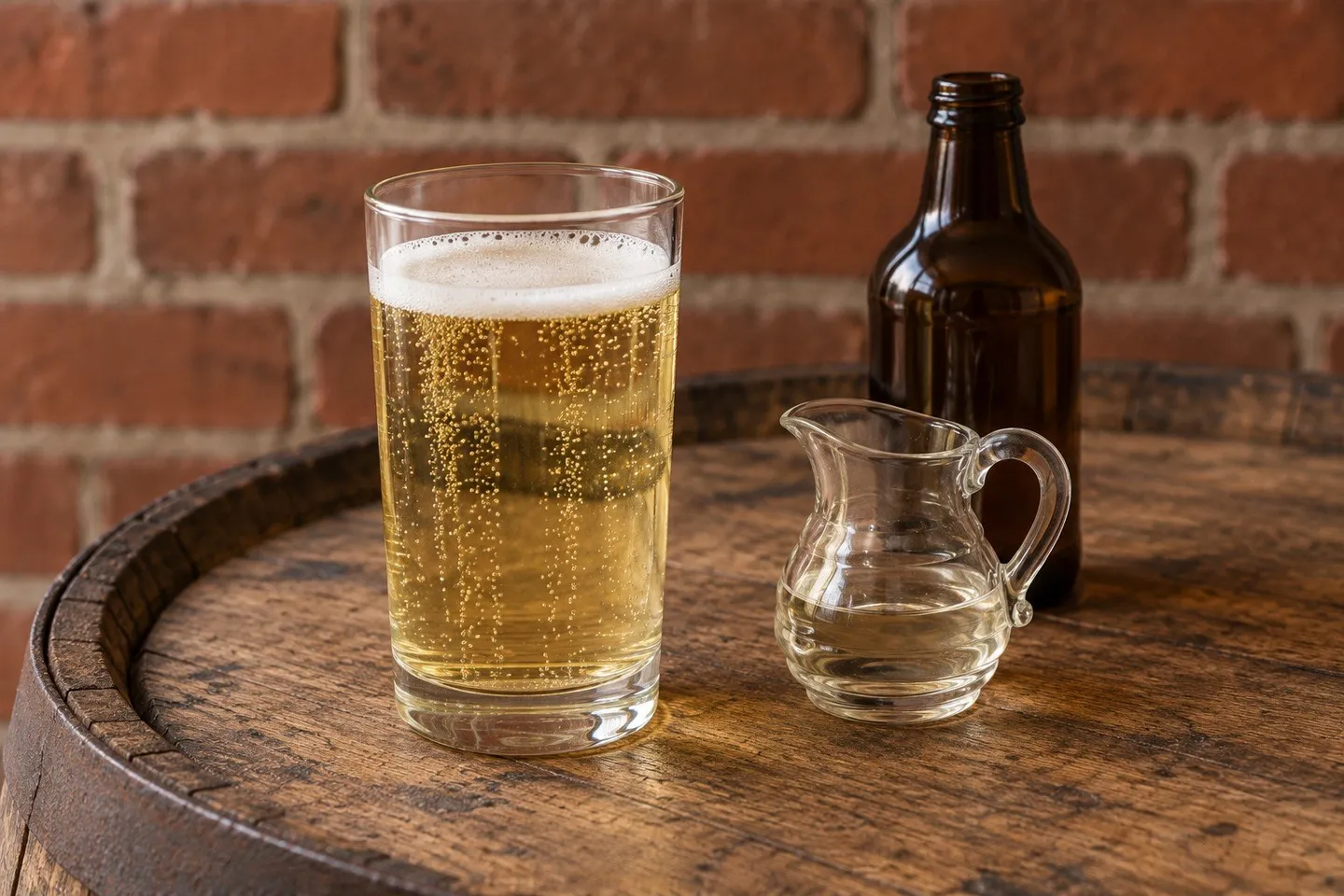
Sweetened sparkling cider in a tall glass on a cask head, with the jug of syrup and the opened bottle.
The story behind the recipe
The sparkle in William Terrington’s “Sparkling Champagne Cider” of 1869 came from a reaction set off inside the barrel. He sweetened ten gallons of old cider in a beer barrel, added tartaric acid, waited ten minutes, then tipped in bicarbonate of potash with the bung already in his other hand. The acid and the bicarbonate fizzed together, and the bung trapped the gas in the cider. This version keeps his sweetened hard cider and lets the bottle supply the bubbles.
Why the barrel had to be strong
Terrington asks for “a strong clean beer barrel, pitched inside,” and with reason. By our arithmetic his 5 ounces of tartaric acid could release about 83 grams of carbon dioxide in the barrel, close to 2 grams for every liter of cider. That alone is a gentle sparkle. The real pressure would come from the old cider and its syrup starting to ferment again behind a tight bung, and nothing in the recipe says how much that makes or when to stop. A US government chemist, C. A. Crampton, measured the gas in two bottles sold as champagne cider in 1887 and found about 1.2 and 1.6 grams per liter, much the same as Terrington’s dose. The bottle that worried him, a “sparkling cider” he judged to be dosed with bicarbonate of soda, held about 5 to 7 grams per liter, a different amount in each bottle he tested. The two cider recipes on Terrington’s page, and the rest of the champagne cider trade, are in What Was Champagne Cider?
Read more about this recipe
Making it today
Don’t repeat the barrel trick. Acid, bicarbonate and sugar sealed in a bottle, jar or keg at home can build enough pressure to burst it. A sparkling hard cider, carbonated in a brewery and sold in a bottle made to hold the pressure, does the same job safely. Terrington’s syrup was 3 pints to 10 gallons, or just under 4 percent of the cider; two teaspoons in a glass of cider is the same share, though his syrup’s strength is unknown, so the sweetness is our choice. With a 5.5 percent cider the glass comes to about 5 to 5.5 percent alcohol.
His other champagne cider, on the same page, is fortified with spirit and scented with orange-flower water; it is the Champagne Cider with Orange-Flower Water. For a glass without alcohol, pour the sparkling apple juice.
Sparkling Champagne Cider.—Put 10 gallons of good clear old cider into a strong clean beer barrel, pitched inside; add 3 pints clean syrup, and 5 oz. of tartaric acid. In ten minutes take the bung in one hand, and quickly add 7½oz. of bicarbonate of potassa; bung up as tight as possible immediately.

Recipe makes: 1 tall glass, about 260 ml
Ingredients
For 1 tall glass, about 260 ml. Quantities are shown as written.
Quantities as written here, for 1 tall glass, about 260 ml.
- Simple syrup, chilled2 metric tsp (5 ml per tsp)
- Dry sparkling hard cider, chilled250 ml
Measurement notes
Ingredients as written here
- 2 tsp simple syrup, chilled
- 250 ml dry sparkling hard cider, chilled
Equipment
 Tall glass
 Bar spoon
 Measuring teaspoon
Instructions
Spoon the simple syrup into a chilled tall glass.
Open the dry sparkling hard cider and pour it slowly down the inside of the tilted glass, so it keeps its bubbles.
Stir once, gently, with a bar spoon, and drink at once.
Nutrition
140calories per serving
- Recipe makes
- 1 tall glass, about 260 ml
Estimated from USDA FoodData Central values for granulated sugar (in the syrup), with dry hard cider estimated from its alcohol at 7 kcal per gram and a little residual sugar.
Recipe notes
When adjusting quantities
Keep about 2 teaspoons of syrup to each 250 ml of cider, and mix each glass separately.
Notes
Quantities mentioned in these notes don’t change when you adjust the batch.
The amounts follow Terrington’s proportions, and the syrup is our choice. Use a dry cider, since a sweet one plus syrup is very sweet. A clear, filtered cider is closest to his “good clear old cider.”
Don’t add tartaric acid or bicarbonate to the glass, and don’t put the sweetened cider back in its bottle. Sugar in a sealed bottle of live cider can start a new fermentation and raise the pressure until the glass breaks.
Storage
Mix it in the glass just before drinking. Never reseal sweetened cider in a bottle or jar.
Scaling changes the ingredients only; glassware, ice and timings need their own judgment. To adapt this recipe further, try the recipe tool at TuneMyRecipe (opens in a new tab), our sister site.
Sources and attribution
Modern adaptation of William Terrington, Cooling Cups and Dainty Drinks (London: Routledge, 1869), p. 111
See the original pages (scan at Internet Archive) (opens in a new tab)
Recipe details
- Drink family
- Wine, Beer & Mead
- Region
- British
- Era
- 19th century
- Source decade
- 1860s
- Base
- Fruit & juice
- Difficulty
- Easy
- Season
- Summer