Champagne Cider with Orange-Flower Water, the 1869 Fortified Cider
Reader ratingsStill hard cider with a little vodka, syrup and a few drops of orange-flower water, poured into small stemmed glasses: Terrington’s 1869 champagne cider, fortified and scented, in a modern version.
- Recipe makes
- 2 small glasses, about 130 ml each
- Prep
- Total
Chill the cider, the vodka and the glasses for a few hours first. Make the simple syrup ahead: equal weights of sugar and water, warmed until clear, then cooled.
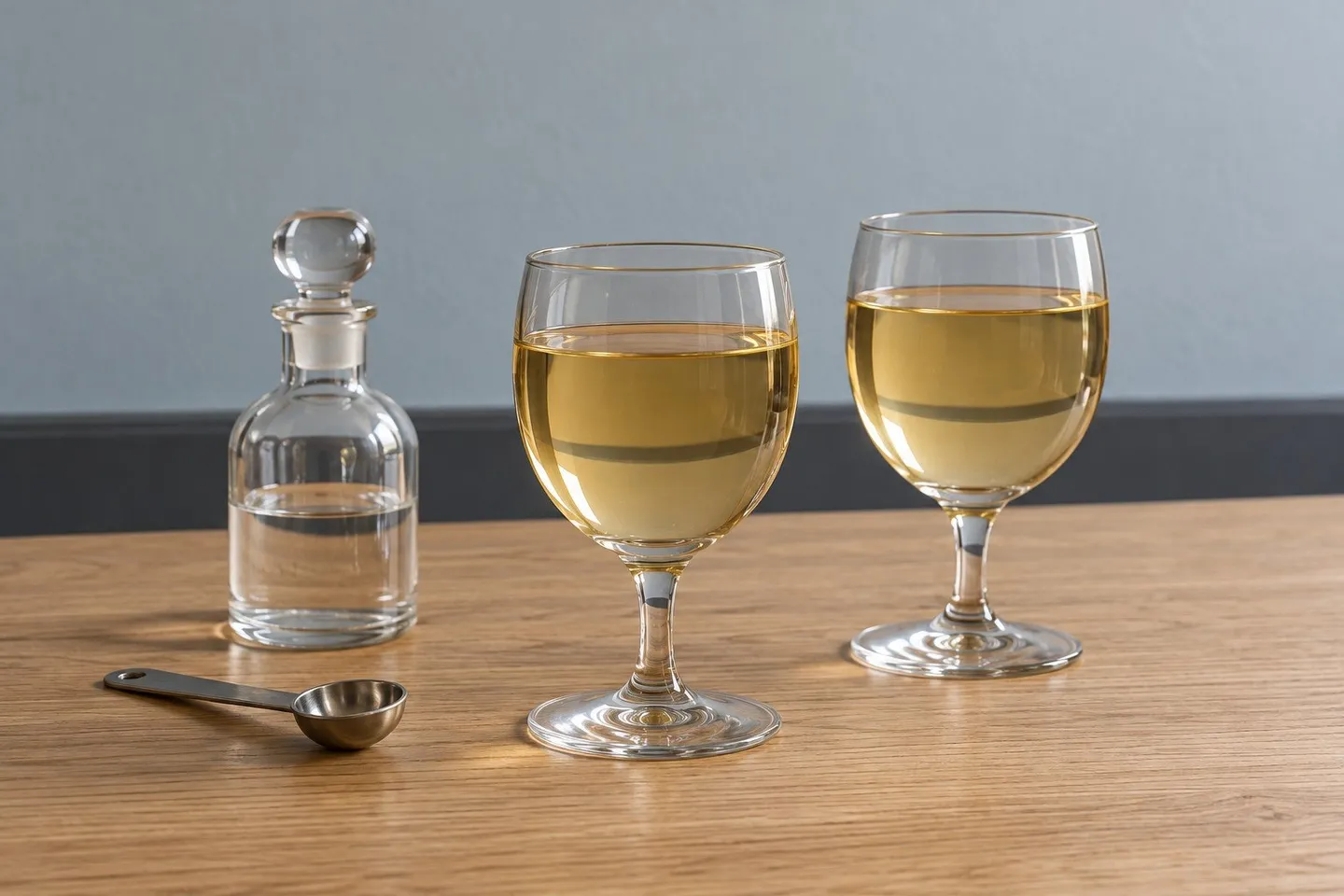
Champagne cider scented with orange-flower water in two small stemmed glasses, with the bottle of orange-flower water.
The story behind the recipe
Terrington’s “Champagne Cider” of 1869 dresses cider as champagne without the acid and bicarbonate: strong spirit for strength, syrup for sweetness, skimmed milk to make it bright, orange-flower water for a scent no apple has, and champagne bottles. On the same page of Cooling Cups and Dainty Drinks his “Sparkling Champagne Cider” gasses a barrel of cider with them instead. Terrington doesn’t say whether this one sparkled, though champagne bottles with the corks wired down suggest he expected some pressure.
Three weeks, a pint of milk
His quantities are for a cask: 18 gallons of cider, 3 pints of rectified spirit and 5 pints of syrup, left three weeks. Then come a pint of skimmed milk and a gill of orange-flower water, with “3 drops of neroli,” the oil of bitter-orange blossom, as an optional improvement. The milk is a fining. Stirred into acid cider, its protein curdles into fine curds that sink through the cask and carry the haze down with them, so the cider above can be drawn off clear. The same trick, with lemon juice doing the curdling, made the clarified milk punch of the 18th century.
Terrington gives no reason for the spirit, but its effect is on strength. Rectified spirit was distilled alcohol at close to its highest strength, and by our arithmetic, if Terrington’s was around 90 percent, his 3 pints would lift a 5.5 percent cider to about 7 percent. Not everyone counted such a drink as cider at all: William B. Alwood, writing for the US Department of Agriculture in 1903, called champagne cider “not, properly speaking, a pure cider,” though his complaint was the added sugar rather than spirit. The shape of the whole cider trade, and the bottles a government chemist tested, are in What Was Champagne Cider?
Read more about this recipe
Making it today
Ordinary 40 percent vodka stands in for the rectified spirit. Two teaspoons in 240 ml of cider add about the same share of alcohol as Terrington’s spirit, and bring the drink to about 6.5 percent. The milk fining needs a cask and time, and a fresh, filtered cider is already clear, so we leave it out. We also leave out the neroli: most of it sold today is an essential oil for perfume, not a food flavoring. A still cider is our choice, to set it apart from the sparkling recipe; use the Sparkling Champagne Cider if you want the fizz.
Champagne Cider.—Put in a cask 18 gallons of cider, 3 pints of rectified spirit, and 5 pints of syrup; in three weeks time fine with 1 pint of skimmed milk, 1 gill of orange-flower water—3 drops of neroli will improve it; bottle in Champagne bottles, and tie down with wire.

Recipe makes: 2 small glasses, about 130 ml each
Ingredients
For 2 small glasses, about 130 ml each. Quantities are shown as written.
Quantities as written here, for 2 small glasses, about 130 ml each.
- Vodka, chilled2 metric tsp (5 ml per tsp)
- Simple syrup2 metric tsp (5 ml per tsp)
- Orange-flower water1/8 metric tsp (5 ml per tsp)
- Dry still hard cider, chilled240 ml
Measurement notes
Ingredients as written here
- 2 tsp vodka, chilled
- 2 tsp simple syrup
- 1/8 tsp orange-flower water
- 240 ml dry still hard cider, chilled
Equipment
 Small jug
 Measuring jug and spoons
 Small stemmed glasses
Instructions
Measure the vodka, the simple syrup and the orange-flower water into a small jug and stir.
Pour in the dry still hard cider and stir gently.
Taste, and add a drop or two more orange-flower water only if the scent is faint.
Pour into two chilled small stemmed glasses and serve at once.
Nutrition
80calories per serving
- Recipe makes
- 2 small glasses, about 130 ml each
- Servings
- 2
Estimated per glass from USDA FoodData Central values for 80-proof vodka and granulated sugar (in the syrup), with dry hard cider estimated from its alcohol at 7 kcal per gram and a little residual sugar.
Recipe notes
When adjusting quantities
Orange-flower water varies in strength; when making more, add it a little at a time and taste.
Notes
Quantities mentioned in these notes don’t change when you adjust the batch.
Terrington’s proportions give about 8 ml of syrup and less than half a milliliter of orange-flower water for this much cider; we use a little more syrup, and an eighth of a teaspoon of orange-flower water because the strength of modern brands varies. Use culinary orange-flower water from the baking or Middle Eastern shelf, never a cosmetic floral water.
For a glass without alcohol, there is the sparkling apple juice.
Storage
Mix it just before serving. Don’t bottle and wire it at home: sweetened cider can ferment again in a sealed bottle.
Scaling changes the ingredients only; glassware, ice and timings need their own judgment. To adapt this recipe further, try the recipe tool at TuneMyRecipe (opens in a new tab), our sister site.
Sources and attribution
Modern adaptation of William Terrington, Cooling Cups and Dainty Drinks (London: Routledge, 1869), p. 111
See the original pages (scan at Internet Archive) (opens in a new tab)
Recipe details
- Drink family
- Wine, Beer & Mead
- Region
- British
- Era
- 19th century
- Source decade
- 1860s
- Difficulty
- Easy
- Occasion
- Summer party