Hannah Wolley’s White Metheglin with Rosemary and Balm, 1672
Reader ratingsSpring water with honey enough to float an egg, boiled with whole spice, rosemary and balm and fermented: the white metheglin of Hannah Wolley’s Queen-like Closet, 1672.
- Recipe makes
- About 3.4 liters, 22 small glasses
- Prep
- Cook
- Total
Brew day is about 3 hours with cooling. It ferments 4 to 6 weeks, then rests about 8 weeks in the bottle, our choice since Wolley bottles it after a few days.
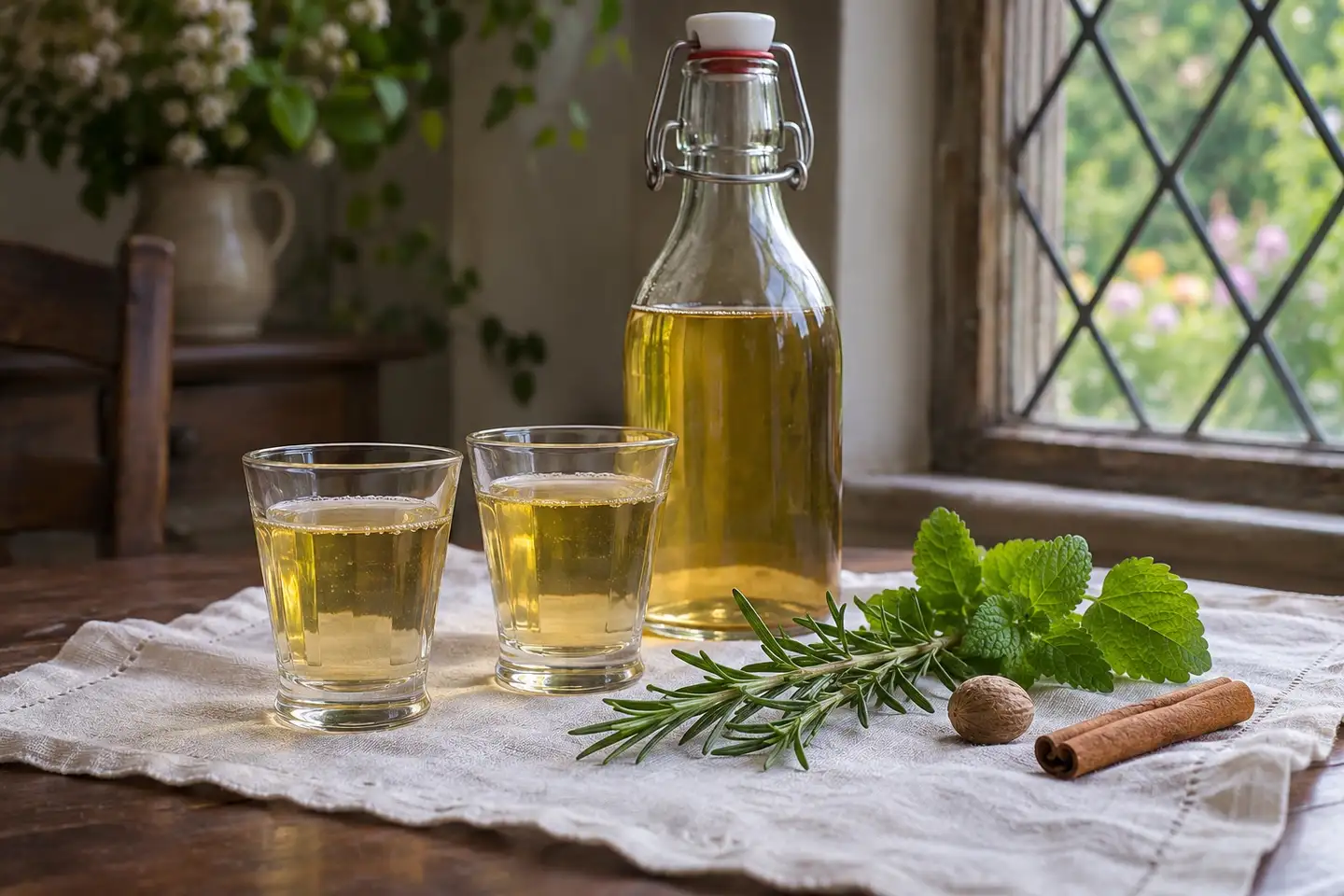
White metheglin in two small glasses, with a swing-top bottle, rosemary, lemon balm and spices.
The story behind the recipe
Hannah Wolley’s metheglin is a strong herb mead, made “so strong with Honey that it will bear an Egg”: the honey goes into spring water until a fresh egg floats in it. It is boiled down with “a good quantity of whole Spice, Rosemary, Balm, and other cordial and pleasant Herbs or Flowers,” strained, fermented with a little yeast and bottled. Her recipe is in The Queen-like Closet, or Rich Cabinet, printed in London; we follow the second edition of 1672.
White is best, red takes ale
Her heading offers a choice: “either Brown or White, but White is best.” The white is the one with water. “If you would have it red,” the last line says, “you must put the Honey to strong Ale Wort in stead of Water,” the sweet malt liquor that beer is brewed from. So her red metheglin was a honey and malt drink, not a fruit mead, and what made it red was the ale.
The spice bag goes in twice. It boils with the herbs, comes out when the liquor is strained, and goes back into the cask with the yeast once the liquor is cold. She names no amounts at all, only the egg test, a boil “till a good part be wasted,” and a few days’ standing before bottling.
Read more about this recipe
Making it today
The floating egg is a rough test for a strong must, so we weigh instead: 820 ml of honey to about 3.8 liters, which by our arithmetic ferments out at about 12% ABV, half as strong again as our 8% version of Gower’s Metheglin, a Herb Mead of 1669, printed three years earlier. Her herbs are kept and her “other” herbs and flowers are left to your taste; we read balm as lemon balm. The spice bag goes back into the demijohn for two days only, and we wait for the mead to finish instead of bottling after a few days. What the English drank before coffee and tea came is in What Did People Drink Before Coffee and Tea?. Her egg test and the other old meads are in What Was Mead? For a glass without alcohol, Sir Kenelm Digby’s honey and water of three years earlier, simmered with ginger, a clove and rosemary and chilled before any yeast goes in, is our Spiced Honey Water from Digby’s 1669 Mead.
To go with it, our sister site The Forgotten Menu has Hannah Woolley’s furmity, from the same 1672 book (opens in a new tab).
2. To make Metheglin, either Brown or White, but White is best.
Take what quantity you please of Spring-Water, and make it so strong with Honey that it will bear an Egg, then boil it very well, till a good part be wasted, and put in to it boiling a good quantity of whole Spice, Rosemary, Balm, and other cordial and pleasant Herbs or Flowers.
When it is very well boiled, set it to cool, it being strained from the Herbs, and the Bag of Spices taken out;
When it is almost cold, put in a little Yest, and beat it well, then put it into Vessels when it is quite cold, and also the Bag of Spice, and when it hath stood a few days, bottle it up; if you would have it red, you must put the Honey to strong Ale Wort in stead of Water.

Original: About 3.4 liters, 22 small glasses
Ingredients
My drinksFor About 3.4 liters, 22 small glasses. Quantities are shown as written.
Quantities as written here, for About 3.4 liters, 22 small glasses.
- Water3.5 l
- Runny honey820 ml
- Small sprig fresh rosemary1Author measures: about 1 g.
- Small handful fresh lemon balm leaves1Author measures: about 3 g.
- Small piece cinnamon stick, about 3 cm1
- Dried ginger1 g
- Clove1
- Yeast nutrient2 metric tsp (5 ml per tsp)
- Dried champagne yeast5 g
Measurement notes
Ingredients as written here
- 3.5 l water
- 820 ml runny honey
- 1 small sprig fresh rosemary (about 1 g)
- 1 small handful fresh lemon balm leaves (about 3 g)
- 1 small piece cinnamon stick, about 3 cm
- 1 g dried ginger
- 1 whole clove
- 2 tsp yeast nutrient
- 5 g dried champagne yeast
Equipment
 Large saucepan
 Wooden spoon
 Muslin
 Fine sieve
 Instant-read thermometer
 Funnel
 Glass demijohn with an airlock, 4.5 liters
 Hydrometer
 No-rinse sanitizer
 Siphon tube
 Swing-top bottles or jugs
Instructions
Clean the demijohn, airlock, funnel, siphon tube and bottles well, without soap, and sanitize them with a no-rinse brewing sanitizer, following its label.
Tie the cinnamon stick, dried ginger and whole clove in a square of muslin.
Heat four fifths of the water in the large saucepan until hot, take it off the heat and stir in the runny honey until no honey lies on the bottom.
Add the spice bag, the fresh rosemary and the fresh lemon balm leaves. Bring it to a gentle boil and simmer for 20 minutes, skimming off any foam.
Lift out the spice bag and keep it on a clean plate. Pour the liquor through the sieve into a clean bowl or pan to take out the herbs.
Cover it and stand it in a sink of cold water, changing the water as it warms, until it is at 68 °F (20 °C).
Pour it through the funnel into the demijohn and top it up with the rest of the water, boiled and cooled, to the shoulder.
Sanitize the outside of the spice bag by dipping it in the sanitizer, then drop it into the demijohn. Add a quarter of the yeast nutrient and the dried champagne yeast, fit the airlock and set the demijohn somewhere at 64 to 70 °F (18 to 21 °C).
Add another quarter of the nutrient on each of the next three days, a little at a time, as it may foam. Take out the spice bag after the second day and throw it away.
Leave it until fermentation has finished, usually 4 to 6 weeks. Check with the hydrometer: when two readings taken a week apart are the same, and at 1.000 or below, it is done. If it stops sweet, well above 1.000, leave it under the airlock somewhere warmer and don’t bottle it.
Siphon the metheglin into beer-grade swing-top bottles, made to hold pressure, leaving the yeast sediment behind, and close them. Add no sugar.
Keep the bottles somewhere cool for about 8 weeks before drinking. Serve it cool, in small glasses.
Nutrition
105calories per serving
- Servings
- 22
Estimated from the planned starting gravity (about 1.089) and a dry finish, with the standard brewers’ calorie formula, for one 150 ml glass.
Recipe notes
When adjusting quantities
Wolley measures the honey by an egg that floats, not by weight. Keep about 820 ml of honey to each 3.8 liters of must for the same strength. The yeast and nutrient are for one 4.5 liter demijohn.
Notes
Quantities mentioned in these notes don’t change when you adjust the batch.
Changes from the source: Wolley gives no amounts, so the honey, water, herbs and spices, the 20-minute boil and the two days for the spice bag are our choices. Wine yeast and nutrient replace “a little Yest,” and we bottle a finished mead, not one that has stood a few days.
Her red version uses strong ale wort in place of the water. That needs a malt recipe of its own, which she doesn’t give, so it isn’t attempted here.
Bottling before fermentation has finished is what makes bottles burst. Wait for the steady hydrometer readings. For a lighter mead of the same years, see Digby’s Weak Hydromel, a Light Mead of 1669.
Storage
Keep the bottles somewhere cool and dark and drink them within two years. Once a bottle is open, keep it in the fridge and finish it within a week.
Scaling changes the ingredients only; glassware, ice and timings need their own judgment. To adapt this recipe further, try the recipe tool at TuneMyRecipe (opens in a new tab), our sister site.
Sources and attribution
Hannah Wolley, The Queen-like Closet, or Rich Cabinet, 2nd ed. (London: printed for Richard Lowndes, 1672), part II, no. 2, “To make Metheglin, either Brown or White, but White is best,” p. 160
Recipe details
- Drink family
- Wine, Beer & Mead
- Region
- British
- Era
- 17th century
- Difficulty
- Advanced