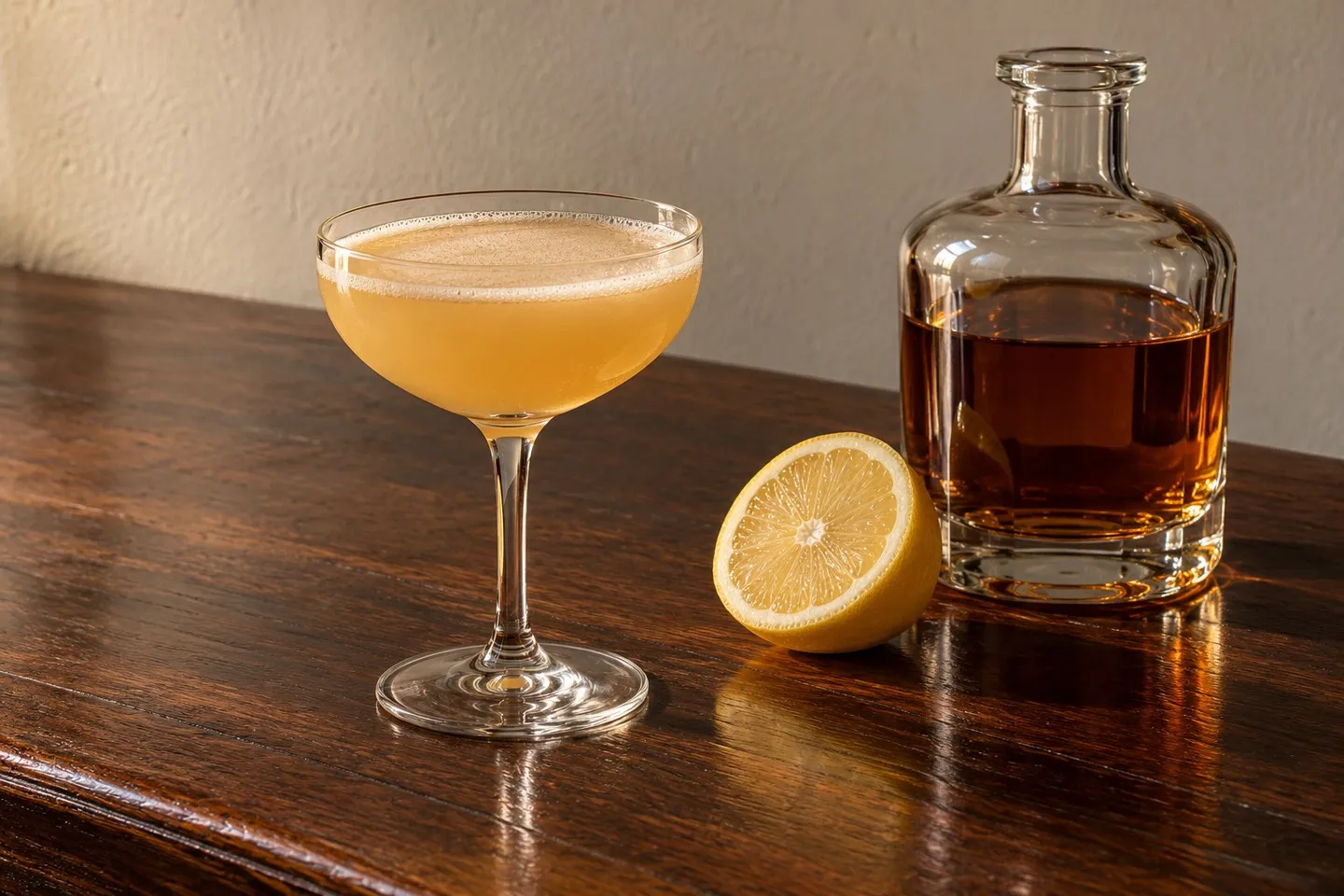
Sidecar, Brandy, Cointreau and Lemon
Reader ratingsHarry MacElhone’s Sidecar, printed in London in late 1923 or after: brandy, Cointreau and lemon in equal parts, sharper and more orange-led than the brandy-heavy version poured today.
- Recipe makes
- 1 drink
- Prep
- Total
The equal-parts Sidecar in a small cocktail glass, with lemon and brandy.
The story behind the recipe
Harry MacElhone’s Sidecar has no method and no glass, only three ingredients in equal parts: brandy, Cointreau and lemon juice. That is all his London recipe says. The drink is sharper and more orange-led than the brandy-heavy Sidecar most bars pour today, which came later.
Credited to a London club
MacElhone’s ABC of Mixing Cocktails was printed in London for the wine merchants Christopher & Co., and this printing dates from late 1923 or after: its front matter, an attack on American Prohibition, refers to President Harding as already dead, and Harding died in August 1923. MacElhone didn’t claim the Sidecar. He credited it to MacGarry, the bartender at Buck’s Club in London. Robert Vermeire’s Cocktails: How to Mix Them (1922) gives the same credit, so the earliest record points to London even though the Ritz in Paris claims the drink and its name is usually linked to the motorcycle sidecars of the war years. Neither of those last two stories has a document behind it.
By 1927 MacElhone owned Harry’s New York Bar in Paris, and his Barflies and Cocktails repeats the recipe and the MacGarry credit almost word for word. The one change is a typo: the 1923 printing misspells triple sec, and the 1927 book puts it right. Later editions of his book credited the drink to MacElhone himself.
Read more about this recipe
Equal parts against two to one
The Savoy Cocktail Book (1930) doubled the brandy, and David Embury’s The Fine Art of Mixing Drinks (1948) pushed it to eight parts brandy to two of Cointreau and one of lemon. Today’s international bartenders’ standard sits between them, at 50 ml cognac to 20 ml each of triple sec and lemon.
The arithmetic shows what changes. Equal parts put the orange liqueur level with the brandy, and the lemon level with the liqueur’s sugar, so the drink is tart and sweet in about equal measure, with brandy underneath. Shaken with ice, it comes out near 17% ABV against about 20% for the modern standard. Use Cointreau, which MacElhone names, a young cognac or other grape brandy, and lemons squeezed just before mixing. For another of MacElhone’s Cointreau drinks, see the White Lady. Among the same 1923 book’s gin drinks are the Monkey Gland, which MacElhone claimed as his own, and the long, minty South Side. For anyone at the party not drinking, a London book of the same years has Fresh Orangeade. Cocktails in 1920s London and Paris follows the Sidecar from MacElhone’s London book to the Savoy’s.
Recipe makes: 1 drink
Ingredients
For 1 drink. Quantities are shown as written.
Quantities as written here, for 1 drink.
- Brandy1 fl oz
- Cointreau1 fl oz
- Fresh lemon juice1 fl oz
- Ice cubes
Measurement notes
Ingredients as written here
- 1 fl oz brandy
- 1 fl oz Cointreau
- 1 fl oz fresh lemon juice
- ice cubes
Equipment
 Cocktail shaker
 Strainer
 Small cocktail glass
Instructions
Chill a small cocktail glass in the freezer or with ice water.
Pour the brandy, Cointreau and fresh lemon juice into a shaker and fill it two-thirds with ice cubes.
Shake hard for about 12 seconds, until the outside of the shaker is very cold.
Strain into the chilled glass and serve at once, without garnish.
Nutrition
165calories per serving
- Recipe makes
- 1 drink
Estimated from published values for 80-proof brandy, Cointreau and lemon juice, counting alcohol at 7 calories per gram plus the sugars.
Recipe notes
When adjusting quantities
Keep the three liquids in equal parts when you scale; shake no more than two drinks at a time.
Notes
Quantities mentioned in these notes don’t change when you adjust the batch.
MacElhone gives one-third each of Cointreau, brandy and lemon juice, with no method. Shaking with ice and straining into a cocktail glass is our choice, following how the same book makes its other short sours. The 1 fl oz (about 30 ml) measures make a 3 fl oz drink before ice, a size that fits a small period cocktail glass.
For the Savoy’s 1930 version, use 1 1/2 fl oz brandy with 3/4 fl oz each of Cointreau and lemon: half brandy, a quarter each of the others. A modern version, also heavier on the brandy than MacElhone’s, is on TuneMyRecipe (opens in a new tab).
London bartenders already had an answer for the teetotal customer: the Florida Cocktail of 1922 shakes lemon and orange juice with bitters.
Scaling changes the ingredients only; glassware, ice and timings need their own judgment.
Sources and attribution
Harry MacElhone, Harry of Ciro’s ABC of Mixing Cocktails (London: Dean & Son for Christopher & Co., 1923), p. 65; also Barflies and Cocktails (Paris: Lecram Press, 1927), p. 64
Recipe details
- Drink family
- Cocktails & Mixed Drinks
- Region
- British
- Era
- Jazz Age
- Source decade
- 1920s
- Difficulty
- Easy
- Occasion
- 1920s party