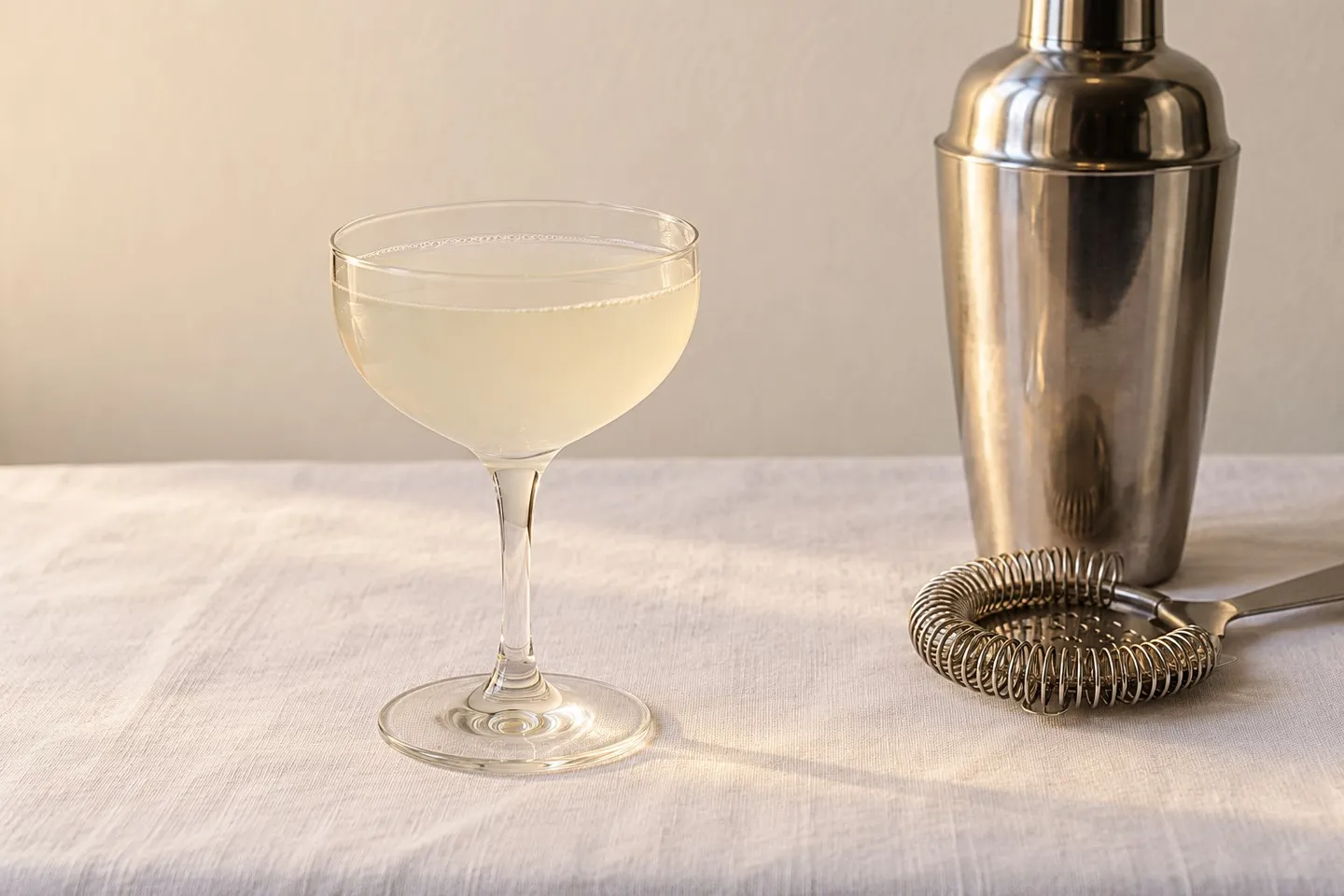
White Lady, Brandy and Mint Cocktail
Reader ratingsHarry MacElhone’s earliest printed White Lady had no gin: two-thirds Cointreau with a little brandy and crème de menthe, and no citrus at all.
- Recipe makes
- 1 drink
- Prep
- Total
MacElhone’s early White Lady, Cointreau with brandy and white crème de menthe.
The story behind the recipe
Harry MacElhone’s earliest printed White Lady had no gin and no lemon. It is two-thirds Cointreau, with a sixth each of brandy and crème de menthe: a sweet, strong drink of orange and peppermint. Our copy of his ABC of Mixing Cocktails carries no date, but a reference inside places it in late 1923 or after, and he printed the drink again, unchanged, in Barflies and Cocktails in 1927. The gin, lemon and Cointreau White Lady that bars serve today came later, and who made it first is still argued over.
Two ladies, several claimants
MacElhone’s book carries the name of Ciro’s, the London club where he worked. Difford’s Guide dates his first White Lady to his time there in 1919 and finds the same recipe in a 1922 edition of the book; we have not seen either.
The gin version appears in The Savoy Cocktail Book in 1930, which gives gin, Cointreau and lemon juice. Its compiler, Harry Craddock, didn’t claim to have invented it, though the Savoy later credited him. A story that MacElhone himself switched to gin at his Paris bar in 1929 is repeated by his family, but Difford’s finds no evidence for it. The best-supported claim, by the same account, belongs to Victor Cabrin of the Grosvenor House Hotel in London, who was pictured making one in a 1934 gin advertisement and was said in a 1946 newspaper to have invented it in 1929. A tale that Craddock sealed a shaker of White Ladies into the Savoy bar’s walls has never been confirmed: no shaker has been found.
Read more about this recipe
Making the first one
This version is mostly Cointreau, so the orange liqueur leads, with peppermint from the crème de menthe and a little brandy underneath. There is nothing sour in it. Shaken with ice it is still strong, roughly 24 to 28% ABV by our estimate, so pour it small, and keep something softer on the tray for anyone not drinking: the Grape Juice Highball, an alcohol-free highball from a 1920 American hostess’s book. Cocktails in 1920s London and Paris sets the White Lady among the other drinks of MacElhone’s London and Paris books. MacElhone doesn’t say which crème de menthe; white, which is clear, suits the name and keeps the drink pale, where green would tint it. White crème de menthe is usually around 24% ABV; Giffard’s Menthe-Pastille is one example.
The later gin White Lady sits close to the Sidecar: Cointreau and lemon, with gin where the Sidecar has brandy. Gin and lemon were already together in MacElhone’s 1923 book, in the South Side, a gin sour with fresh mint made long with soda.
Recipe makes: 1 drink
Ingredients
For 1 drink. Quantities are shown as written.
Quantities as written here, for 1 drink.
- Cointreau2 fl oz
- Brandy1 tbsp
- White crème de menthe1 tbsp
- Ice cubes
Measurement notes
Ingredients as written here
- 2 fl oz Cointreau
- 1 tbsp brandy
- 1 tbsp white crème de menthe
- ice cubes
Equipment
 Cocktail shaker
 Strainer
 Small cocktail glass
Instructions
Chill a small cocktail glass in the freezer or with ice water.
Pour the Cointreau, brandy and white crème de menthe into a shaker and fill it two-thirds with ice cubes.
Shake for about 12 seconds, until the shaker is frosted.
Strain into the chilled glass and serve.
Nutrition
280calories per serving
- Recipe makes
- 1 drink
Estimated from published values for Cointreau, 80-proof brandy and white creme de menthe, counting alcohol at 7 calories per gram plus the sugars.
Recipe notes
When adjusting quantities
Keep four parts Cointreau to one each of brandy and crème de menthe when you scale.
Notes
Quantities mentioned in these notes don’t change when you adjust the batch.
MacElhone gives one-sixth brandy, one-sixth crème de menthe and two-thirds Cointreau, shaken and strained. On a 3 fl oz drink (about 90 ml) that is 1/2 fl oz each of brandy and crème de menthe, which is 1 tbsp, and 2 fl oz of Cointreau. Choosing white crème de menthe and a cocktail glass is ours.
The strength is arithmetic, not a measurement. It assumes Cointreau and brandy at 40% and crème de menthe at 24%, which makes about 37% before shaking; meltwater from the ice adds roughly a third to a half again, depending on the ice and the shake.
The gin White Lady in the Savoy book is one-quarter lemon juice, one-quarter Cointreau and one-half dry gin: try 1 1/2 fl oz gin with 3/4 fl oz each of Cointreau and fresh lemon juice, shaken and strained. A modern version of the Savoy’s gin White Lady is on TuneMyRecipe (opens in a new tab).
Scaling changes the ingredients only; glassware, ice and timings need their own judgment.
Sources and attribution
Harry MacElhone, Harry of Ciro’s ABC of Mixing Cocktails (London: Dean & Son for Christopher & Co., undated, late 1923 or after), p. 77; also Barflies and Cocktails (Paris: Lecram Press, 1927), p. 77
Recipe details
- Drink family
- Cocktails & Mixed Drinks
- Region
- British
- Era
- Jazz Age
- Source decade
- 1920s
- Difficulty
- Easy
- Occasion
- 1920s party