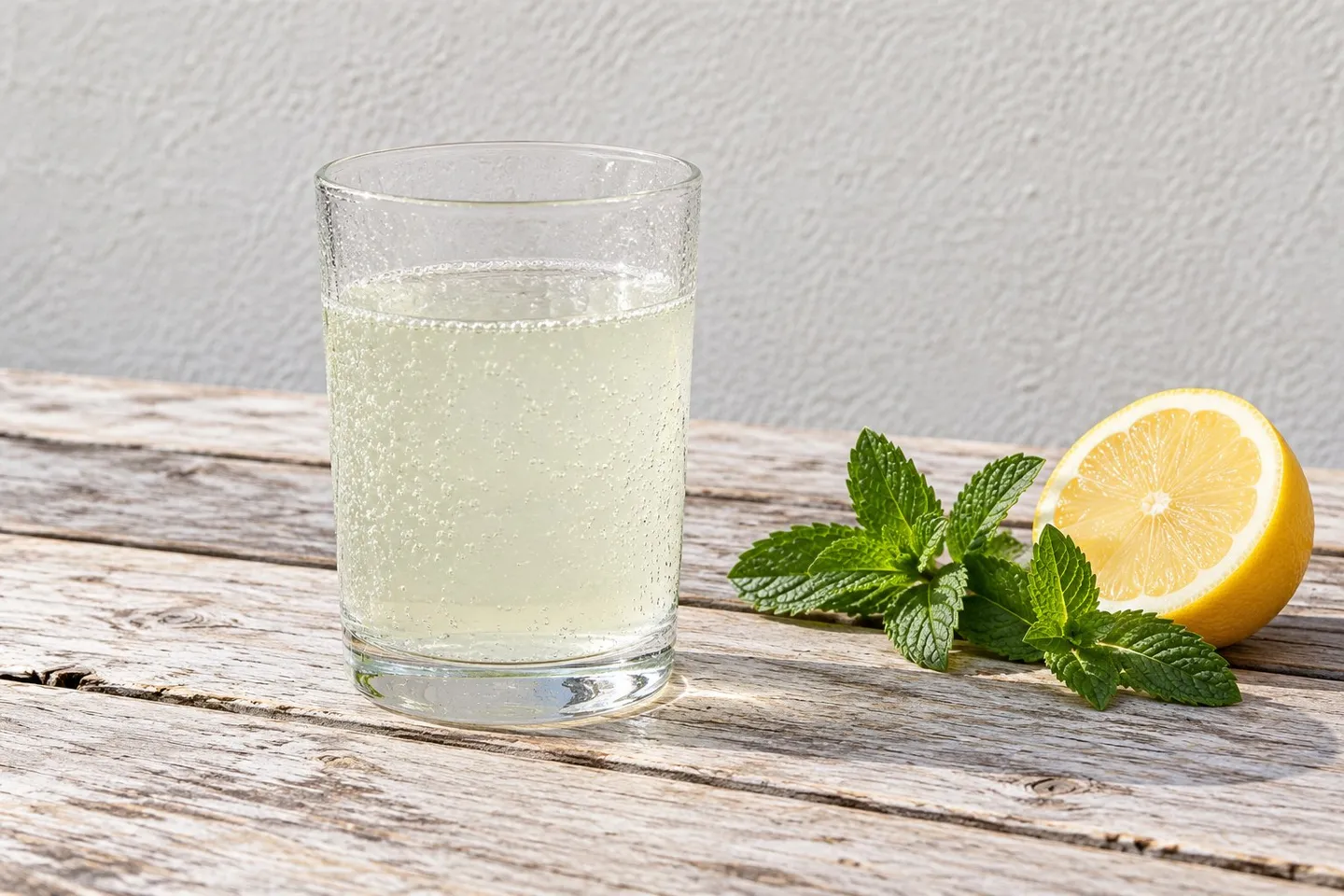
South Side, Gin, Lemon and Mint
Reader ratingsGin, lemon, sugar and fresh mint, shaken and topped with soda in a tumbler: the South Side as Harry MacElhone printed it in 1923, before the gangster stories.
- Recipe makes
- 1 drink
- Prep
- Total
The South Side topped with soda in a tumbler, with fresh mint and lemon.
The story behind the recipe
Harry MacElhone’s London book of 1923 gives the South Side plainly, as a gin sour with fresh mint, made long with soda water in a tumbler, and says nothing about where it came from. That puts it a long way from the Chicago gangster stories now told about it.
What the books say, and what the stories say
The record first. MacElhone’s ABC of Mixing Cocktails gives the South Side on page 68 and names Gordon gin. His Barflies and Cocktails (Paris, 1927) repeats it word for word. The Savoy Cocktail Book (1930) has much the same drink. Drinks historians have found it in American print earlier still, including Hugo Ensslin’s Recipes for Mixed Drinks of 1917, so it was being made before Prohibition began.
Then the legends, and they are only that. The favorite says the drink is named for Chicago’s South Side, where Al Capone’s gang sold a gin so rough it needed sugar and mint to go down. Another credits the Southside Sportsmen’s Club on Long Island. New York’s 21 Club has claimed it too, although it opened after the drink was already in print. None of these stories appears in MacElhone’s books or the Savoy, and none comes with a document.
Read more about this recipe
Long, sharp and minty
Expect a sharp, fresh lemon sour with mint on the nose, lightened by the soda. The teaspoon of sugar is modest, so it stays tart. It comes to about 13% ABV, gentler than the short cocktails of the same books: MacElhone’s Cointreau-heavy White Lady is still roughly 24 to 28% after shaking, by our estimate.
The drink’s shape shifted early. MacElhone’s is a long drink: a whole lemon, a tumbler and a top-up from the siphon. Seven years later the Savoy version uses half the lemon, half a tablespoon of sugar and only a dash of soda, so it comes out shorter and sweeter. This recipe keeps MacElhone’s sharper, longer version; a modern take on the Savoy’s is on TuneMyRecipe (opens in a new tab). The bar side of the same decade, from MacElhone’s London book to the Savoy, is in Cocktails in 1920s London and Paris.
Use ordinary garden mint (spearmint), and superfine sugar, which dissolves in the shaker.
Recipe makes: 1 drink
Ingredients
For 1 drink. Quantities are shown as written.
Quantities as written here, for 1 drink.
- London dry gin2 fl oz
- Fresh lemon juice1 fl oz
- Superfine sugar1 tsp
- Fresh mint3 sprigs
- Chilled soda water1 1/2 fl oz
- Ice cubes
Measurement notes
Ingredients as written here
- 2 fl oz London dry gin
- 1 fl oz fresh lemon juice
- 1 tsp superfine sugar
- 3 sprigs fresh mint
- 1 1/2 fl oz chilled soda water
- ice cubes
Equipment
 Cocktail shaker
 Strainer
- Fine strainer
 Medium tumbler
Instructions
Squeeze the fresh lemon juice into a shaker and add the superfine sugar. Stir until the sugar has mostly dissolved.
Add the fresh mint sprigs and the London dry gin, then fill the shaker two-thirds with ice cubes.
Shake hard for about 12 seconds.
Strain through a fine strainer into a medium tumbler, without ice.
Top with the chilled soda water and serve at once.
Nutrition
150calories per serving
- Recipe makes
- 1 drink
Estimated from published values for 80-proof gin, lemon juice and sugar, counting alcohol at 7 calories per gram; a stronger gin adds a little.
Recipe notes
When adjusting quantities
Scale by whole drinks; shake no more than two at a time and top each glass with soda separately.
Notes
Quantities mentioned in these notes don’t change when you adjust the batch.
MacElhone gives the juice of one lemon, a teaspoonful of sugar, two or three sprigs of fresh mint and one glass of gin, shaken, strained into a medium tumbler and topped with soda from the siphon. A lemon gives roughly 1 fl oz of juice, though lemons vary; taste and add a little more if your lemon is small. We read his glass of gin as 2 fl oz (about 60 ml). He gives no amount of soda, so the one here is ours. He topped the drink from a soda siphon, and a freshly opened, well-chilled bottle of soda water stands in for it. Shaking the mint with the ice bruises the leaves; the fine strainer, our addition, keeps the torn bits out of the glass.
For an alcohol-free mint drink of the same years, Bertha Stockbridge’s What to Drink (1920) crushes mint into a tall pitcher with lemon juice and sliced lemon, then fills it with ginger ale. Her book is the main source for Five Alcohol-Free Drinks for a 1920s Party, the alcohol-free side of the same party.
Scaling changes the ingredients only; glassware, ice and timings need their own judgment.
Sources and attribution
Harry MacElhone, Harry of Ciro’s ABC of Mixing Cocktails (London: Dean & Son for Christopher & Co., 1923), p. 68; also Barflies and Cocktails (Paris: Lecram Press, 1927), p. 68
Recipe details
- Drink family
- Cocktails & Mixed Drinks
- Era
- Jazz Age
- Source decade
- 1920s
- Difficulty
- Easy
- Occasion
- 1920s partySummer party
- Season
- Summer