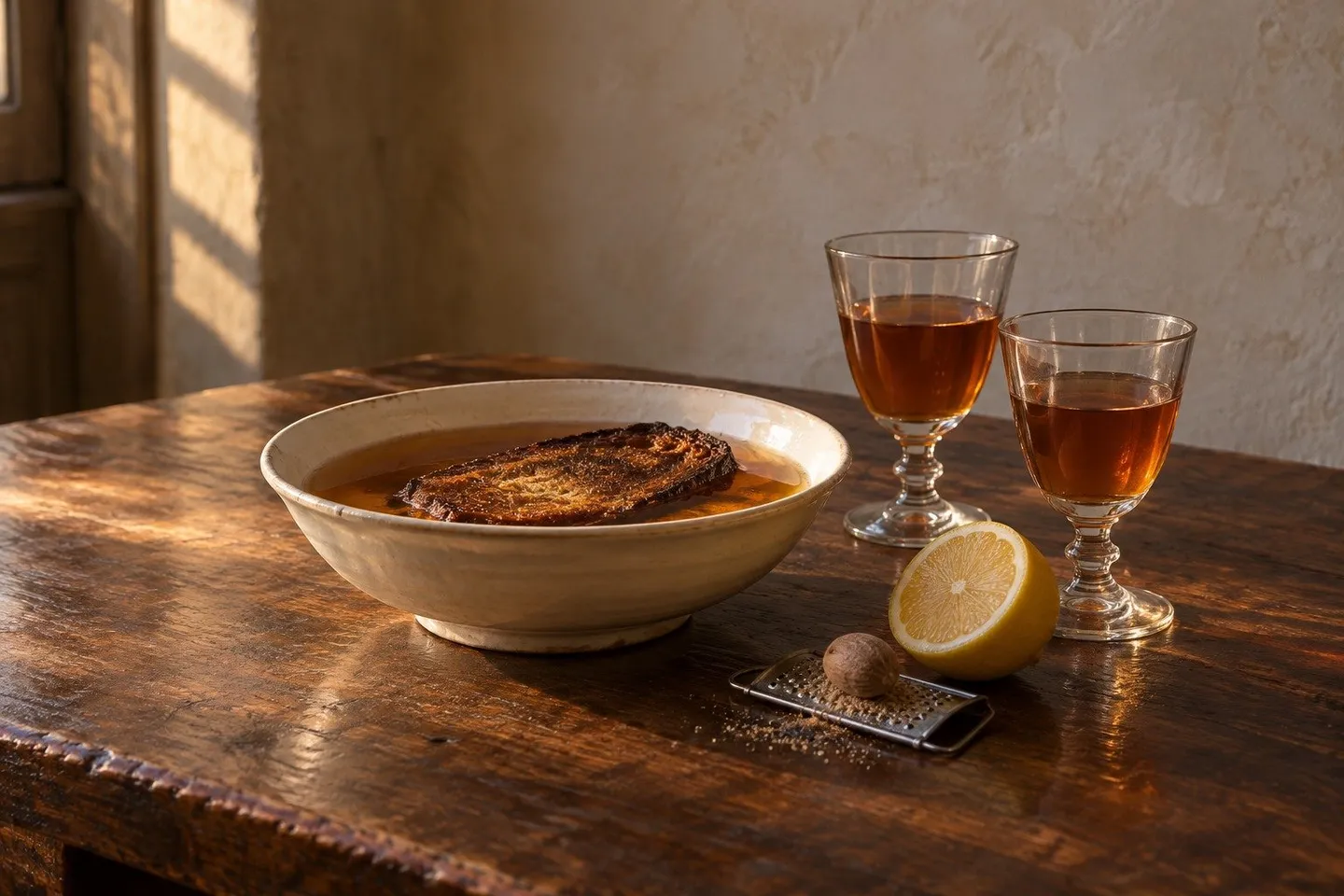
Sang-Gris, Labat’s Madeira Sangaree from the French Islands
Reader ratingsMadeira steeped with sugar, lemon juice, cinnamon, clove, plenty of nutmeg and a crust of dark toast, then strained: the English drink the French islands copied, from Labat’s 1722 account.
- Recipe makes
- About 400 ml, 3 small glasses
- Prep
- Total
About 5 minutes to make and 30 minutes to steep.
Sang-gris steeping in a faience bowl with a crust of dark toast, beside two strained glasses, a lemon and nutmeg.
The story behind the recipe
Sang-gris is Madeira steeped in a bowl with sugar, lemon juice, a little cinnamon and clove, plenty of nutmeg and a crust of toast “even a little burnt,” then strained through a fine cloth. Jean-Baptiste Labat, a French priest who arrived on Martinique in 1694, described it in his Nouveau voyage aux isles de l’Amérique of 1722, with a note in the margin: “Sang-gris, drink come from the English.” It is the drink the English called sangaree.
Very hot, and easily to the head
Labat did not approve, but he did admire it. “Nothing is more agreeable; the taste of lemon makes it seem refreshing, and those who invented it claim so too; but it is easy to see from what goes into it that it is very hot, and that it easily goes to the head.” The English, he wrote, had “invented two or three kinds of liquors, whose use and abuse have passed to our French, always very ardent imitators of what they see that is bad in our neighbors.” That the English invented it is Labat’s word, not a proven origin. How the French islands drank day to day, from cassava beer to cane spirit, is in What Did People Drink in New France?
Read more about this recipe
Our version
Labat gives no amounts, so all of ours are our choice: a half bottle of Madeira, enough sugar and lemon to balance it, a pinch each of cinnamon and clove, and half a teaspoon of nutmeg, since he asks for “much.” His citron could mean a lemon or a lime in the islands; we use lemon, and lime works too. The “crust of toasted bread” is a slice of white bread toasted dark. Labat strains it “when one judges the liquor has taken the taste of the things put in it”; half an hour is ours. He doesn’t say whether it was served cool or warm, and the sources say nothing more about how it tasted. It comes out at about 17% ABV, as strong as the Madeira. Its English cousin, wine with sugar, lemon and nutmeg drunk hot, is Port Wine Negus.
La premiere s’appelle Sang-gris; elle est composée de vin de Madere que l’on met dans une jatte de cristal ou de fayance avec du sucre, du jus de citron, un peu de canelle & de gérofle en poudre, beaucoup de muscade & une croûte de pain rotie, & même un peu brûlée. Lorsqu’on juge que la liqueur a pris le goût des choses qu’on y a mises, on la passe par un linge fin.
Our translation: The first is called sang-gris; it is made of Madeira wine put in a bowl of crystal or faience with sugar, lemon juice, a little cinnamon and clove in powder, much nutmeg and a crust of toasted bread, even a little burnt. When one judges that the liquor has taken the taste of the things put in it, it is passed through a fine cloth.

Recipe makes: About 400 ml, 3 small glasses
Ingredients
For About 400 ml, 3 small glasses. Quantities are shown as written.
Quantities as written here, for About 400 ml, 3 small glasses.
- Madeira375 ml
- Sugar20 g
- Lemon juice20 ml
- Ground cinnamon1 pinch
- Ground cloves1 pinch
- Freshly grated nutmeg1/2 metric tsp (5 ml per tsp)
- White bread1 slice
Measurement notes
Ingredients as written here
- 375 ml Madeira
- 20 g sugar
- 20 ml lemon juice
- 1 pinch ground cinnamon
- 1 pinch ground cloves
- 1/2 tsp freshly grated nutmeg
- 1 slice white bread
Equipment
 Bowl, glass or china
 Grater
 Fine sieve lined with a clean cloth or muslin
Instructions
Toast the white bread until it is deep brown and just catching at the edges.
Pour the Madeira into the bowl and stir in the sugar until it dissolves.
Stir in the lemon juice, ground cinnamon, ground cloves and freshly grated nutmeg, then lay the toast in the wine.
Leave it to steep for about 30 minutes, stirring once or twice. Taste it, and give it longer if you want more spice.
Pour it through the sieve lined with the cloth into a jug, pressing lightly on the toast.
Serve in small glasses, cool or at room temperature.
Nutrition
230calories per serving
- Recipe makes
- About 400 ml, 3 small glasses
- Servings
- 3
Estimated for one glass from USDA FoodData Central values for dessert wine, granulated sugar and lemon juice; the toast is strained out and the spices add almost nothing.
Recipe notes
Notes
Quantities mentioned in these notes don’t change when you adjust the batch.
Use a medium-sweet Madeira such as a Bual or a “rainwater” style; a very sweet Malmsey needs less sugar.
It keeps for a day in a closed bottle in the fridge.
There is no alcohol-free version in Labat; for the alcohol-free drink of this story, make Island Chocolate Frothed with a Fresh Egg.
Scaling changes the ingredients only; glassware, ice and timings need their own judgment. To adapt this recipe further, try the recipe tool at TuneMyRecipe (opens in a new tab), our sister site.
Sources and attribution
Jean-Baptiste Labat, Nouveau voyage aux isles de l’Amérique, vol. 1 (Paris, 1722), pp. 405–406; translation ours
See the original pages (scan at Internet Archive) (opens in a new tab)
Recipe details
- Drink family
- Cocktails & Mixed Drinks
- Era
- 17th century
- Difficulty
- Easy