Island Chocolate Frothed with a Fresh Egg, Martinique 1722
Reader ratingsGrated cacao, sugar, cinnamon and a whole fresh egg, worked into boiling water and milled to a thick froth: chocolate as the French islands made it, from Labat’s 1722 account.
- Recipe makes
- About 500 ml, 4 small cups
- Prep
- Cook
- Total
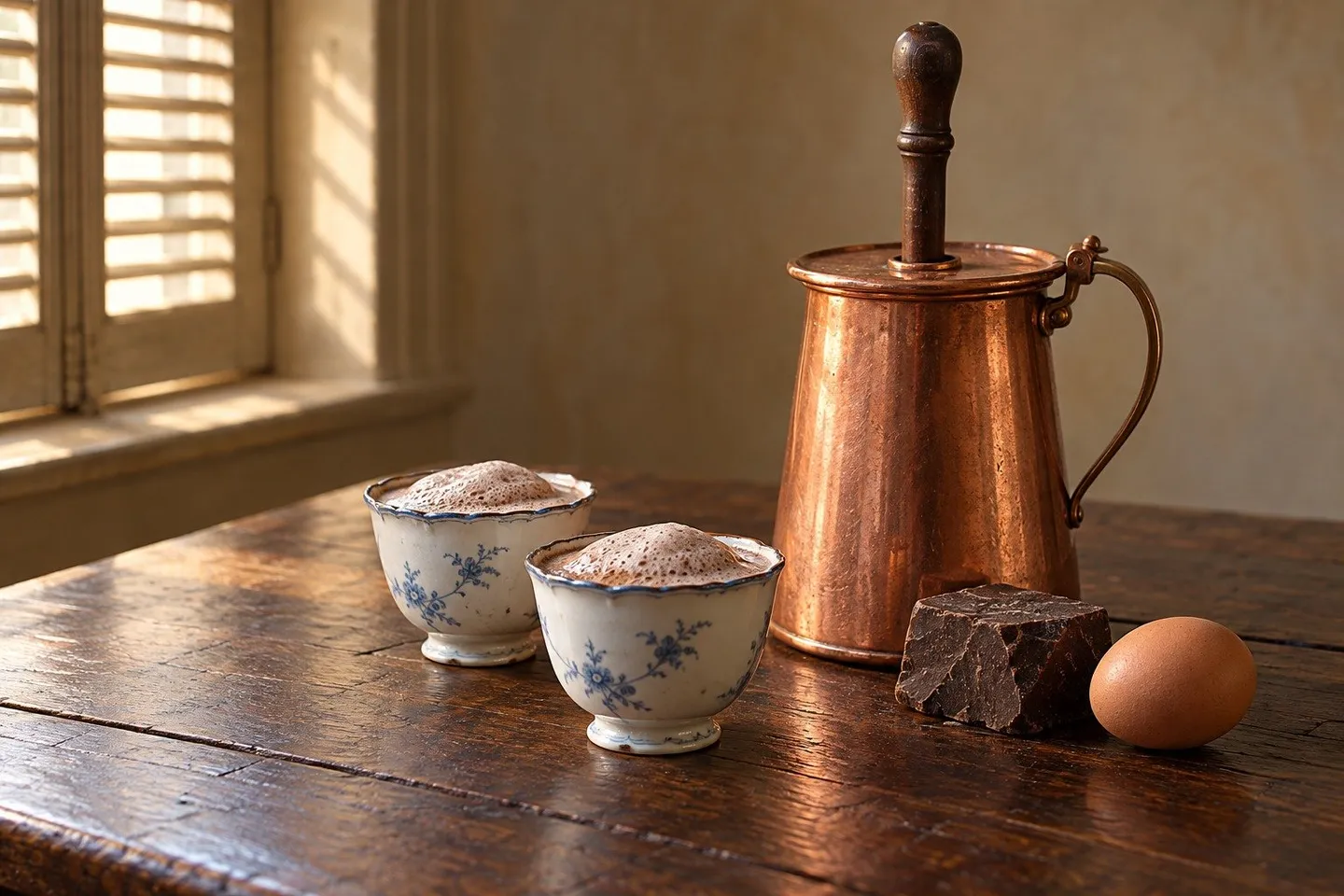
Island chocolate frothed into small faience cups, with the pot and mill, a piece of cacao paste and an egg.
The story behind the recipe
Chocolate in the French islands of the Caribbean was plain cacao, sugar and a little cinnamon, bound with a whole fresh egg and frothed into boiling water. The Dominican priest Jean-Baptiste Labat, who arrived on Martinique in 1694, wrote the method down for eight cups in his Nouveau voyage aux isles de l’Amérique of 1722. This is his recipe, at his own size.
Grey, thick and with small eyes
Labat measured everything: a chopine of water, two ounces of grated cacao paste, three ounces of sugar, “and up to four ounces when the paste is fresh, and so more oily and more bitter,” then “a fresh egg, white and yolk,” and as much cinnamon “as will sit on a liard,” a small copper coin. The boiling water goes in a little at a time, worked with the mill, and the pot goes back to the fire until the froth nearly rises over. The froth was the test. It “must be grey, thick and with small eyes,” he wrote, so light that a cup holding more than a demi-septier, about a quarter liter, “should not weigh three ounces.” What else the French colonies drank, from Quebec’s watered claret to the islands’ cassava beer, is in What Did People Drink in New France?
Read more about this recipe
Our version
A Paris chopine was close to half a liter, so we use 470 ml of water. Two old French ounces were about 61 grams, and we use 60 grams of unsweetened chocolate for Labat’s cacao paste, with 90 grams of sugar, his lower amount. Labat lets the pot “take a few boils” with the egg in; we bring it just short of the boil, well past the 71°C at which an egg is safe, so that it froths without curdling. The book says nothing about taste beyond the froth. Labat also allowed “a third or a quarter of milk” with the water, and then “it is not necessary to put in an egg”; that version is in the notes. For the older Spanish way, heavily spiced and made with water, try Colmenero’s Spiced Chocolate.
Supposé donc qu’on veüille faire huit tasses de chocolat d’une grandeur raisonnable, on met une chopine d’eau sur le feu dans un vaisseau tel qu’il puisse être, afin de la faire boüillir, & on met dans la chocolatiere deux onces de pâte de Cacao rappé en poudre, avec trois onces de sucre, & jusqu’à quatre onces lorsque la pâte est récente & par consequent plus huileuse & plus amére; on y joint un œuf frais blanc & jaune, & tant soit peu d’eau froide ou chaude, cela est indifférent; on y met de la canelle en poudre passée au tamis de soie autant qu’il en peut tenir sur un liard, & si l’on veut que la canelle ait un goût plus piquant & plus rélevé, on pile douze clouds de gerofle dans deux onces de canelle, pour composer la poudre dont je viens de parler. On délaïe autant qu’il est possible la pâte, le sucre & la canelle avec l’œuf & le peu d’eau qu’on y a joint; & lorsque l’eau est boüillante on la verse peu à peu dans la chocolatiere, & on agite fortement la matiere avec le moulinet, non seulement pour bien séparer & dissoudre les parties du Cacao & du sucre; mais principalement pour la faire bien mousser; lorsque toute l’eau est dans la chocolatiere, & qu’on a bien fait agir le moulinet, on la met au feu, où on la laisse jusqu’à ce que l’écume ou la mousse soit prête à passer par dessus. On la retire pour lors, & on fait marcher fortement le moulinet ... On remet la chocolatiere au feu, & on a soin de faire agir le moulinet quand la matiere venant à boüillir, veut s’élever par dessus la chocolatiere; on la laisse prendre quelques boüillons, afin de lui donner une cuisson raisonnable, & on la retire du feu; pour lors on fait agir le moulinet; & à mesure que l’écume s’amasse en haut, on la fait tomber doucement dans les tasses ...
Our translation, in short: For eight cups of a reasonable size, set a chopine of water on the fire to boil. In the chocolate pot put two ounces of cacao paste grated to powder, with three ounces of sugar, up to four when the paste is fresh and so more oily and bitter; add a fresh egg, white and yolk, and a very little water, cold or hot; add sifted cinnamon, as much as sits on a liard (for a sharper taste, pound twelve cloves into two ounces of cinnamon to make that powder). Work the paste, sugar and cinnamon with the egg and water as smooth as you can. When the water boils, pour it in little by little, working hard with the mill, to dissolve the cacao and sugar and above all to make it froth. Put it on the fire until the froth is about to rise over, take it off and mill hard; put it back, mill as it rises, let it take a few boils, take it off, mill again, and let the froth fall gently into the cups.

Recipe makes: About 500 ml, 4 small cups
Ingredients
For About 500 ml, 4 small cups. Quantities are shown as written.
Quantities as written here, for About 500 ml, 4 small cups.
- Water470 ml
- Unsweetened chocolate (100% cacao)60 g
- Sugar90 g
- Large egg1
- Ground cinnamon1 pinch
Measurement notes
Ingredients as written here
- 470 ml water
- 60 g unsweetened chocolate (100% cacao)
- 90 g sugar
- 1 large egg
- 1 pinch ground cinnamon
Equipment
 Saucepan or kettle
- Tall saucepan or chocolate pot
 Fine grater
 Wooden chocolate mill (molinillo) or a whisk
 Instant-read thermometer
Instructions
Bring the water to a boil in a saucepan or kettle.
Grate the unsweetened chocolate finely into the tall saucepan or chocolate pot. Add the sugar, the egg and the ground cinnamon, with a spoonful of water, and work them together with the mill or whisk into a smooth paste.
Pour in the boiling water a little at a time, milling or whisking hard all the while, until it is all in and the chocolate is dissolved and frothy.
Set the pot over medium heat and keep milling until the froth starts to climb the pot and the chocolate reaches about 85°C on the thermometer, just short of boiling. Take it off the heat at once.
Mill hard again for a minute to raise a thick froth, then spoon the froth into small warmed cups and share the rest of the chocolate among them. Serve at once.
Nutrition
190calories per serving
- Recipe makes
- About 500 ml, 4 small cups
- Servings
- 4
Estimated from USDA FoodData Central values for unsweetened chocolate, granulated sugar and whole raw egg, for one cup.
Recipe notes
Notes
Quantities mentioned in these notes don’t change when you adjust the batch.
Labat’s milk version: use about two-thirds water and one-third milk, heated until very hot but not boiled, and leave out the egg. Make it the same way.
For his sharper spice, pound a few cloves into the cinnamon before you measure the pinch.
Use the freshest eggs you can, or a pasteurized egg for anyone very young, old or pregnant.
Labat used up to four ounces of sugar, about 120 grams, when the cacao paste was fresh and more bitter; use that much if you like it sweeter.
Scaling changes the ingredients only; glassware, ice and timings need their own judgment. To adapt this recipe further, try the recipe tool at TuneMyRecipe (opens in a new tab), our sister site.
Sources and attribution
Jean-Baptiste Labat, Nouveau voyage aux isles de l’Amérique, vol. 6 (Paris, 1722), pp. 75–77; translation ours
See the original pages (scan at Internet Archive) (opens in a new tab)
Recipe details
- Drink
- Alcohol-free
- Drink family
- Hot Drinks
- Era
- 18th century
- Difficulty
- Intermediate