Why Victorians Put Chicory in Their Coffee
Roasted chicory root made weak coffee look dark and strong. How London analysts caught it, how Parliament let it be sold, and why some cooks wanted it anyway.
Chicory was in the coffee because it was cheap and it looked like coffee. The root of the wild chicory plant, sliced, dried and roasted, grinds to a dark brown powder, and in hot water it gives a deep color and a bitter taste. Mixed into ground coffee, it made a thin brew look strong. William Terrington put it plainly in 1869: chicory “gives a dark appearance to the liquid, and a bitter flavour, making the coffee appear stronger than it really is.”
In Victorian Britain that made it a favorite trick of the grocery trade. From 1853 it was legal to sell the two together, as long as the packet said so. Yet some people liked the taste, among them a famous London chef and much of France, and chicory stayed in the pot long after the fraud was policed.
Thirty-one coffees out of thirty-four
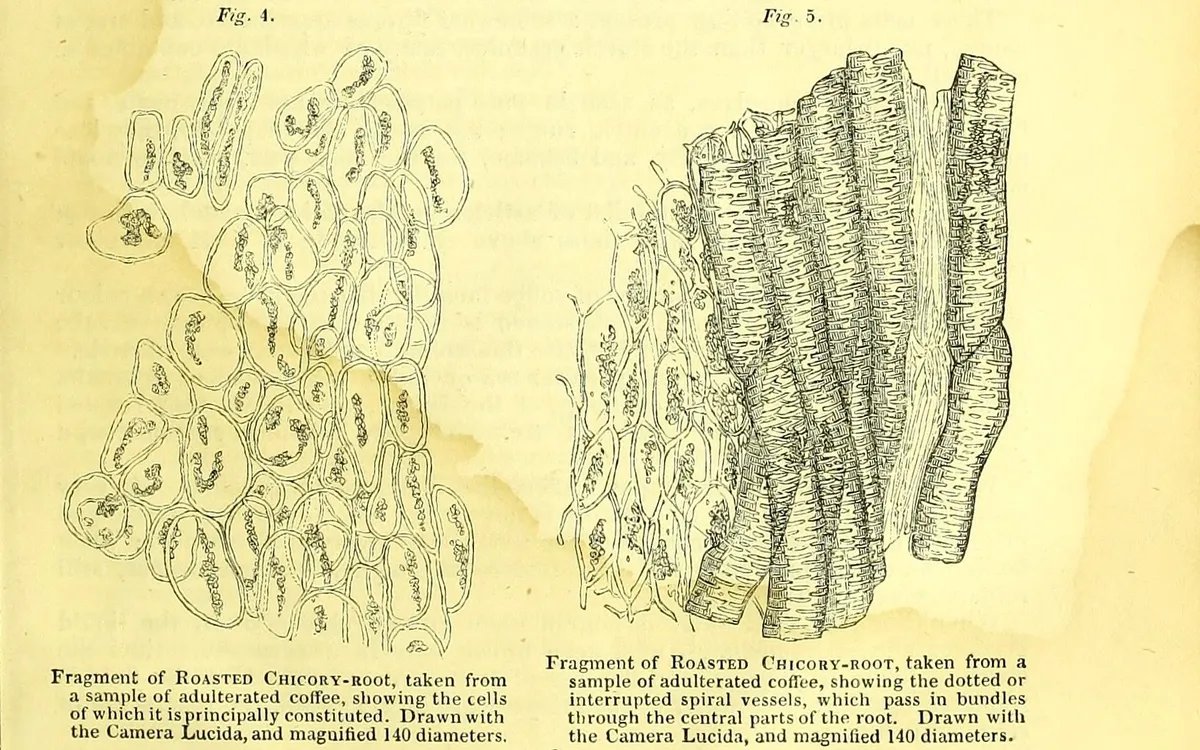
The evidence came from a microscope. Around 1850 and 1851 Arthur Hill Hassall, working for the medical weekly The Lancet, bought coffee all over London and examined each sample under the lens. Roasted coffee and roasted chicory look alike to the eye, but not at a magnification of 140: chicory root is soft rounded cells and long dotted vessels, the drawings that head this page. When Hassall collected his reports as Food and its Adulterations in 1855, the coffee table ran to thirty-four samples, each with the name it was sold under. He put cheap green tea under the same lens, with results told in Lie Tea, the Fake Gunpowder of 1851.
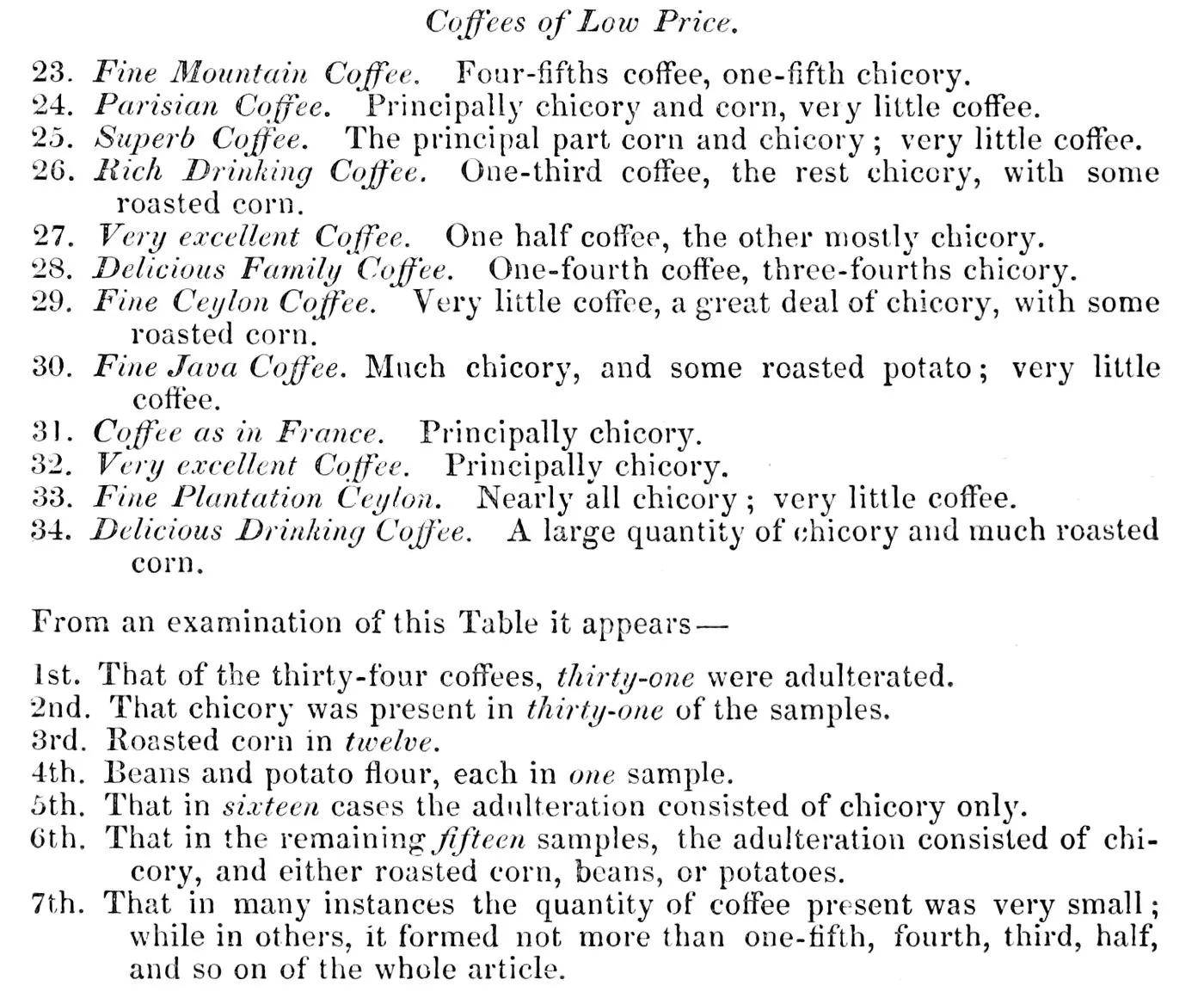 Arthur Hill Hassall, Food and its Adulterations (London: Longman, 1855), p. 8.
“Of the thirty-four coffees, thirty-one were adulterated,” he concluded, and chicory was in all thirty-one. Roasted corn turned up in twelve, beans and potato flour in one each. The names are the best part. “Delicious Family Coffee” was one-fourth coffee and three-fourths chicory. “Coffee as in France” was “principally chicory.”
Hassall knew why it sold. “The uninitiated in the mysteries of coffee imagine that the deep-brown colour of the beverage made from that substance is peculiar to coffee,” he wrote, and take “the richness and depth of the colour” to “indicate the strength and purity of the article.” Chicory, and burnt sugar sold to the trade as “coffee colourer,” gave that color for less. The colorer’s buyers, he says, were the owners of cheap coffee-shops, who sold the result “at a penny and a penny-halfpenny per cup, under the much-abused name of coffee”: about 50p and 75p today by UK consumer prices (Bank of England). A generation later, the coffee taverns meant to win working men from the pub were still complaining in print of weak, thick coffee.
Coffee and chicory mixture
Parliament took the opposite line from the analysts. A Treasury Minute of 1853 allowed grocers to sell the two mixed, on one condition: the mixture was to be “sold in packets, labelled clearly and distinctly as ‘coffee and chicory mixture.’”
The coffee growers of Ceylon objected. In August 1853 Viscount Torrington read their petition to the House of Lords: “Of thirty-four separate purchases accurately tested, three consisted almost entirely of chicory; twenty-two were one-half chicory; six were one-third chicory.” The count matches Hassall’s thirty-four coffees, though the petition doesn’t name its source.
The Prime Minister, the Earl of Aberdeen, answered for the mixture. “Why, half the coffee in Europe was chicory,” the record has him saying; their lordships might prefer pure coffee, “but the great mass of the consumers of this beverage preferred the mixture.” He had a practical point, too. Ground coffee stays a loose powder, but ground chicory “became a solid cake,” which a poor customer, buying an ounce of each, could not easily blend at home.
The argument came back in June 1854, and Torrington brought prices. Coffee, he said, paid a duty of “nearly 75 per cent.,” and there was “gross injustice” in allowing chicory “to be sold as coffee at 1s. per lb., when its value was only 4d. per lb.”: about £4.80 against £1.60 a pound today. The figures given in reply included the Inland Revenue’s own. Of ninety-six samples bought, seven were pure coffee, seventy-three were mixtures properly labeled, four were mixtures labeled badly and twelve were mixtures with no label at all. These were figures quoted in debate, and no one can now check them, but even the ministers’ numbers say that most of what was sold contained chicory.
A little chicory, bought separately
Not everyone wanted chicory out of the pot. Alexis Soyer, the famous London chef, wrote in his Shilling Cookery for the People (1854) that “a good cup of coffee cannot be made without the introduction of a little chicory.” He knew the trade’s reputation: some dealers, he wrote, “imposed on the public by selling an article composed of chicory at a coffee price.” His answer was to praise a shop, Messrs. White and Fairchild, that would sell no ground coffee mixed with chicory but would sell its customers “the one separate from the other.” The buyer did the mixing and knew the proportion.
Mrs. Beeton’s Book of Household Management (1861) followed the same rule in practice. Her essence of coffee, a strong extract to keep in a bottle, allows “to every ¼ lb. of ground coffee… 1 small teaspoonful of powdered chicory”: about 2 percent of the weight, against the half and more in Hassall’s samples. With coffee “at 1s. 8d. per lb.” (about £8.60 today), she reckoned the bottle at sixpence, about £2.60. Two tablespoons went into a breakfast cup of hot milk for café au lait, and she called the result “infinitely superior to the weak watery coffee so often served at English tables.”
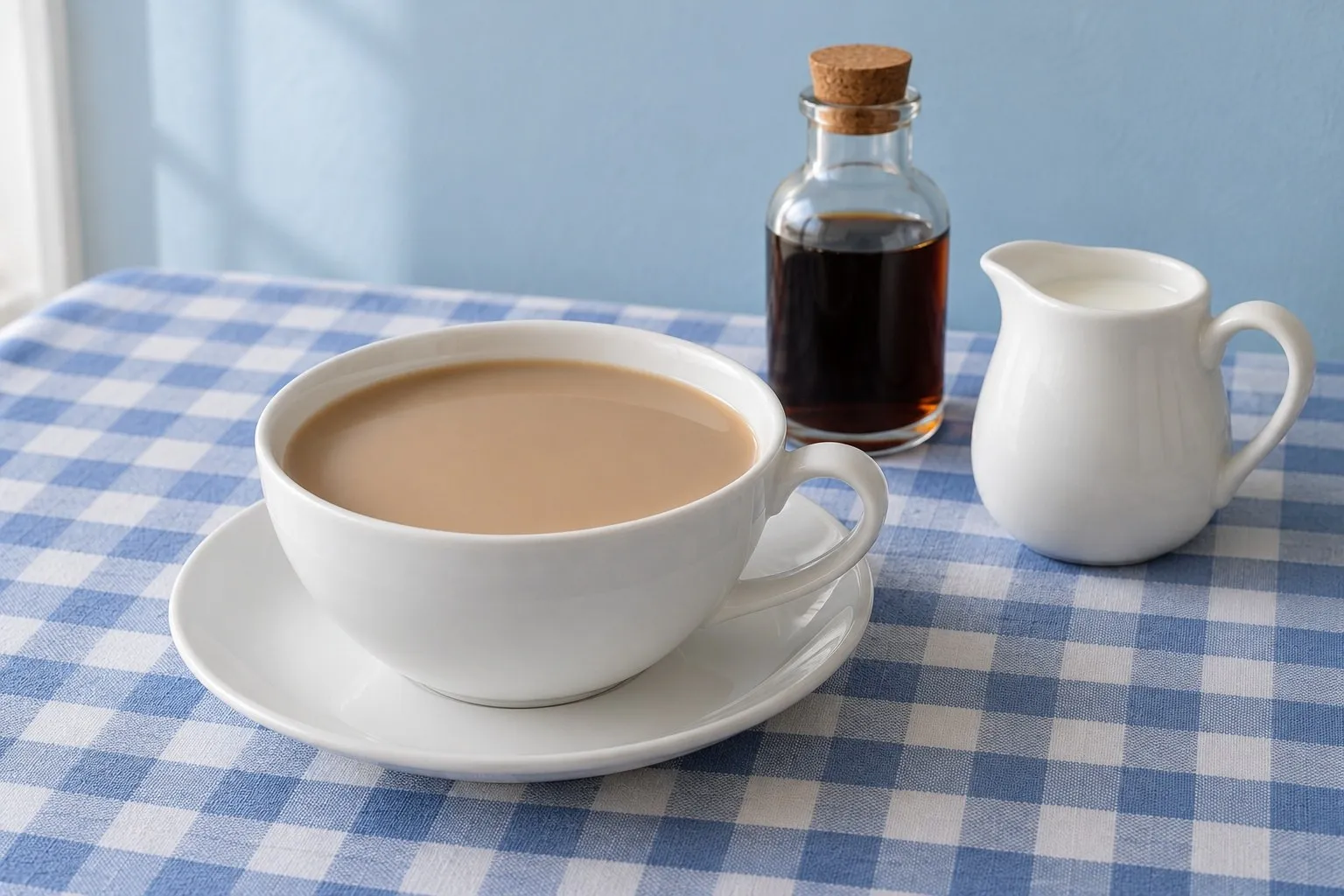 Mrs. Beeton’s café au lait in a breakfast cup, with the corked bottle of coffee essence and a jug of hot milk.
The same book quotes the other side. Florence Nightingale told nurses to buy coffee “in the berry, and grind it at home; otherwise, you may reckon upon its containing a certain amount of chicory, at least.” Her objection was not the taste: “chicory has nothing at all of the properties for which you give coffee.” Chicory has none of coffee’s caffeine, so a nurse who gave coffee as a stimulant was giving less of one.
Not at all a bad drink
By 1919, American experts drew the same line as Soyer. The American food chemist Harvey W. Wiley wrote in Beverages and Their Adulteration (1919) that the French liked coffee “of good body and very dark color” and commonly used chicory to get it. “To those who knowingly use coffee with chicory and like it there can be no objection,” he wrote. Sold “to the unwary or innocent purchaser,” it was “purely a commercial fraud.”
William H. Ukers said much the same in All About Coffee (1922), a book published by the coffee trade’s own journal. He names “many Southerners in the United States” among the drinkers who “insist on having chicory with their coffee,” alongside the French, Italians, Dutch and Germans. He quotes a trade adviser, William B. Harris, who suggests hotels make their coffee heavier with “ten percent of chicory,” while warning that such a drink “can not properly be called coffee,” since some states had laws against it. His own verdict, after time in France: “coffee-and-chicory is not at all a bad drink; indeed the author confesses to have developed a certain liking for it… but it is not coffee.” Ukers also says roasted chicory began in Holland around 1750; he gives no source for it.
A spoonful on cold water
Victorian readers could check their own coffee without a microscope. Terrington’s 1869 book of drinks gives a test, and Hassall describes the same one.
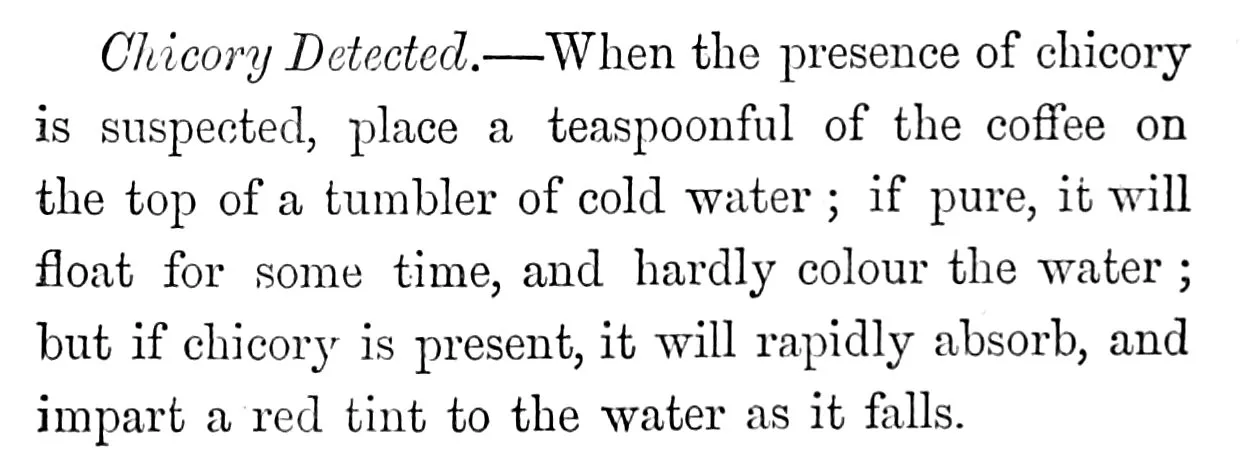 William Terrington, Cooling Cups and Dainty Drinks (London: Routledge, 1869), p. 138.
Ground coffee sits on the water and colors it “very slowly,” in Hassall’s words. Chicory soaks up water at once, sinks, and trails color behind it; Hassall says the water turns “almost immediately of a deep brown.” Try it before making Mrs. Beeton’s café au lait, which uses her own small spoonful of chicory: a teaspoon of the plain coffee on one glass of cold water, a pinch of the chicory on another, and watch which one falls.
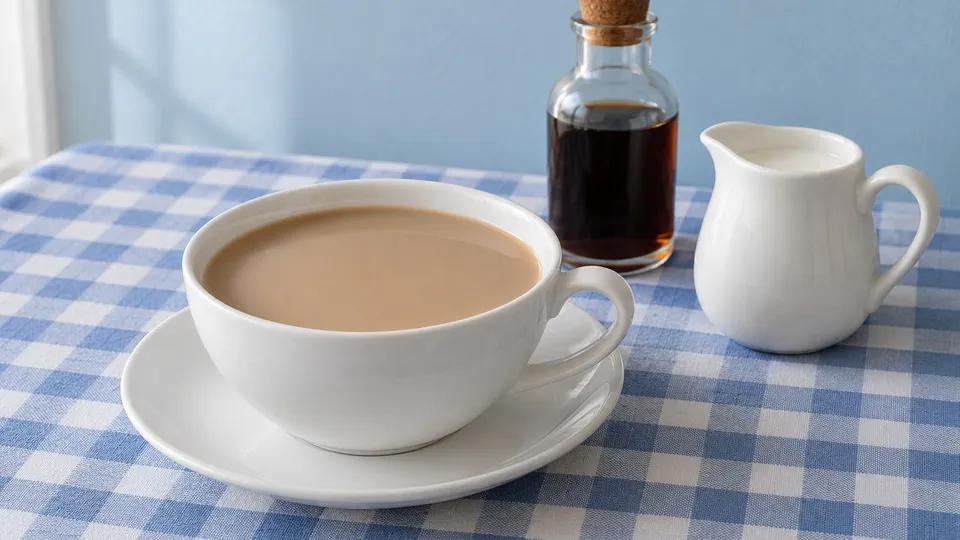 Always alcohol-freeMrs. Beeton’s Café au Lait with Essence of Coffee
Sources
- Arthur Hill Hassall, Food and its Adulterations; Comprising the Reports of the Analytical Sanitary Commission of “The Lancet” (London: Longman, 1855), pp. 5–8.
- House of Lords, “Chicory,” August 2, 1853, Hansard, 3rd series, vol. 129, cols. 1141–53; and “Coffee—Adulteration with Chicory,” June 23, 1854, vol. 134, cols. 596–9. Contains Parliamentary information licensed under the Open Parliament Licence v3.0.
- Alexis Soyer, A Shilling Cookery for the People (London: Routledge, 1854), p. 167.
- Isabella Beeton, The Book of Household Management (London: S. O. Beeton, 1861), nos. 1808 and 1812, pp. 875–878, and p. 899, quoting Florence Nightingale, Notes on Nursing.
- William Terrington, Cooling Cups and Dainty Drinks (London: Routledge, 1869), p. 138.
- Harvey W. Wiley, Beverages and Their Adulteration (Philadelphia: Blakiston, 1919), p. 146.
- William H. Ukers, All About Coffee (New York: Tea and Coffee Trade Journal Co., 1922), pp. 170, 399–400, 404 and 670.