Rundell’s Milk-Clarified Lemonade
Reader ratingsLemon peel, juice and sugar with boiling milk, dripped through a jelly bag until clear: Maria Rundell’s alcohol-free lemonade of 1806–07, made a day ahead.
- Recipe makes
- About 750 ml (our estimate), 4 glasses
- Prep
- Cook
- Total
Includes 3 to 4 hours to steep the peel and about 3 hours (or overnight; our estimate) for the lemonade to drip through the bag. Rundell says to make it a day before it is wanted.
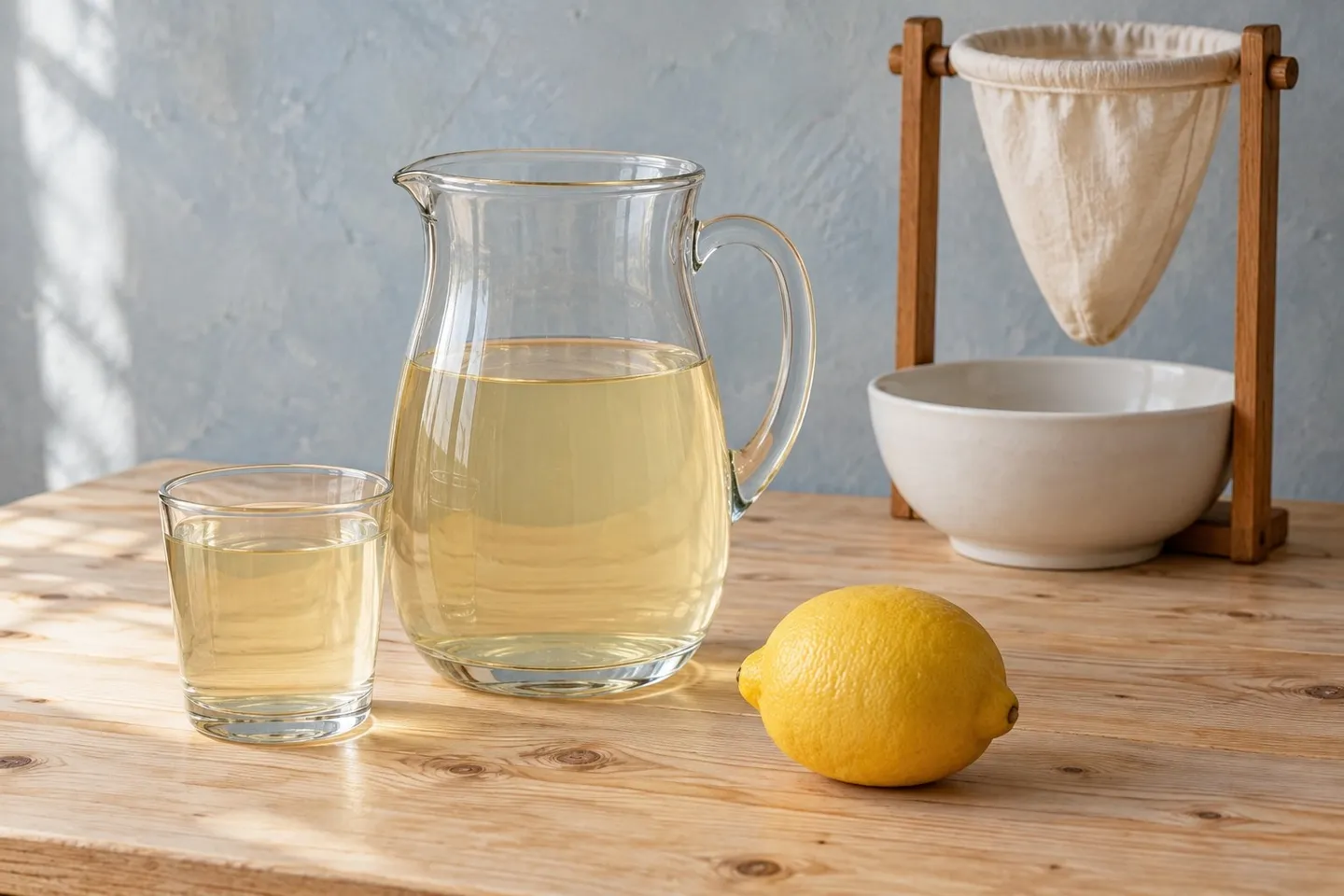
Milk-clarified lemonade in a glass jug and tumbler, with the jelly bag it dripped through.
The story behind the recipe
This is a lemonade cleared with milk. Lemon peel, juice and sugar go into a bowl, boiling milk is poured in, and the lemon curdles it at once; the whole is then dripped through a jelly bag “till perfectly clear.” It has no alcohol, and once it has dripped it shows none of the milk’s white, since the curd never leaves the bag.
Mrs. Rundell’s lemonade
The recipe is from Maria Rundell’s A New System of Domestic Cookery, a household book first published in London in 1806 and printed in Philadelphia the next year, the edition quoted below. Hers is a party quantity: two dozen lemons, three quarts of water, a pound and a half of sugar and three quarts of milk. She heads it “To be made a day before wanted,” because the peel steeps for hours and the bag drips slowly.
She is particular about the peel. All two dozen lemons are pared “as thin as possible,” yet only eighteen of the rinds go into the water, and the water is to be “hot, not boiling.” She never says what becomes of the other six. Benjamin Franklin had sent a friend a brandy punch cleared with milk in 1763, and How Milk Made Franklin’s Punch Clear sets the two drinks side by side; Rundell’s lemonade uses the same trick with no spirit at all.
Read more about this recipe
Smaller, and in the fridge
This version is one-eighth of Rundell’s. Four things end up in the glass: oil from the peel, lemon juice, sugar and the thin whey of the milk.
At this size most of the lemons are pared and one is left whole to be rubbed with sugar, our reading of her “Rub some fine sugar on the lemons to attract the essence.” Whole milk is our choice. Because the drink keeps some of the milk’s whey and sugar, it goes in the fridge and is drunk within two days. Mrs. Beeton’s lemonade, poured over with boiling water, is ready in little more than an hour.
Lemonade. To be made a day before wanted.
Pare two dozen of tolerably sized lemons as thin as possible, put eighteen of the rinds into three quarts of hot, not boiling water, and cover it over for three or four hours. Rub some fine sugar on the lemons to attract the essence, and put it into a China bowl, into which squeeze the juice of the lemons: to it add one pound and a half of fine sugar, then put the water to the above, and three quarts of milk made boiling hot; mix, and pour through a jellybag till perfectly clear.

Recipe makes: About 750 ml (our estimate), 4 glasses
Ingredients
For About 750 ml (our estimate), 4 glasses. Quantities are shown as written.
Quantities as written here, for About 750 ml (our estimate), 4 glasses.
- Lemons, unwaxed if possible3
- Hot water, about 80 °C355 ml
- Granulated sugar85 g
- Whole milk355 ml
Measurement notes
Ingredients as written here
- 3 lemons, unwaxed if possible
- 355 ml hot water, about 80 °C
- 85 g granulated sugar
- 355 ml whole milk
Equipment
 Vegetable peeler
 Two heatproof bowls or jugs
 Small saucepan
 Jelly bag, or a sieve lined with two paper coffee filters
 Glass jug or bottle with a lid, for the fridge
Instructions
Wash the lemons. Pare the zest thinly from all but one of them with a vegetable peeler, leaving the white pith behind.
Put the zest in a heatproof bowl and pour over the hot water, about 80 °C, hot but not boiling. Cover and leave for 3 to 4 hours.
Rub a little of the granulated sugar over the skin of the last, unpared lemon until the sugar smells of lemon, and tip it into a second heatproof bowl with the rest of the sugar.
Juice all the lemons into the sugar bowl. Strain in the lemon-peel water, discarding the zest, and stir until the sugar has dissolved.
Bring the whole milk just to the boil in a small saucepan, then pour it straight into the lemon mixture, stirring gently. It will curdle at once.
Leave it to stand for 30 minutes.
Set the jelly bag (or a sieve lined with paper coffee filters) over a clean bowl and pour in the mixture. Pour the first cloudy runnings back into the bag, and repeat until it runs clear.
Let it drip in the fridge for about 3 hours, or overnight, without squeezing the bag, then pour the clear lemonade into a jug or bottle and keep it cold. Serve chilled.
Nutrition
110calories per serving
- Recipe makes
- About 750 ml (our estimate), 4 glasses
- Servings
- 4
Estimated from USDA FoodData Central values for granulated sugar, raw lemon juice and acid whey, the part of the milk left after the curds are strained out.
Recipe notes
When adjusting quantities
Keep the milk and the peel water equal in volume, and use the juice of every lemon.
Notes
Quantities mentioned in these notes don’t change when you adjust the batch.
Rundell’s quantities divided by eight are 3 lemons, 355 ml each of water and milk, and 85 g of sugar; her “quart” here is the old English wine quart of about 946 ml, the same as a US quart. At this size, pare 2 of the 3 lemons, rub about a tablespoon of the sugar over the third, and juice all 3. Three lemons should give about 135 ml of juice (our estimate).
Rundell gives no standing time once the milk is in; the 30 minutes is our choice, so the curd can firm before it goes into the bag.
The yield of about 750 ml and the drip time of about 3 hours are our estimates from the arithmetic.
The lemonade is sweet, about as sweet as an ordinary soft drink. Pressing the bag makes it cloudy, so let it drip on its own.
It is not dairy-free: most of the milk’s sugar and some of its protein stay in the whey, so it is not suitable for anyone with a milk allergy.
Storage
Keep the lemonade covered in the fridge and drink it within 2 days. It contains whey from the milk.
Scaling changes the ingredients only; glassware, ice and timings need their own judgment. To adapt this recipe further, try the recipe tool at TuneMyRecipe (opens in a new tab), our sister site.
Sources and attribution
[Maria Eliza Rundell], A New System of Domestic Cookery (Philadelphia: Benjamin C. Buzby, 1807), p. 214
See the original pages (scan at Internet Archive) (opens in a new tab)
Recipe details
- Drink
- Alcohol-free
- Drink family
- Sodas & Soft Drinks
- Region
- British
- Era
- 19th century
- Difficulty
- Intermediate
- Occasion
- Summer party