Lie Tea, the Fake Gunpowder of 1851
Tea dust, sand and gum rolled into pellets and glazed with black lead or Prussian blue: the fake tea a London chemist burned to ash in 1851, and its name.
Lie tea was fake tea: tea dust, sand and dirt stuck together with gum or starch, rolled into little pellets and colored on the outside so that it passed for gunpowder green tea or for black “caper” tea. It was made in China, and by the account a London chemist was given in 1851, the Chinese sold it under that very name, lie tea. In Britain it went into the cheaper blends and was sold as tea.
Two heavy samples
Gunpowder tea is green tea rolled tight into small gray-green pellets, which open in the pot back into whole leaves. Black caper tea was rolled the same way. Both looked costly, and the export trade bought by looks. The London chemist Robert Warington quotes an earlier writer on the Canton tea trade: foreign buyers judged “an article used as a drink by the eye instead of the palate,” and a Chinese merchant “had scarcely a chance of selling his tea unless he gave it a ‘face.’” Facing meant a coat of colored powder over the leaf.
In 1851 a merchant brought Warington two samples that had come in small chests, a black “scented caper” and a green “gunpowder.” Both were “exceedingly closely rolled, and very heavy,” and the green was “so highly glazed and faced, that the facing rises in clouds of dust when it is agitated.”
He soaked them. Nothing unrolled. The black coating was “perfectly black,” and proved to be “earthy graphite or black lead,” the same mineral as a pencil’s lead. The green was coated with pale Prussian blue, turmeric and gypsum. Then he burned a weighed portion of each. The genuine teas in his table left 5 to 6.5 percent of their weight as ash, a Java gunpowder 5 percent. The fake caper left 37.5 percent, the fake gunpowder 45.5. “We have in this sample 40·5 per cent. of dirt and sand,” he wrote, and “no leaf to uncurl, the whole of the tea being in the form of dust.” His verdict was tea dust and sand, “agglutinated into a mass with a gummy matter, most probably manufactured from rice-flour,” rolled into granules and colored “either with black lead, if for black tea; or with Prussian blue, gypsum, or turmeric, if intended for green.”
What was lie tea made of?
Then Warington asked around the trade, and came back with a name.
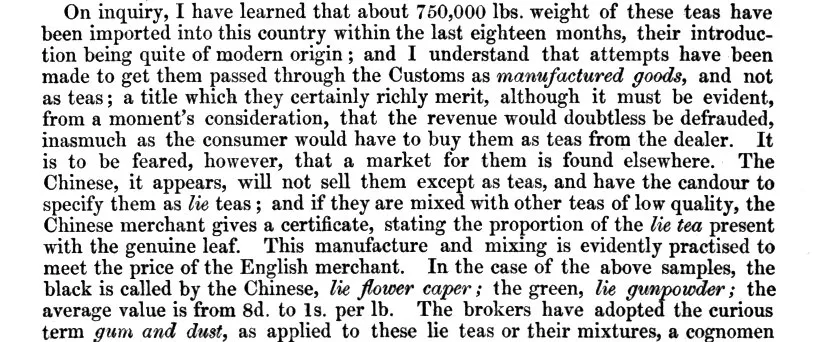 R. Warington, “Observations on the Teas of Commerce,” reprinted in the Monthly Journal of Medical Science (Edinburgh, September 1851), p. 288.
He was told that about 750,000 pounds of it had come into Britain in the previous eighteen months, and that importers had tried to pass it through Customs “as manufactured goods, and not as teas,” which would have spared it the tea duty. The Chinese makers, he heard, would sell it only as tea, “and have the candour to specify them as lie teas.” When it was blended with real tea, the Chinese merchant even gave a certificate stating how much lie tea the chest contained. The black was “lie flower caper” and the green “lie gunpowder,” and it fetched from 8d. to 1s. a pound, about £4 to £6 today by UK consumer prices (Bank of England).
London’s tea brokers had their own word for it: “gum and dust.” Warington admits that at first he could not make out the phrase, “from the rapid manner in which the two first words were run together.”
All of this is hearsay, and Warington presents it that way: “I have learned,” “I understand,” “it appears.” Neither he nor the chemists who came after him cite a Chinese source for the name. The ash, on the other hand, he weighed himself.
Sand, starch and black lead
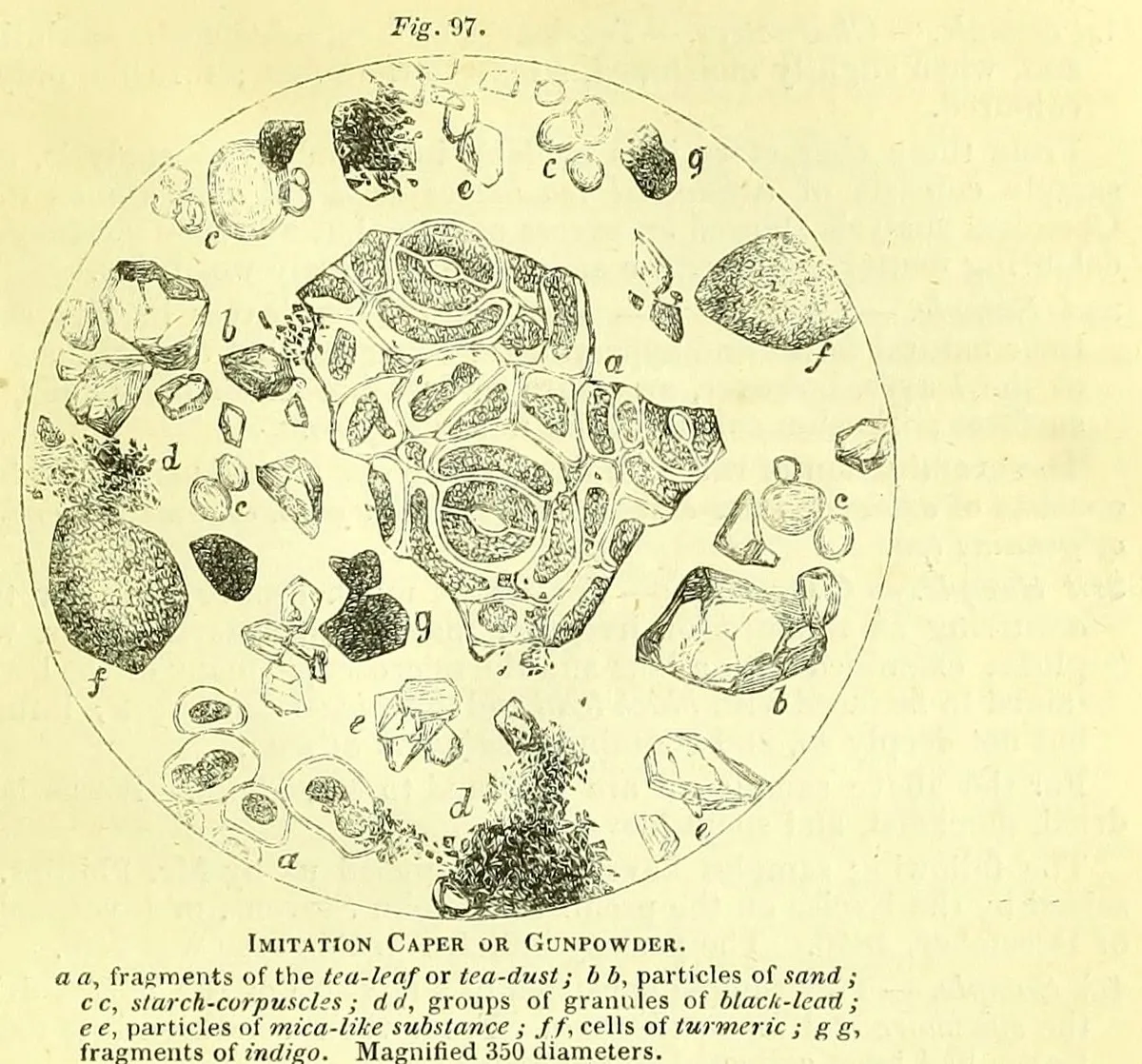
Four years later Arthur Hill Hassall put the same kind of tea under the microscope and drew what he saw: the ring of grains, granules and leaf fragments that opens this story. His key to that drawing, Fig. 97, “Imitation Caper or Gunpowder,” lists fragments of tea leaf or tea dust, particles of sand, starch grains, granules of black lead, a mica-like substance, cells of turmeric and fragments of indigo, magnified 350 times. He calls these “the spurious Caper and Canton Greens, sometimes called ‘lie tea.’”
Hassall’s worry was the blending. Mixed into genuine caper and black gunpowder teas, the fake “eludes the vigilance of the excise,” he wrote, and he believed the large quantity of tea the excise had lately destroyed was of this kind. Food and its Adulterations, the same book that counted the chicory in London’s coffee, has pages of tea samples faced with black lead.
He also passes on a rumor, and labels it as one: the pellets looked “not unlike” the dung of silkworms, “with which, as tea (it has been stated), the Chinese occasionally favour us.” Neither Warington nor Hassall reports finding any. Another popular story of the period, that green tea owed its color to copper, fared no better. The American chemist Harvey W. Wiley thought it “doubtful if copper has ever been employed.”
Into oblivion
By the time Wiley wrote Beverages and Their Adulteration in 1919, lie tea was a museum piece. He describes it the way Warington had found it, tea dust and other matter “held together by means of paste,” colored with one of the facings, with an ash content “in some cases… over 50 percent.” He adds that this adulteration “is very seldom made use of.” The test he gives is simple: pour boiling water on it, and “the aggregation” falls apart into its separate parts. His last line on the subject: “Lie teas have followed foreign leaves into oblivion.”
What it tasted like, nobody says. Warington, Hassall and Wiley analyzed it and none of them describes drinking it. Tea made from it would have been mostly melted gum and settled grit, but that is a guess from the analysis, not a report.
Leaves that open
Real gunpowder tea has a test of its own, and Mrs. Beeton gives it without meaning to. Her Book of Household Management (1861) insists the water be “actually boiling, as the leaves will not open” otherwise. William Terrington’s book of drinks of 1869 counts gunpowder among the green teas, with Twankay and Hyson. Green tea itself was nothing new in England; it was already being brewed in 1685.
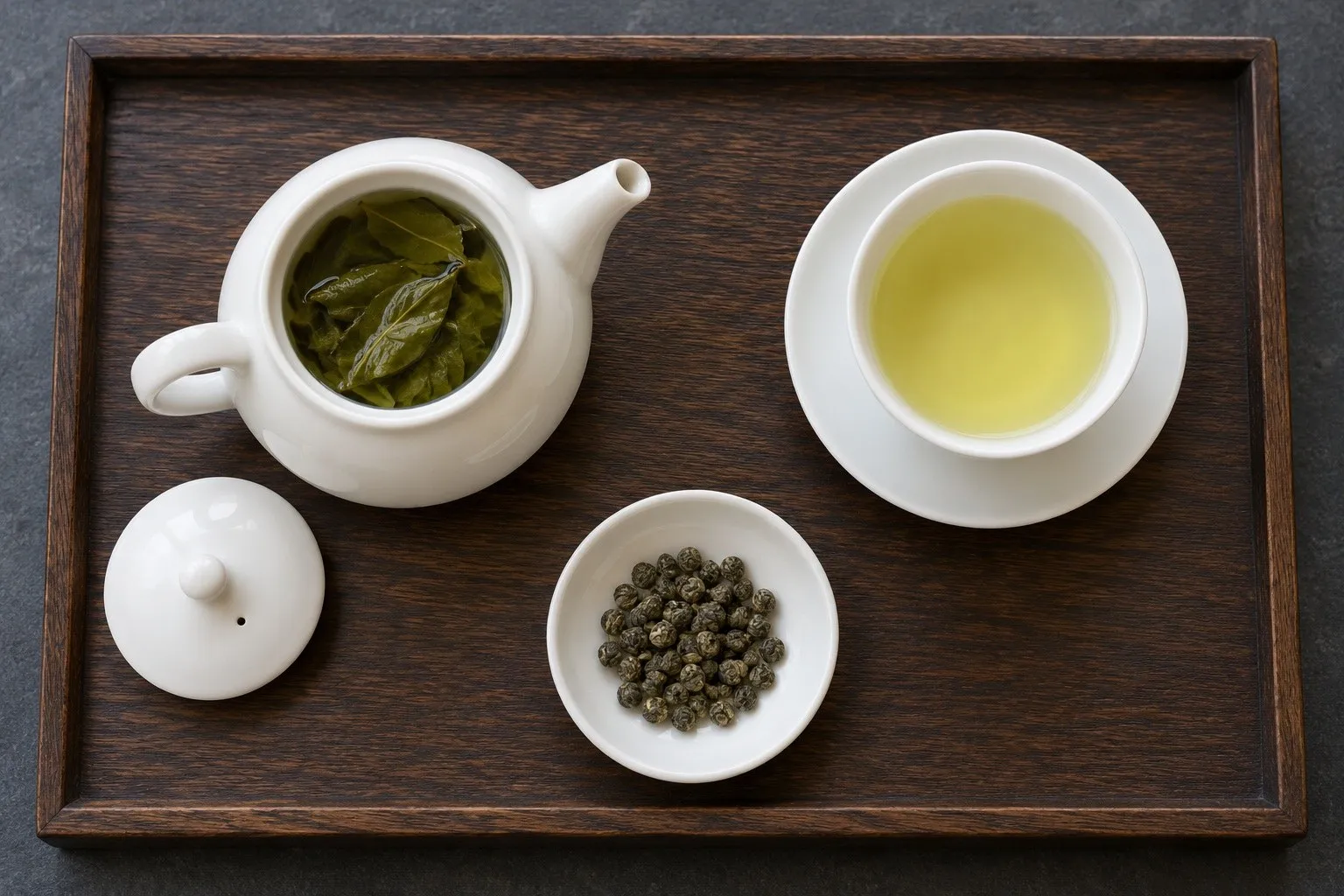 Gunpowder green tea in the cup, the leaves opened out in the pot, and dry pellets in a dish beside them.
The gunpowder green tea, Mrs. Beeton’s way keeps her old measure, “a teaspoonful to each person, and one over,” so a pot for two takes three. Allow about ten minutes from kettle to cup, most of it with the lid shut; five minutes’ drawing, the least she allows, is plenty for green tea.
 Always alcohol-freeGunpowder Green Tea, Mrs. Beeton’s Way
Sources
- R. Warington, “Observations on the Teas of Commerce,” from the Quarterly Journal of the Chemical Society, reprinted in the Monthly Journal of Medical Science (Edinburgh), new series no. 21, September 1851, “Medical News,” pp. 284–289; PubMed Central PMC5891295.
- Arthur Hill Hassall, Food and its Adulterations (London: Longman, 1855), pp. 286–287.
- Isabella Beeton, The Book of Household Management (London: S. O. Beeton, 1861), no. 1814, pp. 879–880.
- William Terrington, Cooling Cups and Dainty Drinks (London: Routledge, 1869), p. 131.
- Harvey W. Wiley, Beverages and Their Adulteration (Philadelphia: Blakiston, 1919), p. 174.