Glasgow Sherbet, the Punch Before the Rum
Reader ratingsSugar melted in cold water, a dozen lemons’ juice strained in, the bowl filled with the coldest water and finished with limes: Glasgow punch as it was tasted before the rum.
- Recipe makes
- About 2 liters, 13 punch cups
- Prep
- Total
Chill the water well ahead, since the bowl is served without ice.
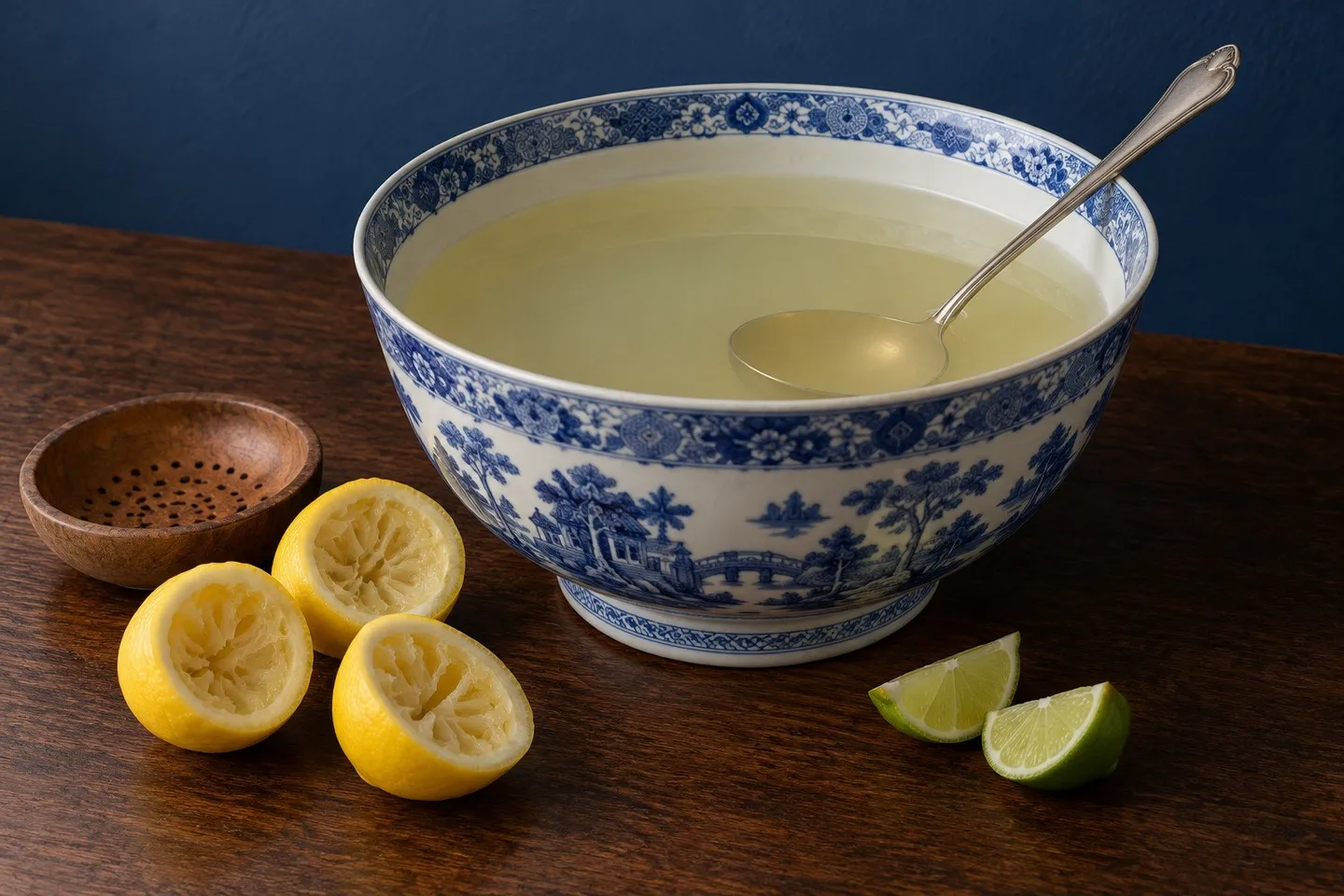
Glasgow sherbet in a blue-and-white porcelain punch bowl, with a wooden strainer, squeezed lemons and lime wedges.
The story behind the recipe
Glasgow sherbet is punch before the spirit goes in: sugar melted in a little cold water, the strained juice of lemons, and the bowl filled up with the coldest water, finished with limes. John Gibson Lockhart described it in 1819, at a Glasgow merchant’s dinner party in his Peter’s Letters to his Kinsfolk, where the guests nearest the bowl had to taste and approve the sherbet before a drop of rum was added. In Glasgow, he wrote, the sherbet was half the battle.
A creed in a china bowl
The host made it in an old porcelain bowl, its red and blue flowers showing through an outer casing of white net-work, and pressed the lemons through a wooden strainer. Rum went in at about one part to seven, and the last touch was the limes, each cut piece run round the rim of the bowl and squeezed in, which Lockhart calls the punch-maker’s master stroke. The Edinburgh Cook and Housewife’s Manual reprinted his account and, in its 1829 edition, added that the water should be the coldest spring water “newly taken from the spring.”
Read more about this recipe
Making it today
Lockhart gives no weight of sugar and no measure of water beyond “enough almost to fill the bowl,” so our amounts are an adaptation. We use half his dozen lemons, about 270 ml of juice from six large lemons, with 150 g of sugar and 1.5 liters of water, which makes a sharp, lemonade-strength drink of about 75 g of sugar per liter. Taste it the Glasgow way before serving and adjust the sugar.
The rum is left out, which makes this our alcohol-free version of the punch; the full story of the St Andrew’s punch bowl, from whisky toddy in 1828 to a dry ball in 1863, is in What Did Scots Drink on St Andrew’s Day?. For a temperance party punch from a century later, try the Ginger Ale Punch for a Dry Party.
The sugar being melted with a little cold water, the artist squeezed about a dozen lemons through a wooden strainer, and then poured in water enough almost to fill the bowl. In this state the liquor goes by the name of Sherbet, and a few of the connoisseurs in his immediate neighbourhood were requested to give their opinion of it—for, in the mixing of the sherbet lies, according to the Glasgow creed, at least one half of the whole battle. This being approved by an audible smack from the lips of the umpires, the rum was added to the beverage, I suppose in something about the proportion of one to seven. Last of all, the maker cut a few limes, and running each section rapidly round the rim of his bowl, squeezed in enough of this more delicate acid to flavour the whole composition.

Recipe makes: About 2 liters, 13 punch cups
Ingredients
For About 2 liters, 13 punch cups. Quantities are shown as written.
Quantities as written here, for About 2 liters, 13 punch cups.
- Sugar150 g
- Cold water, to melt the sugar100 ml
- Lemon juice, from about 6 large lemons270 ml
- Very cold water1.5 l
- Limes2
Measurement notes
Ingredients as written here
- 150 g sugar
- 100 ml cold water, to melt the sugar
- 270 ml lemon juice, from about 6 large lemons
- 1.5 liters very cold water
- 2 limes
Equipment
 Citrus juicer
 Fine strainer
 Punch bowl
 Ladle and heatproof cups
Instructions
Put the sugar in the punch bowl, add the cold water, to melt the sugar, and stir until it has dissolved.
Strain the lemon juice into the bowl.
Pour in the very cold water, stopping a little short of the rim, and stir.
Taste, and add a little more sugar or water if you like.
Cut the limes into wedges. Run each wedge quickly round the rim of the bowl, then squeeze it into the sherbet.
Ladle into punch cups and serve at once, while it is cold.
Nutrition
55calories per serving
- Recipe makes
- About 2 liters, 13 punch cups
- Servings
- 13
Roughly estimated from USDA FoodData Central values for lemon juice, lime juice and granulated sugar, for one 150 ml punch cup.
Recipe notes
When adjusting quantities
This is half of Lockhart’s dozen lemons. Double everything for a very large bowl, as Glasgow made it.
Notes
Quantities mentioned in these notes don’t change when you adjust the batch.
Changes from the source: Lockhart’s punch has rum, which we leave out. The sugar weight, the water volume and the two limes are ours; Lockhart gives a dozen lemons, “a little cold water” for the sugar, water “enough almost to fill the bowl” and “a few limes.” Halving the lemons is ours.
For the period punch, add one measure of rum to seven of sherbet, Lockhart’s guess at the proportion. That is about 285 ml of 40% rum for this bowl, making a punch of about 5% alcohol, and it is no longer alcohol-free.
Chill the water for several hours, or overnight, in place of the Glasgow spring.
Scaling changes the ingredients only; glassware, ice and timings need their own judgment. To adapt this recipe further, try the recipe tool at TuneMyRecipe (opens in a new tab), our sister site.
Sources and attribution
J. G. Lockhart, Peter’s Letters to his Kinsfolk, vol. 3 (Edinburgh: Blackwood, 1819), p. 174; reprinted with a note in “Mistress Margaret Dods” [Christian Isobel Johnstone], The Cook and Housewife’s Manual, 4th ed. (Edinburgh: Oliver & Boyd, 1829), “Glasgow Punch”, p. 458
Recipe details
- Drink
- Alcohol-freeMocktail
- Drink family
- Punches & Cups
- Region
- Scottish
- Era
- 19th century
- Base
- Fruit & juice
- Difficulty
- Easy
- Season
- Winter