Athole Brose, Heather Honey and Whisky
Reader ratingsOne part heather honey to two of Scotch whisky, stirred until smooth, with an egg yolk beaten in if you like: the Highland drink as an Edinburgh cookbook printed it in 1829.
- Recipe makes
- About 360 ml, 12 small glasses
- Prep
- Total
Warm the honey gently first if it is thick or set.
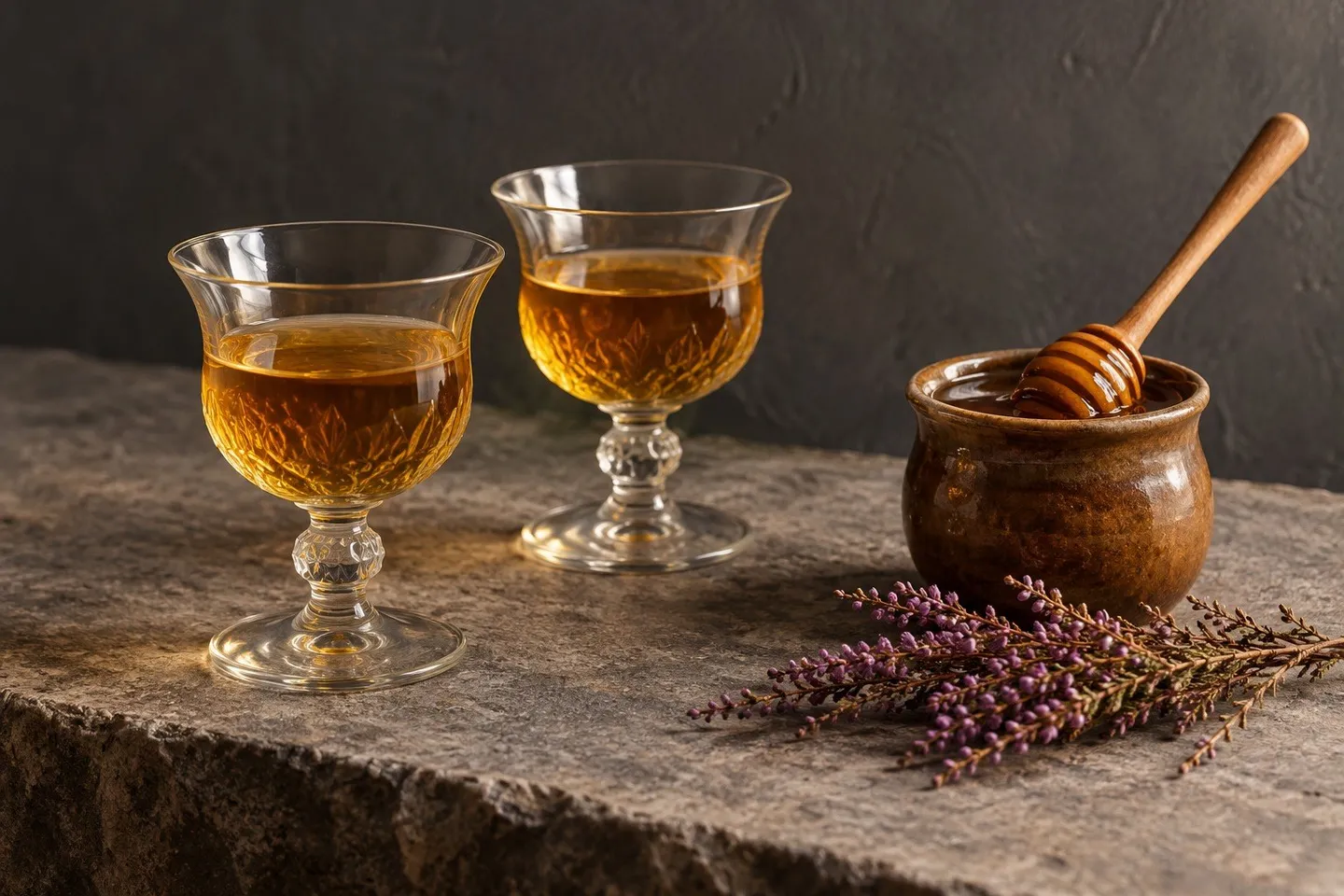
Athole brose in two small stemmed glasses, with a jar of heather honey and a sprig of dried heather.
The story behind the recipe
Athole brose is heather honey stirred into whisky, one part to two. The Edinburgh Cook and Housewife’s Manual printed it in 1829 in a single sentence, a cupful of heather honey to two of whisky, “alias mountain-dew.” Brandy and rum would mix with honey too, the book allows, but the result “cannot be called Athole Brose.”
A Highland name in an Edinburgh book
The manual was published under the name of “Mistress Margaret Dods,” the landlady of Walter Scott’s St Ronan’s Well, and written by Christian Isobel Johnstone. The brose is in the 1829 edition but not in the first, of 1826. It sits among the book’s liqueurs and cordials beside Auld Man’s Milk, an eggnog of milk, eggs and spirits mixed “in the china punch-bowl,” and the optional egg yolk in the brose makes the two cousins. The name comes from Atholl in Perthshire. The tale that an Earl of Atholl caught a rebel by filling his well with honey and whisky is a legend, and Dods does not tell it.
Read more about this recipe
Making it today
At one part honey to two of whisky, the brose is strong: with whisky at 40% alcohol, 240 ml of whisky in about 360 ml of brose makes it about 27% alcohol, about the strength of a liqueur, and very sweet. Serve it in small glasses. Heather honey is thick and sometimes set, so warm the jar in hot water first.
Dods does not connect the brose with St Andrew’s Day; what was drunk at St Andrew’s dinners is in What Did Scots Drink on St Andrew’s Day?. For the drink a guest who isn’t drinking can share from the same table, make the Glasgow Sherbet.
1082. Athole Brose.—Mix with a cupful of heather-honey, two cupfuls of whisky, alias mountain-dew, or in this proportion; brandy and rum are also used, though the combination they form with honey cannot be called Athole Brose. The yolk of an egg is sometimes beat up with the brose.

Recipe makes: About 360 ml, 12 small glasses
Ingredients
For About 360 ml, 12 small glasses. Quantities are shown as written.
Quantities as written here, for About 360 ml, 12 small glasses.
- Heather honey120 ml
- Scotch whisky240 ml
- Pasteurized egg yolk (optional)1
Measurement notes
Ingredients as written here
- 120 ml heather honey
- 240 ml Scotch whisky
- 1 pasteurized egg yolk (optional)
Equipment
 Jug
 Whisk
 Small glasses, about 4 fl oz
Instructions
Warm the jar of heather honey in a bowl of hot water until it runs freely.
Measure the honey into a jug and pour in the Scotch whisky a little at a time, stirring until the honey has dissolved.
If using the pasteurized egg yolk, whisk it in until the brose is smooth.
Pour into small glasses and serve at room temperature.
Nutrition
90calories per serving
- Recipe makes
- About 360 ml, 12 small glasses
- Servings
- 12
Roughly estimated from USDA FoodData Central values for 80-proof whisky and honey, for one 30 ml glass, without the egg yolk.
Recipe notes
When adjusting quantities
Dods gives a proportion, not a batch: one cup of honey to two of whisky. Keep that ratio at any size.
Notes
Quantities mentioned in these notes don’t change when you adjust the batch.
Changes from the source: the metric amounts keep Dods’s proportion of one cupful of honey to two of whisky. Warming the honey is ours, and so is Scotch whisky: Dods says only whisky. The egg yolk is optional, as in the book.
Use a pasteurized egg yolk. The FDA advises pasteurized eggs or egg products for any dish made with raw or lightly cooked eggs. With the yolk, make it just before serving.
Any honey works, but heather honey is the one Dods names. Any Scotch whisky works; she simply calls it mountain dew.
The brose is about 27% alcohol, so a 30 ml glass holds about 8 ml of alcohol, roughly half as much as a 125 ml glass of 12% wine.
The same Edinburgh cookbook has a bowl with no whisky in it, Glasgow Sherbet: sugar, lemons and the coldest water, the punch before the rum went in.
Scaling changes the ingredients only; glassware, ice and timings need their own judgment. To adapt this recipe further, try the recipe tool at TuneMyRecipe (opens in a new tab), our sister site.
Sources and attribution
“Mistress Margaret Dods” [Christian Isobel Johnstone], The Cook and Housewife’s Manual, 4th ed. (Edinburgh: Oliver & Boyd, 1829), “Athole Brose”, no. 1082, p. 462
Recipe details
- Drink family
- Cocktails & Mixed Drinks
- Region
- Scottish
- Era
- 19th century
- Difficulty
- Easy
- Season
- Winter